Pakistani bridal hair guide for dupattas and jewellery
Plan bridal hair as an engineering partnership between hairstyle, dupatta and jewellery.
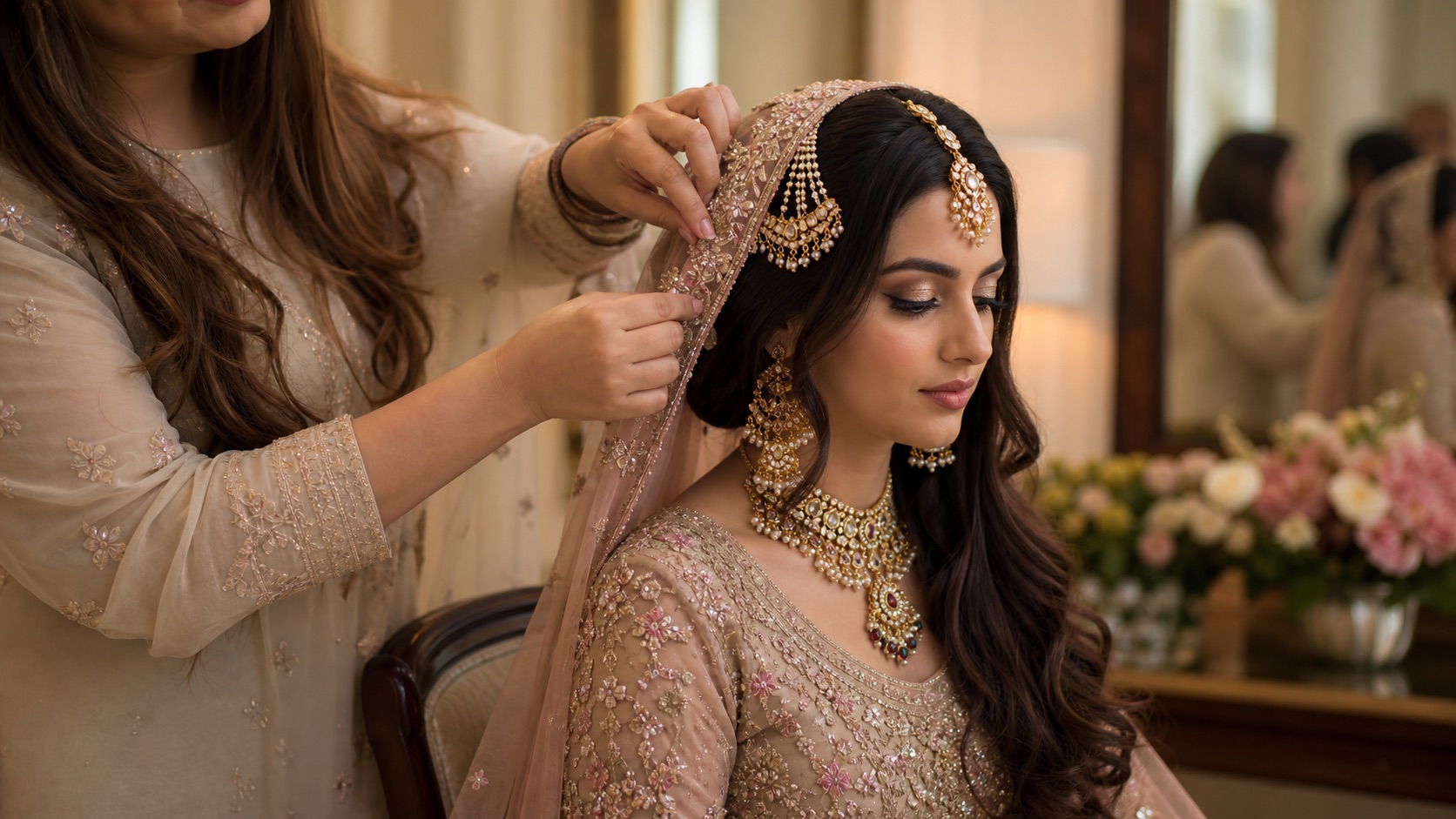
Choose the dupatta before finalising the hairstyle. Its weight, border and intended placement determine where the hair needs strength; a saved photograph cannot tell a stylist what several hours of pull will feel like. Bridal hair for Pakistani weddings is engineering as much as aesthetics: anchors, jewellery paths, neckline clearance and emergency access.
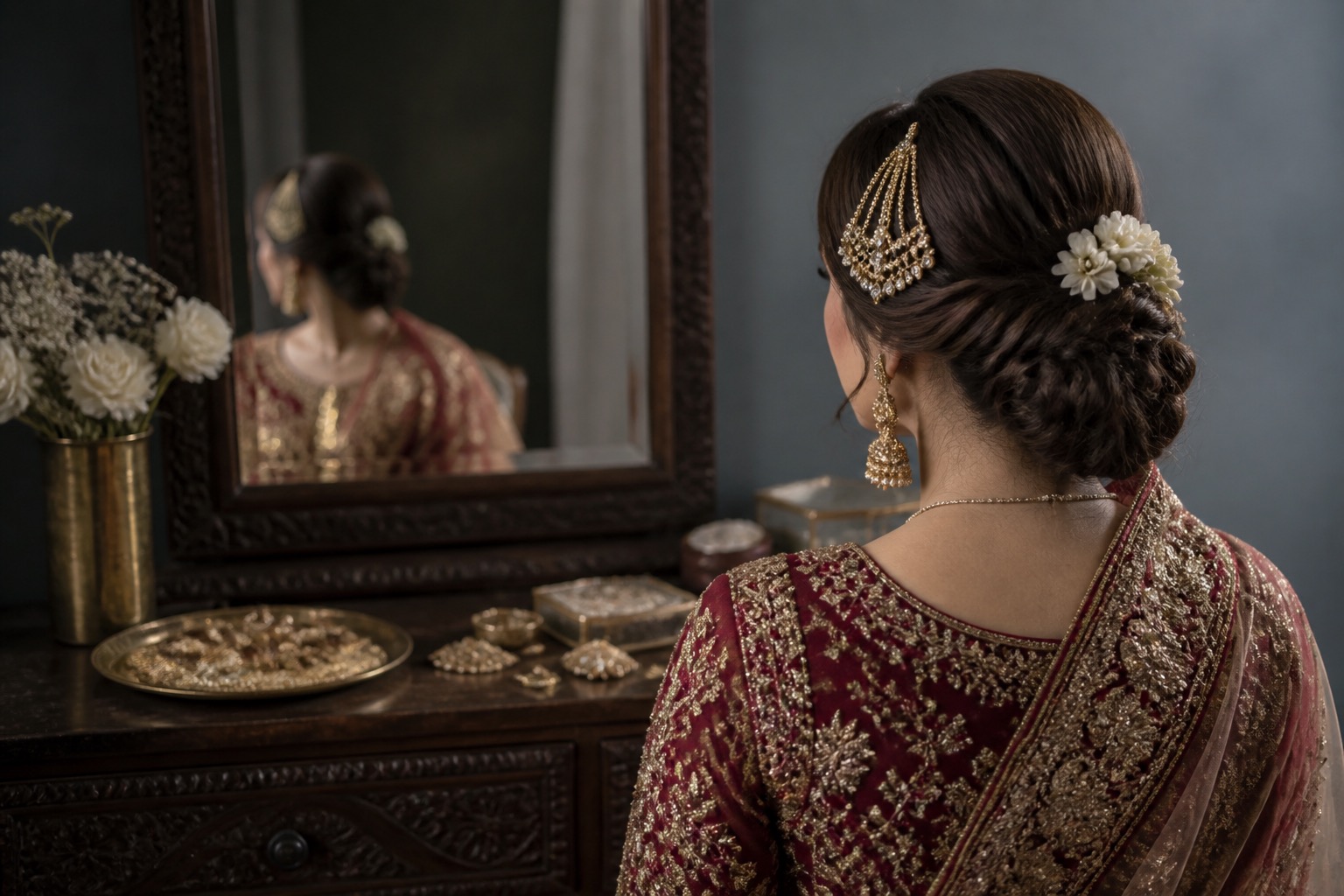
Bring the actual dupatta, tikka, jhoomar, earrings, extensions and blouse neckline to the trial. Mark where the border should frame the face, then let the stylist build anchors beneath that line. A centre part must accommodate the tikka chain without forcing the pendant sideways. Jhoomar placement changes the balance again, particularly when one side already carries a heavy border.
| Look | Practical question |
|---|---|
| Low bun | Will it meet the blouse, jewellery or chair? |
| High bun | Can the dupatta sit without creating a second peak? |
| Open waves | Where will fabric anchor without pulling loose lengths? |
| Braid | Can the head covering lift without disturbing its base? |
Trial duration is part of the brief
Wear the complete arrangement for at least an hour. Turn, bow, sit, rise from floor seating if your ceremony uses it, and hug someone. Pain, headache or a pin pressing the scalp is a failure at the trial, not a price of beauty. The American Academy of Dermatology warns that repeated pulling from tight styles or extensions can cause traction alopecia; ask for tension to be reduced immediately.
Embellished dupattas pull differently after two hours of sitting, hugging and turning for photographs. Humidity and dry air-conditioned halls both change hold; ask which products were tested for your climate rather than relying on a brand name mentioned online.
Handover, extensions and emergencies
Give one trusted dresser a photograph of the finished back and the location of removable pins. Pack matching grips, a tail comb and a small amount of the products already tested. Never improvise glue near hair or skin. Record the order in which jewellery, hair padding and dupatta are fitted, because removing one pin out of sequence can loosen the structure.
If extensions are used, match texture and colour in daylight and practise their removal before the wedding. Avoid last-minute colour or chemical treatment; follow product instructions and seek clinical help for a reaction. Agree whether the stylist stays for a second ceremony look and what that service includes. Schedule enough dressing time that discomfort can be corrected instead of hidden beneath another anchor.
Second ceremony and overnight care
If mehndi and baraat need different structures, plan two secure bases rather than destroying one look overnight. Sleep plans matter: careful pin removal prevents morning emergencies. Keep a mini kit with grips, tissue and the exact pins used. Children who hang on the bride’s neck are a structural load—soften the silhouette if that is likely.
Put the outfit on before any hair element that cannot safely pass through its neckline. Keep earrings supported while dressing. The successful style remains recognisable after the dupatta comes off—and lets the bride forget it while the ceremony is happening.
Building anchors the fabric can trust
Ask the stylist to show where the structural pins sit before decoration hides them. A beautiful surface with a weak base fails when the dupatta shifts during salaam. If padding or nets are used, confirm comfort after an hour and whether they will show under sheer fabric or bright flash. Match extension colour in daylight beside a window, not under yellow bathroom bulbs.
Practice the exact motion of lifting the dupatta for prayer or photographs without dragging the bun sideways. If a second look is required the next day, decide whether pins are removed fully overnight or partly loosened. Write that plan so morning helpers do not invent a new architecture while you are half awake.
Nominate one dresser after the stylist leaves. Give that person the pin map photograph and permission to say no to additional hands. Keep water away from the crown during emotional moments; tears at the cheeks are expected, but pouring water on the scalp to cool down dissolves hold.
If children will cling to your neck, choose a lower, denser structure that can survive that affection. Pack spare pins that match the ones already in the style. After the walima, remove extensions carefully according to the method practised at the trial. Scalp tenderness that persists is a reason to speak to a clinician, not to push through another tight style the following week.
Humidity, dry air-conditioning, and long sits all change hold. Ask which products were tested for your climate. Embellished borders pull differently after two hours of hugging and photographs—trial that duration rather than approving a look that only survives the first ten minutes in the salon chair.
Keep earrings supported while dressing, and put the outfit on before any hair element that cannot safely pass through its neckline. The successful style remains recognisable after the dupatta comes off—and lets the bride forget it while the ceremony is happening.
Family helpers and the single point of contact
Nominate one dresser after the stylist leaves. Give that person the pin map photograph and permission to say no to additional hands. Keep water away from the crown during emotional moments; tears at the cheeks are expected, but pouring water on the scalp to “cool down” dissolves hold. If children will cling to your neck, choose a lower, denser structure that can survive that affection.
Pack spare pins that match the ones already in the style, not a random handful from a drawer. After the walima, remove extensions carefully according to the method practised at the trial. Scalp tenderness that persists is a reason to speak to a clinician, not to “push through” another tight style the following week.
Climate, second looks and the long day
Plan for humidity, dry halls, and the hours between mehndi and baraat. If two structures are required, budget two secure bases rather than destroying one overnight. Sleep with careful pin removal so morning helpers inherit a plan, not a puzzle. Keep a mini kit with matching grips, tissue and the exact pins already used in the style.
Discuss prayer covering motions at the trial so the dupatta can lift without collapsing the bun. If a veil or additional scarf will be used for part of the ceremony, trial that layer too. Weight stacks. What looked balanced with one border may tip with two.
Confirm whether the stylist remains for a second ceremony and what travel time that includes. A beautiful first look that cannot be reconstructed for the walima is incomplete engineering. Write the reconstruction steps while the trial is still on your head.
Finally, check the back of the head in photographs taken by someone standing behind you. Many styles fail only in the rear view—the view parents see during the processional. Fix that at the trial, not when the music has already started.
Measure the distance from crown to blouse neckline while seated and standing. Many “perfect” salon buns collide with high collars only after the outfit is on. Trial with the real blouse whenever possible. If the blouse arrives late, trial with a similar neckline and schedule a quick re-check when the garment lands.
Ask about emergency repairs between events: which pins can be tightened without restarting, and which failures require the stylist’s return. Put the stylist’s contact and the contingency owner’s number on the same card as the face chart. Hair emergencies are usually logistics failures, not destiny.
When the day ends, remove jewellery before major hair deconstruction so chains do not tangle in nets. Store the dupatta flat or rolled as the fabric requires. Tomorrow’s photographs of the empty hooks and pins will teach the next bride more than another saved reel.
If the stylist uses heat tools, agree maximum temperature and a strand test on a hidden section when hair is chemically treated or recently coloured. Heat damage discovered on the wedding morning is preventable logistics. Keep a soft brush only for finishing flyaways—aggressive brushing after anchors are set loosens what you just paid to secure.
Photograph the agreed back view and both profiles before leaving the trial. Those three images, plus the pin map, are the reconstruction kit. Without them, the wedding morning becomes guesswork dressed as glam.
Sources and official profiles
Filed under
Was this helpful?
Keep reading
Related stories
More from this desk, this beat, and the tags on this piece.

Dandruff or dry scalp: the flakes look similar, the treatment may not be
Nadia Shah · 24 Oct 2026
Hard water and hair in the UK: fix the buildup before blaming your texture
Nadia Shah · 1 Oct 2026

Readers
The conversation
0 notes
Anyone can leave a note. Guests add a name and email — no account required, and the email is never published.
No notes yet. Yours would be the first.