Ambreen Butt: miniature technique, collage, and public memory
How Ambreen Butt carries NCA miniature training into layered paper, Mylar, stitching, and public-memory works—via MFA Boston and her studio record.
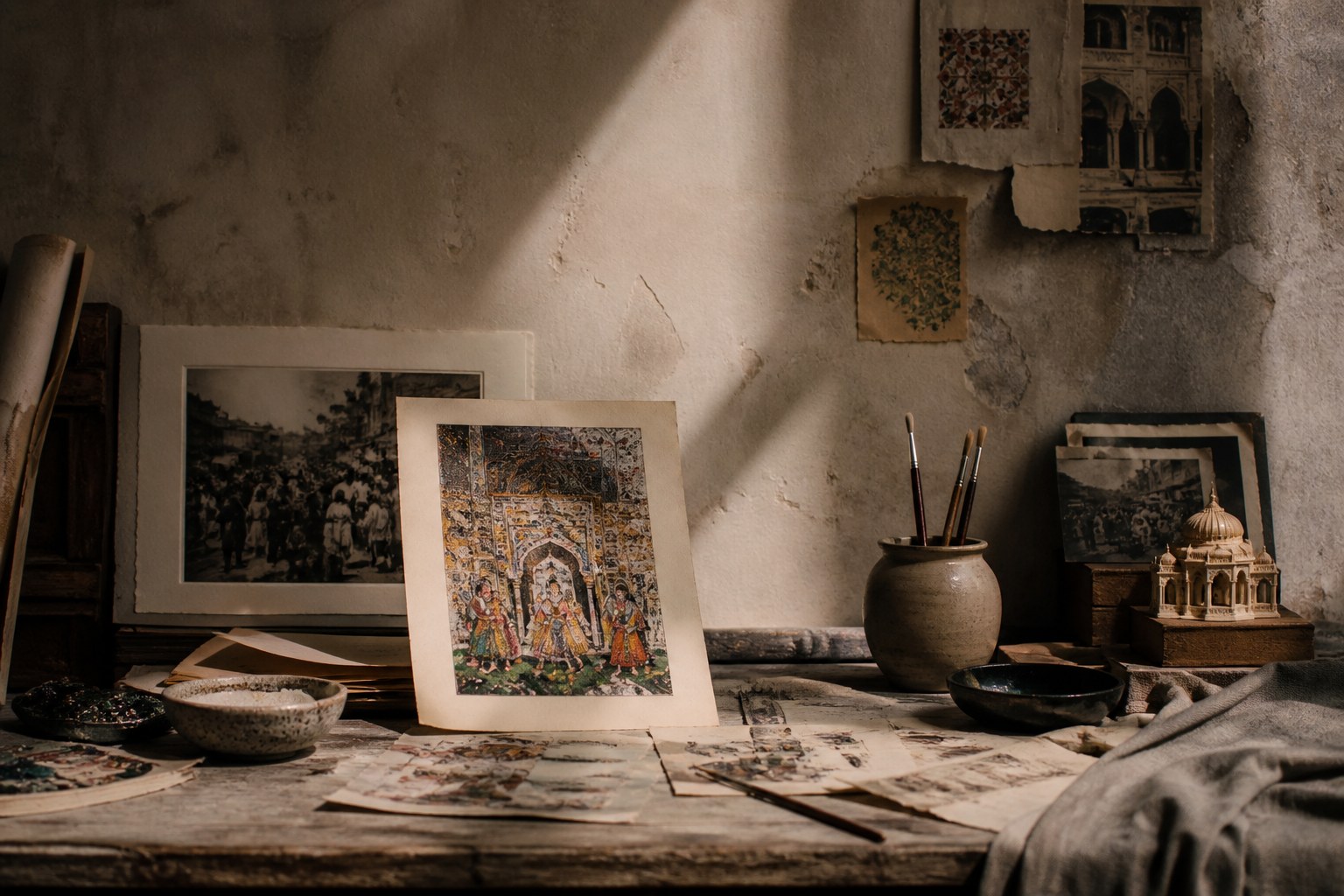
Ambreen Butt’s work keeps miniature training visible without freezing it as heritage display. Fine brushwork, layered paper, translucent supports, stitching, and collage turn manuscript discipline toward public memory—news images, gendered labour, and the afterlives of political spectacle. The useful entry is not a ranked “neo-miniature” label. It is a materials trail from Lahore’s National College of Arts to Boston institutions that collected and awarded the work.
What survives of miniature when the page is cut, stacked, stitched, and asked to hold a newspaper’s violence?
— PakStyles culture desk
From NCA Lahore to MassArt Boston
According to the artist’s official biography, Butt was born in Lahore and received a BFA in traditional Indian and Persian miniature painting from the National College of Arts. She moved to Boston in 1993 and earned an MFA in painting from Massachusetts College of Art and Design in 1997. That sequence matters because it places manuscript skill inside a second training culture of contemporary painting and critique, not as an untouched export.
NCA miniature curricula emphasise brush control, layering, burnishing, and the ethics of detail. Butt’s later surfaces often keep that patience while changing the support: paper stacked or torn, Mylar and related translucent films, threads that bind or scar the sheet. When writers call the work “miniature-inspired,” ask which miniature procedures remain—scale of mark, sequential building of colour, ornamental framing—and which have been deliberately broken.
Boston’s museum and nonprofit ecology—ICA, MFA, Gardner residency structures—shaped early visibility. That is geography of institutions, not a personality myth. Track which prize or residency opened which public conversation, then return to the sheets themselves.
Prizes as institutional dating tools
Public awards help date attention without turning the career into a trophy shelf. In 1999 Butt was the first recipient of the James and Audrey Foster Prize at the Institute of Contemporary Art, Boston, and an artist-in-residence at the Isabella Stewart Gardner Museum the same year. The Museum of Fine Arts, Boston, awarded her the Maud Morgan Prize; the 2006 Maud Morgan Prize exhibition page anchors that recognition in MFA Boston’s programme for Massachusetts women artists. Additional grants listed on her biography include support from the Joan Mitchell Foundation, the Boston Foundation’s Brother Thomas Fellowship, and the Canada Council for the Arts.
Use prizes to locate when institutions publicly committed to the work. Do not treat them as proof that every later collage is “award-winning” in the marketing sense. Living artists continue; a 1999 or 2006 marker is a chapter, not a ceiling.
Prize language can also trap women artists inside “first” narratives. Firstness is sometimes historically accurate and still insufficient as an interpretive method. Prefer: what did the Foster Prize exhibition make visible about materials that Boston critics had not yet learned to describe?
Layer, stitch, and the news image
Butt’s exhibition history, as summarised on her site and museum pages, includes the Museum of Fine Arts, Boston; ICA Boston; the Brooklyn Museum; the Heard Museum; Asia Pacific Museum; Kunsthalle Fridericianum; Pakistan’s National Art Gallery; and venues in Beijing among others. Across that itinerary, recurring strategies include building images through translucent layers so that under-drawing and over-drawing remain in tension, and using stitch as both repair metaphor and literal structure.
Works that engage public memory—political violence, media spectacle, women’s labour—should be described through specific series titles and dates when available. ICA Boston’s collection record for pieces such as Multiplicité (AB95 series) gives readers a concrete object trail. Avoid inventing narratives about private motives. Prefer: what paper is used, what is cut away, what newspaper or photographic source is cited in wall text, and how scale relates to manuscript intimacy.
Stitch can read as mending, scarring, binding, drawing by other means, or all of these in sequence as the eye moves. Do not pick one metaphor and force the entire career through it. Describe the thread’s path first.
Collections and the Boston–Dallas arc
Public collections listed in the official biography include the Brooklyn Museum; MFA Boston; ICA Boston; the Library of Congress; the National Museum of Women in the Arts; Worcester Art Museum; Hood Museum at Dartmouth; and DeCordova Sculpture Park and Museum. Collection pages beat auction adjectives for medium and dimensions. Butt now lives and works in Dallas and is represented by Gallery Wendi Norris—facts useful for locating current studio geography, not for speculative lifestyle coverage.
Press appearances in The New York Times, The Boston Globe, Artforum, and related journals, plus NPR and PBS mentions listed on her biography, form reception history. Cite them as coverage, not as primary evidence for materials.
Dallas is not a disappearance from Boston’s record; it is a relocation of studio labour. Editors should update geography carefully and keep early Boston institutional facts dated rather than rewritten as if they happened everywhere at once.
How to look without the neo-miniature shortcut
Stand close enough to see brush hair and paper fibre. Ask whether ornament frames the subject or interrupts it. Compare a densely worked passage with an area left translucent or empty. If stitch is present, decide whether it reads as mending, scarring, binding, or drawing by other means. Only then reach for large cultural labels. Miniature training is a toolkit; public memory is a subject; neither automatically explains the other.
For diaspora classrooms, assign one museum object page and the artist biography before debate. Ask what changed between a distant JPEG and a materials list. Corrections to this PakStyles page should cite titled works, prize pages, or collection records. Refuse gossip, medical speculation, and unsupported “best of” rankings. Specificity—NCA, MassArt, Foster Prize, Maud Morgan, named collections—is how miniature technique stays a living method rather than a brand.
Paper as politics without slogan density
Newsprint and photographic fragments enter some of Butt’s layered works as charged guests. The manuscript tradition knew borders and cartouches; contemporary collage knows crops and captions. When those systems meet, the page can hold more than one regime of truth at once. Describe that tension as structure. Do not decide in advance that every newspaper scrap “equals” trauma content.
Teachers can pair a Butt sheet with a historical miniature folio reproduction and ask students to list shared procedures—brush scale, sequential colour, edge control—before listing differences. The exercise prevents both nostalgia and novelty worship. It also clarifies why NCA training remains audible even when the finished object no longer looks like a court scene.
Rights and reproduction matter unusually here. Layered works photograph badly when flash flattens translucency. Prefer museum images authorised for education, and note when a detail view hides stacking depth. Depth is often the argument.
Ambreen Butt’s career rewards slow materials literacy more than fast identity summary. Keep the biography page, one prize record, and one collection object open together. If a claim cannot survive that trio, it does not belong on this page.
Translucency, opacity, and how photographs lie
Many of Butt’s layered works depend on seeing through one sheet toward another. Camera autofocus and social-media compression punish that dependence. What looks like a flat decorative field online may, in person or in a careful museum photograph, show stacked decisions—pencil under wash, thread over print, a cut edge revealing an earlier crop. Editors should prefer institutional images and should caption uncertainty when only a JPEG is available.
Opacity has politics too. A fully covered news image can be protection, censorship, mourning, or formal play. Do not decide which before describing how much of the source remains legible. Legibility is measurable: can you read a headline fragment, recognise a face, identify a uniform? Those answers belong in the notes before any thesis about Pakistan’s public sphere.
Gardner residency and ICA prize contexts also trained Boston audiences to expect contemporary work that spoke through craft intensity. Butt’s miniature background met that expectation halfway and then redirected it toward collage and stitch. The redirection is the interesting part—not the reassurance that “tradition survives.”
Compare a densely stitched passage with an area of open translucent film. The contrast teaches pacing. Miniature training often implies even finish; Butt’s pages frequently refuse evenness. That refusal is contemporary without abandoning the hand’s discipline.
Public memory versus private myth
PakStyles’ living-person standard applies. Do not speculate about relationships, health, or motives. Do not invent studio anecdotes. Collection records and prize pages already supply a public career arc from Lahore training through Boston recognition to later Texas studio geography. That arc is enough for a responsible profile.
When works address violence or gendered harm reported in news media, keep the distinction between the artwork’s constructed field and the historical events referenced. The collage is not a documentary substitute; it is a crafted argument about how images circulate. Readers seeking news history should be pointed to journalism and official records, not asked to treat a paper construction as a court transcript.
Diaspora classrooms can use Butt to discuss what “heritage technique” means when the technique migrates into another country’s museum system. The question is not whether the work is authentic enough. It is whether viewers can still name procedures—brush, layer, stitch—after the object has changed address.
Sources and official profiles
Was this helpful?
Keep reading
Related stories
More from this desk, this beat, and the tags on this piece.
Walima explained: what the reception is for and why every family does it differently
Bilal Ahmed · 27 Oct 2026
Dholki, mayun and mehndi: why Pakistani pre-wedding events are not the same thing
Bilal Ahmed · 25 Oct 2026
NADRA Family Registration Certificate: what an FRC proves and what it does not
Bilal Ahmed · 22 Oct 2026
Sending money from the UK to Pakistan: compare the amount received, not the fee alone
Bilal Ahmed · 20 Oct 2026

Birmingham's Pakistani community in Census 2021: why 17% is a local story, not a UK average
Bilal Ahmed · 20 Oct 2026
Readers
The conversation
0 notes
Anyone can leave a note. Guests add a name and email — no account required, and the email is never published.
No notes yet. Yours would be the first.