Nusrat Fateh Ali Khan: where to begin with the recordings
A listener\u2019s entry to Nusrat Fateh Ali Khan that starts with complete qawwali performances, ensemble labour and poetry\u2014then places studio collaborations as another doorway.
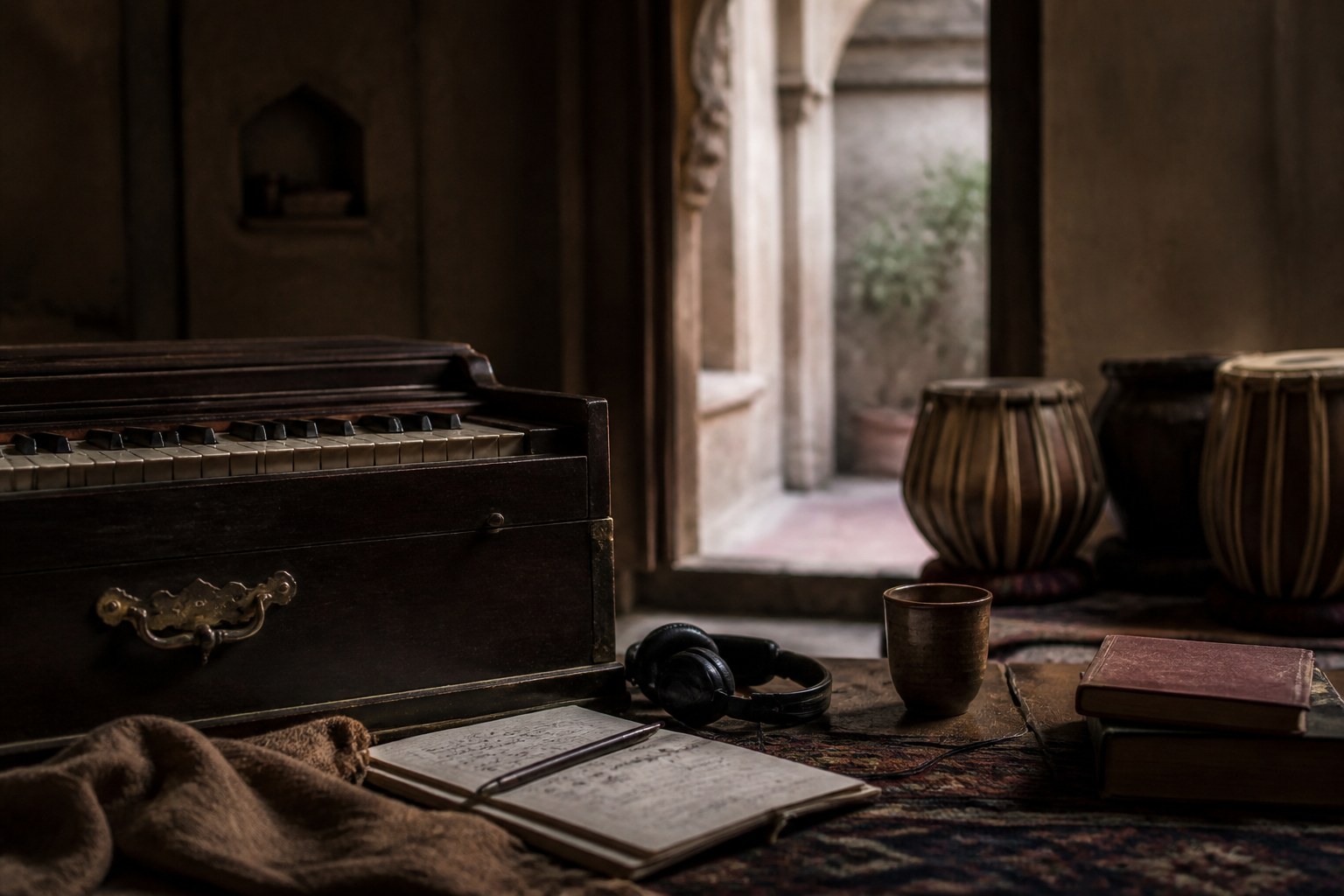
The way into Nusrat Fateh Ali Khan is not a greatest-hits shuffle. It is learning how a qawwali performance gathers force through poetry, repetition, handclaps, chorus and improvisation. Clips that jump straight to a peak scream can be thrilling and still mis-teach the form. Duration is not excess. Accumulation is part of the art.
Nusrat (1948–1997) became one of the twentieth century’s most widely heard voices in qawwali and a global reference point for Pakistani music. Prefer labelled releases and reputable archives when possible—institutions such as Smithsonian Folkways and research libraries like the British Library help orient ethical listening.
Begin with a complete qawwali
Choose one full performance and hear how the opening establishes text and mode before the lead voice intensifies. Early minutes teach the poem’s contour and the party’s rhythmic agreement. Later minutes earn their heat because the room has been prepared. If you only know Nusrat through a two-minute social upload, you have heard a weather report, not the climate.
Practical suggestion: pick an evening, disable shuffle, and commit to one long track without multitasking through the first ten minutes. Boredom in minute four is sometimes just unfamiliarity with how qawwali paces revelation. Teaching children or new listeners works better with one complete performance repeated than with a buffet of peaks. Repetition is how the form teaches. Peaks without preparation create addiction to climax and impatience with poetry.
The party is the instrument
Harmonium, tabla or dholak, clapping and responsive chorus create the platform from which improvisation rises. A solo-genius story erases that labour. Listen for call-and-response between lead and chorus. Family lineage and the Qawwal Bachchon ka Gharana tradition matter historically; they should not become a substitute for hearing ensemble precision.
When recommending Nusrat, name the recording and the duration you expect someone to give. A two-minute dare is not an introduction; it is a tease.
Poetry, language, and devotion without exotic fog
Qawwali texts may draw on Persian, Punjabi, Urdu and related literary worlds depending on the piece. Identify the language and poet where credits allow. Translation can open meaning; repeated listening to pronunciation and melodic stress teaches what a summary cannot. Do not reduce the repertoire to exotic vocal athletics. If credits are thin, seek a labelled reissue rather than inventing explanations.
Devotional listening does not require shared theology, but it does require refusing mockery and exotic athleticism frames. If you are uncomfortable, choose education over irony: read a credited translation, learn who is in the party, try again.
Studio collaborations and film songs as other doorways
Work associated with international film, remix culture and cross-cultural producers introduced different textures and audiences. Those recordings can be excellent entry points. They can also mislead if treated as the real Nusrat while traditional performances are filed as inaccessible. Hear a collaboration beside a traditional performance in the same week.
Playback and film-adjacent popularity brought Nusrat into households that never attended a mehfil. Keep a film song you love—and then add one long-form performance so improvisational intelligence has room to show itself. Film-song love can coexist with mehfil seriousness. The failure mode is declaring one door the only door.
A four-evening route
- Evening one: one complete traditional qawwali, no skip.
- Evening two: same performance again while reading available credits or translation notes.
- Evening three: a studio collaboration or film-associated track, then five minutes of silence.
- Evening four: a different complete qawwali to prevent one piece from becoming the whole artist.
After each evening, write three concrete observations: one about rhythm, one about poetry or vowel, one about ensemble response. If you can only write “spiritual,” listen again for a physical detail. Prefer releases that name accompanying musicians and publishers. For cultural orientation, Google Arts & Culture’s Pakistan pages can help map related traditions.
| Evening | Focus | Success looks like |
|---|---|---|
| 1 | Complete traditional performance | You stayed through the opening without skipping to a scream |
| 2 | Credits and translation | You can name language, poet, or party roles better than yesterday |
| 3 | Collaboration or film doorway | You can describe what the contract with time changed |
| 4 | Second complete qawwali | One piece no longer stands in for the whole artist |
Building a shelf without drowning in mislabels
Nusrat’s catalogue is vast, reissued, remixed, mislabelled and sometimes poorly attributed online. Prefer releases that name accompanying musicians, recording contexts and publishers. Fan uploads can be loving and still wrong about titles. When a track arrives without context, restore year, party and text before judging the form by a peak alone.
This guide will not declare a single definitive best recording, invent concert dates it cannot source, or treat Western discovery narratives as the beginning of the music’s importance. Where to begin is modest and exacting: one complete performance, attention to the party, patience with repetition. That habit scales to a lifetime of listening without requiring a perfect discography on day one.
Teaching patience without turning listening into punishment
New listeners often fail in minute four because they expect a pop-song curve. Tell them what will happen: the poem establishes itself, the party agrees on a pulse, repetition returns with changed weight, and heat arrives because the room was prepared. That forecast is kinder than scolding someone for boredom. Boredom is sometimes just an uninformed expectation.
Parents and teachers can use a lighter entry without lying about the form. Play a film-associated doorway first if needed, then insist on one complete traditional performance the same week. The ethical failure is declaring the doorway the whole artist. The pedagogical failure is demanding a two-hour mehfil on day one from a teenager raised on thirty-second clips.
Catalogue chaos remains the other obstacle. Prefer labelled releases that name accompanying musicians and publishers. When a social upload mis-titles a track, correct the label in your notebook even if you cannot correct the internet. A shelf of honest titles beats a cloud of thrilling mislabels.
After four evenings on the route, you should be able to describe rhythm, vowel, and ensemble response without reaching only for “spiritual.” If you cannot, repeat evening one. Nusrat’s art teaches through accumulation. Your listening should too—patiently, with the party audible, and without treating Western discovery stories as year zero.
Archives, ethics, and the long shelf
Smithsonian Folkways, research libraries and careful reissue labels cannot solve every streaming mislabel, but they model an ethic: name the musicians, name the context, refuse anonymous peak culture as the whole art. When you build a personal shelf, copy that ethic even if your files come from mixed sources. Write the party down. Write the duration you expect a friend to give.
Devotional listening does not require shared theology. It does require refusing mockery. If a listening circle includes people uneasy with Sufi vocabulary, offer education—credited translation, ensemble roles, poetic return—before irony. Irony is a cheap shield against unfamiliar duration.
Film songs and collaborations remain legitimate doorways. Sequence them honestly beside complete qawwali. After a month of that practice, you should be able to explain why accumulation matters without scolding. Nusrat Fateh Ali Khan’s recordings reward that humility. Clips will always scream louder. The art still begins when you stay.
What “where to begin” is allowed to mean
Where to begin is not where to end. A four-evening route is an on-ramp. After it, your shelf should branch by language, by party, by live versus studio contract, by film doorway versus mehfil duration. Branching prevents one beloved performance from becoming a false total.
Beginners often ask for the most emotional track. Offer them the most complete one instead. Emotion arrives as a consequence of preparation in qawwali; skipping preparation trains a craving that the form cannot ethically satisfy on demand. If a friend refuses duration, keep the doorway open with a film song—but schedule the complete performance as a second date with the music, not as an optional appendix.
British Library catalogues, Folkways ethics and careful liner notes will not make you a scholar overnight. They will make you harder to fool. In a catalogue as reissued and mislabelled as Nusrat’s, that hardness is love. Stay for the party. Stay for the poem. Stay past the first scream.
Handclaps, chorus, and the ethics of attention
Qawwali asks listeners to notice collective labour. When you fixate only on Nusrat’s upper register, you erase the chorus that answers him and the claps that build the room’s pressure. Rebalance your attention for one full performance: count returns of a phrase, notice who answers, notice when the tabla or dholak changes the floor under the poem.
That rebalancing is also an ethic for recommendation culture. Share the party, not only the scream. Tell friends how long to stay. Admit when a upload’s title may be wrong. The recordings will still overwhelm you. They will overwhelm you more honestly.
Sources and official profiles
Was this helpful?
Keep reading
Related stories
More from this desk, this beat, and the tags on this piece.

Walima explained: what the reception is for and why every family does it differently
Bilal Ahmed · 27 Oct 2026

Dholki, mayun and mehndi: why Pakistani pre-wedding events are not the same thing
Bilal Ahmed · 25 Oct 2026

NADRA Family Registration Certificate: what an FRC proves and what it does not
Bilal Ahmed · 22 Oct 2026


Sending money from the UK to Pakistan: compare the amount received, not the fee alone
Bilal Ahmed · 20 Oct 2026

Birmingham's Pakistani community in Census 2021: why 17% is a local story, not a UK average
Bilal Ahmed · 20 Oct 2026
Readers
The conversation
0 notes
Anyone can leave a note. Guests add a name and email — no account required, and the email is never published.
No notes yet. Yours would be the first.