Pakistani wedding invitation wording and etiquette
Clear Pakistani wedding invitation wording that respects family conventions while giving guests complete, unambiguous instructions.
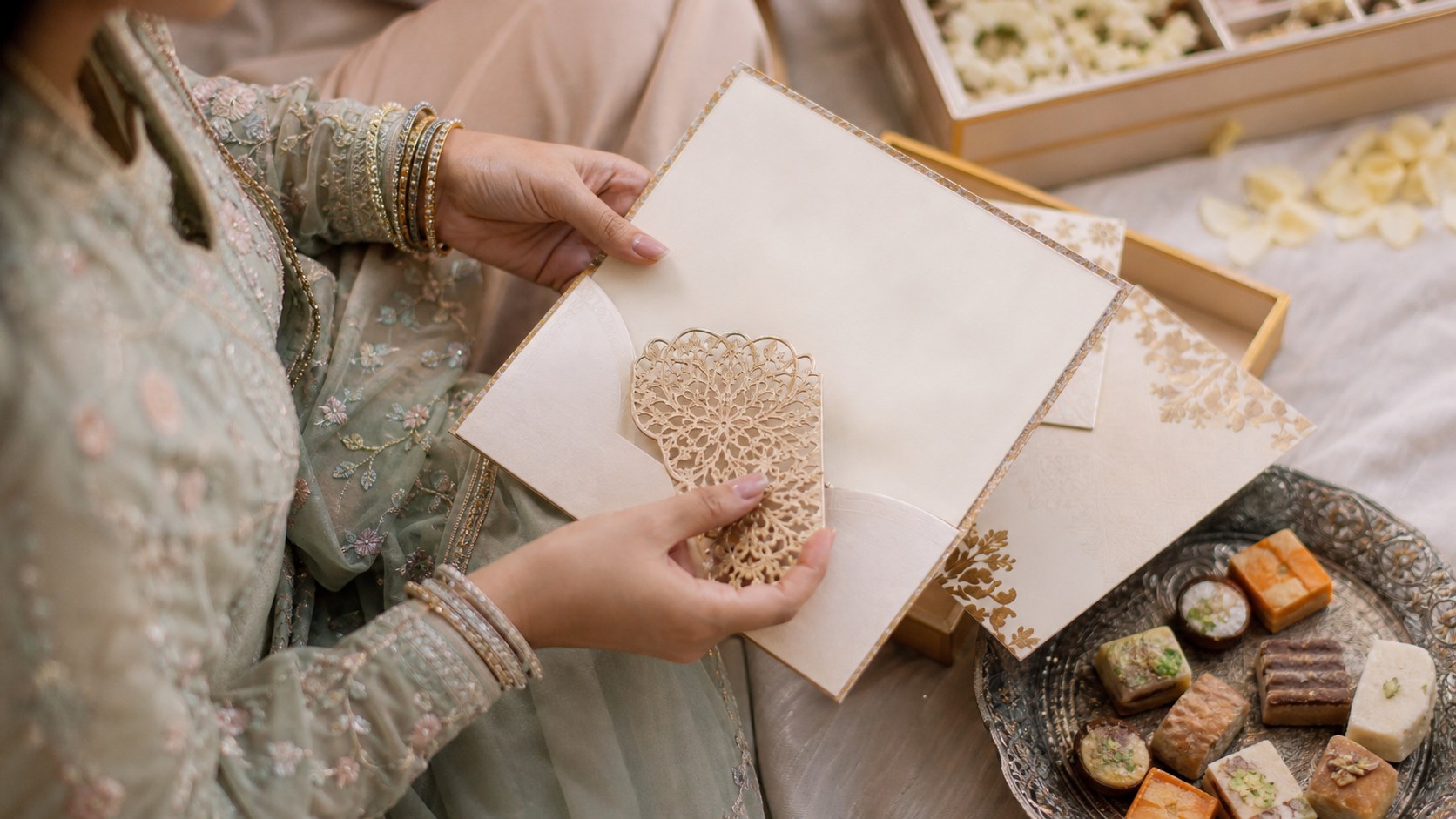
An invitation has two voices. One welcomes the guest; the other gets them to the correct room at the correct time. Honour family conventions in the first, then make the second impossible to misunderstand.
Write information before ornament
- Names exactly as the couple wants them presented.
- Event name—nikah, mehndi, baraat, walima or another family term—with a plain-language cue if guests may not know it.
- Date, arrival time, ceremony time and finish time where useful.
- Full venue address, entrance or room, parking and accessibility contact.
- RSVP deadline, method and the names included in the invitation.
“Seven onwards” is not useful when the nikah begins at 7:15. Distinguish doors, meal and ceremony. For a mosque, state shoe, head-covering or photography expectations sensitively and identify what the venue provides. Do not present one family’s practice as universal religious etiquette.
| Issue | Clear wording |
|---|---|
| Children | Name invited household members or state the policy warmly and directly |
| Plus-ones | Include the guest’s name rather than relying on inference |
| Gifts | Make any preference optional; avoid language that resembles an invoice |
| Dress | Describe formality, venue and practical needs rather than policing culture |
Names and hosts need a conversation
Decide how parents, deceased relatives, stepparents or other hosts are acknowledged before design begins. There are several respectful formulations; no template can settle a family relationship. Read the final sequence aloud to everyone named.
Send corrections as clearly as the invitation
If a time or venue changes, do not quietly replace an image in the family chat. Send a dated correction in text, name the affected event and ask for acknowledgement where the change is material. Keep the current details on one stable page and ensure older links point there. For international guests, include the local time zone and avoid date formats that can be read two ways. Translation should preserve instructions as carefully as blessings and family titles.
Proof every spelling and number from the source, then ask someone outside the planning group to follow the invitation literally. Their questions reveal missing information. A graceful invitation reduces private follow-up messages because its hospitality includes clarity.
Names, hosts and ceremony labels
Decide how parents, deceased relatives, stepparents and other hosts are acknowledged before design begins. Read the final name sequence aloud to everyone named. Label events—nikah, mehndi, baraat, walima—with a plain-language cue if guests may not know the term. Distinguish doors, ceremony and meal times; “seven onwards” fails when the nikah begins at 7:15.
| Issue | Clear wording |
|---|---|
| Children | Name invited household members or state the policy warmly and directly |
| Plus-ones | Include the guest’s name rather than relying on inference |
| Gifts | Make any preference optional; avoid invoice language |
| Dress | Describe formality, venue and practical needs |
Corrections and international guests
If a time or venue changes, send a dated text correction naming the affected event. Include local time zones for international guests and avoid ambiguous date formats. Translation should preserve instructions as carefully as blessings. Proof every spelling from the source, then ask someone outside the planning group to follow the invitation literally.
Design that does not hide information
Ornament is allowed; illegible addresses are not. Put essential facts in a typeface and size older relatives can read. If you use Urdu and English, ensure both carry the same times and places. QR codes may supplement RSVP but should not be the only path for guests who will not scan.
For multi-event weddings, consider separate cards or a clear stacked layout so a guest invited only to the walima does not arrive at the mehndi. Hospitality includes not embarrassing people at the door. Keep a text-only version of the details for screen readers and for pasting into messages when images fail to load.
Children, plus-ones and gifts
Name invited household members or state children’s policy warmly and directly. Include plus-one names rather than relying on inference. Make gift preferences optional; avoid invoice language. Describe dress by formality and venue needs rather than policing culture.
Digital invites must still pass the test: can a guest find date, postcode or ZIP, ceremony time and RSVP without replaying animation? Send corrections as dated text naming the affected event. Include time zones for international guests and avoid ambiguous date formats. Proof from the source, then ask an outsider to follow the card literally.
Multi-event clarity
If a guest is invited only to the walima, the invitation should not look like a mehndi pass. Separate cards or a clear stacked layout prevent door embarrassment. Keep a text-only version for accessibility and for pasting into messages when images fail. Translation should carry instructions as carefully as blessings and titles.
Digital, corrections and multi-event clarity
Digital invites must still pass the test: can a guest find date, postcode or ZIP, ceremony time and RSVP without replaying animation? QR codes may supplement RSVP but should not be the only path for guests who will not scan. Keep a text-only version for accessibility and for pasting into messages when images fail.
If a time or venue changes, send a dated text correction naming the affected event. Include time zones for international guests and avoid ambiguous date formats. Translation should preserve instructions as carefully as blessings. Proof from the source, then ask an outsider to follow the card literally.
If a guest is invited only to the walima, the invitation should not look like a mehndi pass. Separate cards or a clear stacked layout prevent door embarrassment. Ornament is allowed; illegible addresses are not. Put essential facts in a typeface and size older relatives can read. If you use Urdu and English, ensure both carry the same times and places.
Proofing and the outsider test
Ask someone outside the planning group to follow the invitation literally: find the entrance, state who is invited, and say when to arrive. Their confusion is your missing line. Check spellings of every name against identity documents where those names will appear on legal paperwork.
If elders need larger type, produce a large-print companion card rather than forcing them to decode ornamental script. Hospitality includes readability. Keep the current details on one stable page if you use a website, and make older links redirect there.
When families disagree about titles—doctor, engineer, hazrat, or none—resolve the dispute before printing. Invitations are permanent records of temporary arguments. Prefer the couple’s stated preference when the conflict is about their names, and prefer living elders’ stated preference when the conflict is about theirs.
Avoid packing every hashtag, registry link and dress code essay onto the primary card. Use an insert or webpage for secondary information. The main card should answer who, what, when, where, and how to reply. Everything else is optional depth for people who want it.
When using calligraphy, set a text-only proof round before ink. Beautiful letters that misspell a parent’s name are still wrong. If a designer resists a plain proof, find a designer who understands that clarity is part of beauty.
File the final print-ready PDF with the RSVP tracker. Future corrections should edit one source, not five versions floating through chats. Version control is etiquette toward your future self.
For destination guests, add a single line pointing to travel and hotel information without turning the invitation into an itinerary. The card’s job is attendance clarity; the packet’s job is logistics. Mixing them usually harms both.
When in doubt, cut ornament before cutting facts. Guests forgive a simpler design. They do not forgive arriving at the wrong entrance because the calligraphy hid the room name.
If you print bilingual cards, commission a native proofreader for each language. Machine translation of blessings often fails politeness even when times are correct. Pay for the proof; it is cheaper than reprinting.
Keep a single master details sheet—date, times, addresses, RSVP contact, guest inclusions—and force every designer, printer and website update to copy from that sheet alone. Parallel versions in chat threads are how wrong postcodes survive into the final print. After the cards leave the printer, send one plain-text confirmation message to every household with the same facts, so guests who lose the envelope still have a reliable source.
Sources and official profiles
Was this helpful?
Keep reading
Related stories
More from this desk, this beat, and the tags on this piece.
Walima explained: what the reception is for and why every family does it differently
Bilal Ahmed · 27 Oct 2026
Dholki, mayun and mehndi: why Pakistani pre-wedding events are not the same thing
Bilal Ahmed · 25 Oct 2026
NADRA Family Registration Certificate: what an FRC proves and what it does not
Bilal Ahmed · 22 Oct 2026


Sending money from the UK to Pakistan: compare the amount received, not the fee alone
Bilal Ahmed · 20 Oct 2026

Birmingham's Pakistani community in Census 2021: why 17% is a local story, not a UK average
Bilal Ahmed · 20 Oct 2026
Readers
The conversation
0 notes
Anyone can leave a note. Guests add a name and email — no account required, and the email is never published.
No notes yet. Yours would be the first.