Finding Pakistani sewing alterations in US suburbs
How to brief a US suburban alterations desk on lawn hems, side slits, lined trousers and dupatta finishes when the nearest specialist Pakistani tailor is a long drive away.
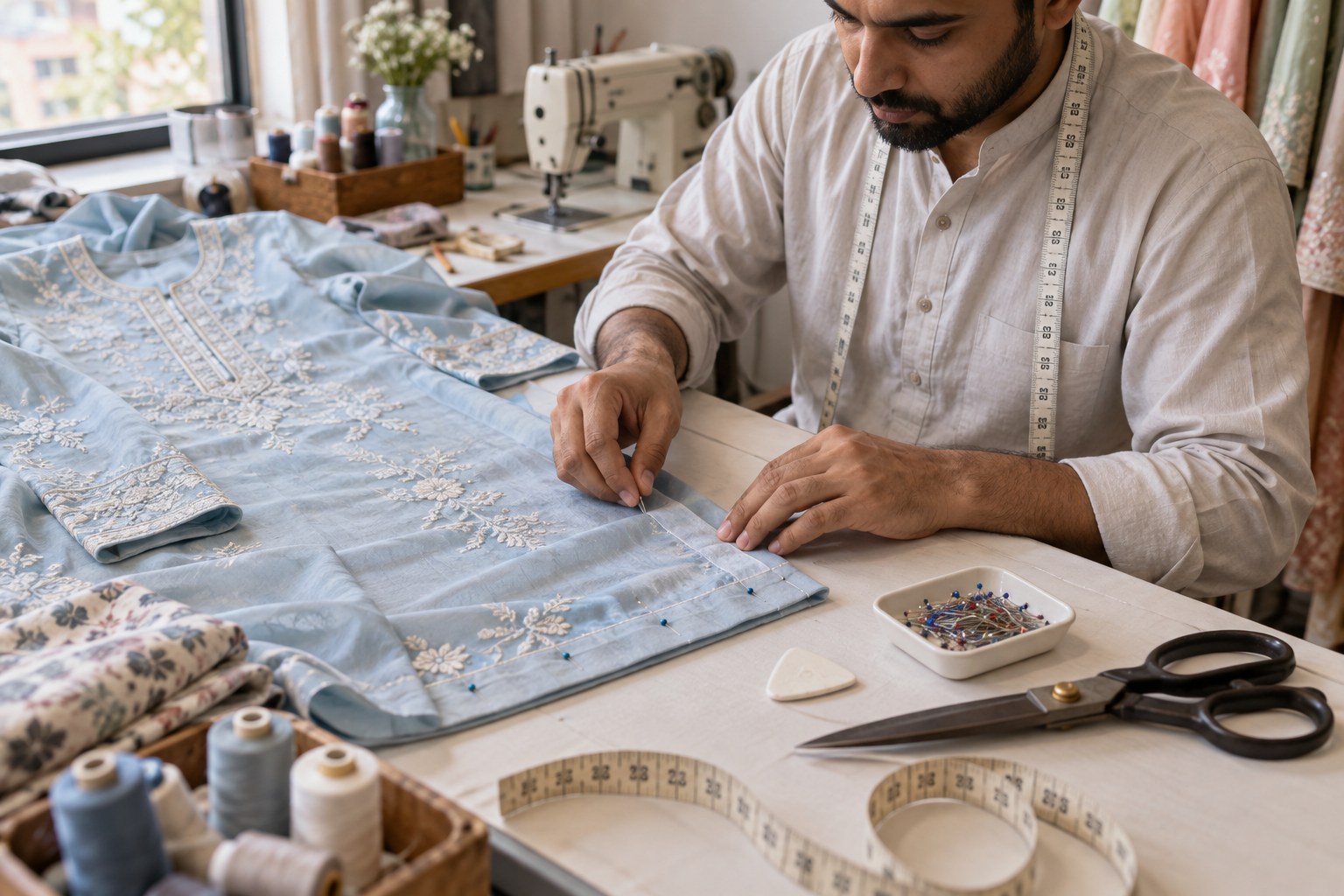
A lawn suit that fitted in Lahore can pool at the ankle after a US summer of parking lots and air-conditioned malls. The waist that worked with Pakistani heels may sit differently with the shoes you actually own in New Jersey or the Bay Area. The fix is rarely another rushed online order. It is a clear brief to whoever will take a needle to the hem, even if that person has never draped a dupatta.
This article is a method for Pakistani and South Asian diaspora shoppers in US suburbs who need alterations without a ranked directory of “desi” shops. It does not invent prices, lead times, or endorsements. Care-label notes below refer to US Federal Trade Commission public guidance on apparel labelling, checked around September 2026.
Search by skill, not by nostalgia keywords alone
“Pakistani tailor” is a useful search when you live near a dense diaspora corridor. In many suburbs it returns nothing within a reasonable drive, or returns a shop that only stocks ready-made suits and sends sewing elsewhere. Widen the net before you conclude nobody can help.
Try combinations that map to the actual work: alterations, bridal alterations, hem alterations, dry cleaners with sewing, formalwear alterations, and “take in waist” or “shorten lined pants.” Call before you drive. Ask whether they shorten lined trousers, take in a waist at the side seams, handle chiffon or net without melting it under a too-hot iron, and whether they will touch heavily embroidered panels or only plain fabric zones. A shop that does wedding-gown hems has more transferable skill than a place that only cuffs jeans, even if neither advertises Urdu on the door.
Read the care label before you negotiate heat and steam
Many imported lawn, chiffon, and silk-blend garments arrive with care labels that still matter once you alter them. In the United States, the Federal Trade Commission’s Care Labeling Rule generally requires manufacturers and importers of covered textile apparel to provide care instructions consumers can follow without harming the garment. The FTC’s consumer-facing apparel labelling pages and its Care Labeling Rule summary explain that washing or drycleaning instructions, plus necessary drying, ironing, bleaching, and warnings, must be supported by a reasonable basis. If a label says “do not iron” or limits temperature, that warning is for you and for the alterations desk.
Bring the garment with its label intact when you can. Point to fibre content and ironing limits before someone tests a hot iron on a sheer panel. For broader consumer framing on how apparel information is presented in the US market, the FTC’s apparel labeling topics page is a useful official orientation. If a dispute later arises over damaged fabric, written ticket notes about the agreed method matter more than a verbal “they said it would be fine.”
What to say about Pakistani cuts that general shops misread
Pakistani women’s suits are not mysterious, but they are easy to shorten in the wrong place. A kameez hem that looks “too long” in photos may be intentional coverage for the shalwar when you raise your arms. Side slits may be functional, decorative, or both. A shalwar or cigarette pant may have a cuff, a drawstring waist, or a lined shell that must be shortened with the outer fabric. A gharara or sharara flare changes length differently from a straight trouser.
Explain the occasion in one sentence: wedding guest, office party, Eid prayer, or everyday wear. Then explain movement: sitting on the floor, climbing stairs, driving, and whether the shirt must still cover the seat of the trousers when you reach up. A sketch on paper beats an abstract request to “make it modest” or “make it modern.” Mark the hem while you are standing in the shoes you will wear. Sitting marks lie.
| Brief the tailor about | Why it matters | What often goes wrong |
|---|---|---|
| Shoe heel height for the event | Hem length is relative to footwear | Marked in trainers, worn in heels |
| Side slits and panel seams | Slits can be shortened or closed unevenly | One side raised; embroidery cut through |
| Lining versus shell | Lined trousers and jackets need both layers moved | Outer hem raised; lining hangs below |
| Dupatta fall, pins, or hidden weights | Many desks have never draped one | Burn marks from iron; uneven border |
| Embellished zones that must not be cut | Mirror work and heavy embroidery fight needles | Broken sequins; puckered stitch line |
| Waist take-in at side seams only | Centre embroidery or pockets may block other routes | Distorted print match; strained zipper |
Bring the whole outfit, not an orphan piece
Wear or bring the shoes, the underlayers, and the dupatta you will actually use. If the suit has a matching slip or inner pant, bring that too. Ask the fitter to check length while you walk a few steps and sit once. If you need the shirt to remain long enough for prayer postures or floor seating at a mehndi, say so before the chalk line is final.
For men’s shalwar kameez or waistcoats, the same discipline applies: cuff height against the shoe, sleeve length with the jacket or waistcoat on, and whether the kameez must cover the seat when arms are raised. “A little shorter” is not a measurement. A pin at the agreed point is.
Price, ticket, and scraps in writing
Ask for a price range and a completion date on the ticket before you leave the garment. Note whether a deposit is required, whether fittings are included, and what happens if the date slips. For general US consumer help if a service purchase goes wrong, USA.gov’s state consumer resources point you toward state-level complaint and mediation routes; they do not replace reading your ticket.
Collect a scrap of leftover fabric if they trim a hem. Scraps help with future repairs and colour matching. Photograph the ticket and the chalk marks if the shop allows it. Inspect the work in daylight before you leave: stitch tension, even length all the way around, lining shortened with the shell, and whether embroidery was crushed or cut. Do not wait until the morning of the event to discover one leg is longer than the other.
Dry cleaner with sewing versus a dedicated alterations desk
Many US suburbs fold light sewing into a dry-cleaning counter. That can be enough for a plain hem on cotton lawn or a simple trouser shorten. It is often the wrong queue for net, chiffon, mirror work, or a gharara that must keep its flare. Ask who will do the work: the person at the counter, a contractor who picks up twice a week, or a bridal specialist elsewhere. If the answer is vague, treat the garment as too valuable for that ticket.
Dedicated alterations shops are usually clearer about fittings and rush fees. Bridal salons sometimes accept outside garments for hemming if capacity allows; call with fibre and embellishment details before you assume they only touch gowns bought there. Community WhatsApp recommendations help you build a shortlist, but you still verify skill on the phone and in the first fitting.
Men’s shalwar kameez and kids’ suits need the same discipline
Men’s pieces fail in quieter ways: a kameez that rides up when arms lift for prayer, a waistcoat that pulls across the button stance after a US weight change, shalwar cuffs that drag on wet suburban pavements. Bring the waistcoat or jacket to the shirt fitting. Mark sleeve length with the outer layer on. For children’s suits bought “with room to grow,” decide whether you are shortening for a single event or leaving length that will be revisited in six months. Growing room left unpinned becomes a trip hazard in photos.
If the outfit came as a stitched three-piece with a separate inner pant, keep the pieces together on the hanger when you drop them off. Shops that receive only the outer trouser cannot guess the intended stack height against the kameez.
Lawn, chiffon, and net behave differently under a needle
Cotton lawn often forgives a careful hem. Chiffon and net punish thick needles, hot irons, and uneven tension. Embroidery tunnels can make a “simple” side take-in impossible without opening a panel. Tell the fitter which seams are structural and which are decorative. If a motif crosses the seam you wanted taken in, ask for an alternative route or accept that the garment cannot lose that inch without visible damage.
Steam is not neutral. Some synthetic blends shine or water-spot. If the care label warns against ironing or limits temperature, put that warning on the ticket in your handwriting before you leave the counter. A verbal reminder evaporates at shift change.
When to drive farther, and when a local desk is enough
Drive farther for heavily embellished bridalwear, complex gharara proportions, or garments where a mistake cannot be hidden. A suburban alterations desk that regularly hems lined formal trousers and chiffon bridesmaid dresses can often handle a lawn guest suit, a straight-pant shalwar hem, or a simple waist take-in. Match the difficulty of the garment to the skill you verified on the phone, not to the nostalgia of wanting a shop that “understands our clothes” without evidence.
If the first consultation feels dismissive of slits, modest lengths, or dupatta finishes, leave with the garment. You are buying craft. You are not obliged to educate a shop that will not listen. Schedule a daylight pickup even if that means an extra trip; fluorescent shop light hides uneven hems. Try the outfit on fully before you leave. Walk, sit, raise your arms, and check the back view in a long mirror.
Good alterations keep a diaspora wardrobe wearable across climates and shoe collections. The tailor does not need to know every regional cut. They need the measurements, the movement, the care limits on the label, and the finish you will notice in photographs.
Sources and official profiles
Was this helpful?
Keep reading
Related stories
More from this desk, this beat, and the tags on this piece.
Lawn, cambric and voile are not the same fabric: a Pakistani summer textile guide
Zainab Noor · 20 Oct 2026

Readers
The conversation
0 notes
Anyone can leave a note. Guests add a name and email — no account required, and the email is never published.
No notes yet. Yours would be the first.