Eid hosting checklist for a small UK or US home
A small-home Eid plan built around guest flow, prayer, food holding and hospitality that does not exhaust the host.
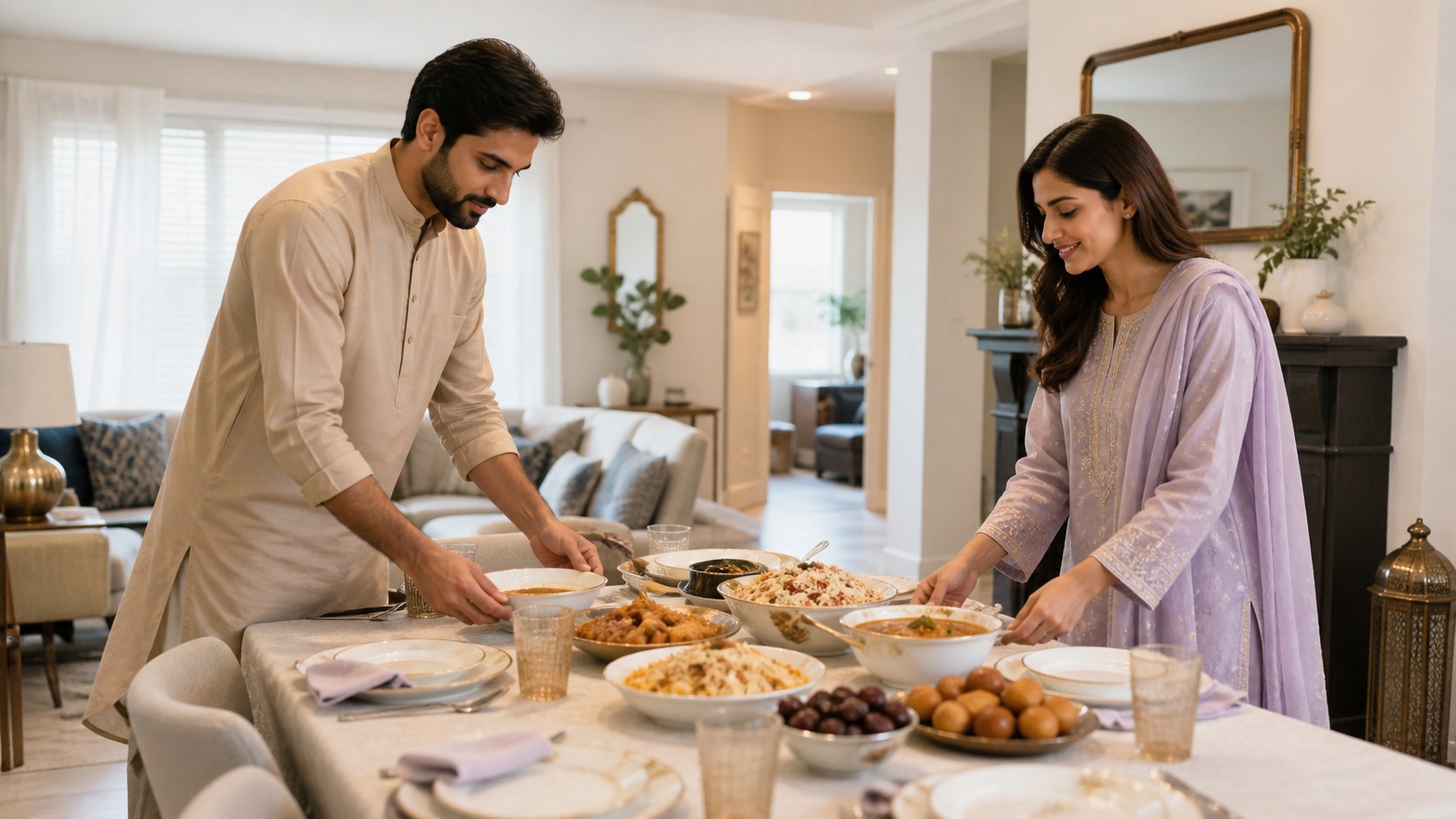
Eid in a small flat fails when the menu is sized for a hall and the furniture is sized for three people. Host well by designing guest flow first: where coats land, where shoes stack, where prayer can happen without blocking the kitchen, and how food stays safe while conversations overrun the timetable. Hospitality is attention and pacing, not proving abundance.
Use food-safety rules as non-negotiable infrastructure. In Britain, follow Food Standards Agency guidance on chilling and cooking. In the United States, keep hot and cold foods out of the USDA FSIS danger zone and plan leftovers with FSIS leftover guidance.
Seventy-two hours out: decisions that shrink the day
- Final guest count with a hard yes/no, including children.
- Menu locked to oven, hob and fridge capacity—not to fantasy.
- Prayer plan: at home, at the mosque, or split by household.
- Allergy and diet list written where cooks can see it.
- One person assigned to door/coats; one to kitchen timing; one to clearing plates.
If you are alone, simplify until one person can run the day. A smaller menu served calmly beats a banquet that leaves you invisible in the kitchen.
Space map for a one-bedroom or compact house
| Zone | Job | Small-home tactic |
|---|---|---|
| Entry | Shoes, coats, salaam | One mat, one chair, labelled baskets; stop the corridor pile early |
| Sitting | Conversation | Clear coffee-table clutter; extra floor cushions beat obstructing walkways with random chairs |
| Prayer | Quiet orientation | Pre-clear a rectangle; store rugs rolled and ready |
| Kitchen | Hot holding and plating | One landing zone for dirty dishes; no decorative clutter on the hob |
| Children | Containment without exile | One bag of quiet toys; agree outdoor rules if you have a yard |
| Exit | Takeaway boxes, goodbyes | Stack clean containers before guests arrive |
Menu design for four burners and one oven
Choose contrast, not duplication: one meat centrepiece or substantial vegetarian main, one daal or vegetable, rice or bread, one fresh element (salad, raita, fruit), one sweet. Avoid three rich gravies that all need last-minute heat.
Cook-ahead candidates: daal, pullao components you can finish safely, baked desserts, chopped salads without dressing. Day-of candidates: shallow-fried items you cannot hold well, fresh naan if you insist, delicate herbs.
For allergen honesty, use FSA allergen information for consumers thinking even at home: know where nuts, milk, gluten, sesame and eggs hide in mithai and snack mixes. In the US, remember sesame’s status among major allergens in FDA materials such as the food allergies overview.
Hot-holding without a banquet kitchen
Keep hot food hot and cold food cold. Do not leave biryani on a warm counter for unstructured hours because “guests are late.” Stagger arrivals if your community treats Eid as an open house; publish a window (“1–3pm”) rather than an infinite drop-in.
Use oven low-heat holding only when you know the dish and the appliance. Transfer leftovers into shallow containers and refrigerate promptly according to FSA or FSIS guidance. Rice deserves particular respect; do not treat a giant pot as safe forever because it still “looks fine.”
Prayer, timing and mixed households
If guests will pray at your home, clear the space before food service peaks. Provide a clean direction reference, spare scarves if that is your household practice, and a quiet corridor for ablution logistics without flooding the only bathroom queue.
If most people will pray at the mosque, do not schedule food for the exact minute khutbah ends unless you enjoy cold dishes and stressed hosts. Build a buffer. Tell guests whether you are serving immediately after prayer or later in the afternoon.
Non-Muslim or non-fasting friends need a clear invitation: what to wear if you have a preference, whether alcohol is absent (usually), and whether they should bring anything. Clarity prevents awkward empty-handed panic and prevents surprise wine bottles you then have to store.
Children, noise and neighbour diplomacy
Small homes amplify kids. Appoint one adult rotation for the children bag—or accept that parents will supervise their own. For UK flats and US apartments, know your building’s quiet expectations; USA.gov’s pages on noise complaints and housing are reminders that neighbours have levers. A polite note to adjacent flats about afternoon guests can prevent a worse conversation later.
Seating without pretending you have a dining hall
Serve buffet-style along one wall so people plate and return to seats. Or serve thali-style to a smaller list. Standing bites work for short visits; they fail for elders who need chairs with backs. Borrow folding chairs only if fire exits and corridors stay clear.
Place water within reach. Sweet drinks are fine; dehydration after a warm flat and heavy food is not hospitality.
Day-of checklist
- Bins emptied; spare bags ready
- Bathroom restocked; one clear surface
- Prayer rectangle cleared
- Allergy note on the fridge
- Hot dishes timed backward from serving window
- Cold dishes parked in fridge, not on the table early
- Takeaway containers clean and stacked
- Host water bottle filled—eat something before guests arrive
Gifts, money and mithai without kitchen collapse
Guests may bring boxes of sweets you cannot store. Accept graciously, then consolidate duplicates into one plate and send surplus home with visitors who have car boots and teenagers. Do not open six boxes “to be polite” if fridge space is already negotiated against meat.
If money gifts circulate among relatives, keep them out of the food landing zone. A small bowl on a side table beats envelopes beside the biryani.
Cleanup as hospitality to your future self
Run a wash cycle during the party if your machine is quiet enough. Soak pans immediately. Assign a fifteen-minute reset team before the last guests leave: surfaces, floor crumbs, fridge doors closed on leftovers labelled with times.
Open-house versus fixed sitting: pick one
An open house suits relatives who stagger mosque times and toddler naps. It demands continuous hot/cold discipline and a host who can greet without replating for two hours. A fixed sitting suits a smaller list and a single prayer plan. Mixing both—“come anytime, but also sit for a formal meal at 2”—is how small kitchens break.
Publish the model in the invitation. People can honour a clear window more easily than an ambiguous “drop by.”
Borrowed hands without borrowed chaos
If a cousin offers to bring a dish, assign the dish. “Anything” becomes three biryanis and no salad. Ask about nuts and sesame before their tray enters your house. Reheat instructions should be agreed the day before, not shouted over the doorbell.
Paid help, if you use it, needs a written task list: wash, plate, guard the door, manage bins. Do not assume someone hired for cleaning wants to negotiate family politics at the threshold.
Photographing Eid without turning elders into props
Agree whether phones will be out during dua or prayer. Ask before posting children’s faces to public accounts. A single group photograph after food beats a continuous ring light in a tiny lounge.
Rain, coats and British doorways
UK Eid mornings are often wet. Put a towel for umbrellas by the door and accept that the entry zone will be ugly for an hour. Better an ugly organised entry than wet shoes polishing your only carpet into a hazard.
US homes with garages can stage shoes there if weather allows; still keep a clean indoor path for elders with mobility needs.
The host’s plate
Eat before guests arrive, or plate a small portion when the first dishes go out. Hypoglycaemia and martyrdom are not Islamic virtues of hospitality. A present host who has drunk water is better company than a perfect spread abandoned by its maker.
Eid hosting in a small UK or US home is logistics married to warmth. Cap the guest list to the floorplan, design zones, protect the chill chain, and let people remember that you were present—not that you vanished behind a mountain of dishes proving love the hard way.
Two sample timelines
Fixed 1:30–3:30 sitting (eight adults, four children): night-before daal and dessert; morning rice and salad prep; prayer either before guests arrive or at mosque with a 45-minute buffer before plating; serve buffet at 1:45; dessert at 2:45; leftover pack-up at 3:15; reset by 4:00.
Open house 12:00–4:00: two hot dishes that hold safely in rotation; one cold spread refreshed from the fridge; kettle always ready; prayer rectangle available for the first ninety minutes; stop accepting new hot drops after 3:30 so cleanup can begin.
Adjust numbers downward if your oven is unreliable or your fridge is already half full of mithai deliveries.
What to skip without apology
Skip deep-fried batches that demand a host beside hot oil while guests arrive. Skip three desserts. Skip elaborate table décor that consumes the only flat surface you need for plating. Skip inviting “everyone who might be offended” when the room seats twelve. Eid is not a referendum on your worth measured in trays.
A clear no to an extra household can be phrased as capacity, not rejection: “We are keeping it small this year so we can sit with people properly.” Most relatives understand floorspace even when they pretend not to.
Sources and official profiles
Was this helpful?
Keep reading
Related stories
More from this desk, this beat, and the tags on this piece.

Eid gifts for children without turning the house into a toy warehouse
Bilal Ahmed · 12 Oct 2026


Sending money from the UK to Pakistan: compare the amount received, not the fee alone
Bilal Ahmed · 20 Oct 2026
British Pakistanis in Census 2021: what the 1.59 million figure actually means
Bilal Ahmed · 12 Oct 2026

Raising children with Urdu and English: keep the home language useful, not ceremonial
Bilal Ahmed · 9 Oct 2026
What to take from the UK for relatives in Pakistan without packing for everybody
Bilal Ahmed · 9 Oct 2026
Readers
The conversation
0 notes
Anyone can leave a note. Guests add a name and email — no account required, and the email is never published.
No notes yet. Yours would be the first.