Quiet rooms and prayer at UK workplaces during Ramadan
How UK employees and managers handle quiet rooms and prayer during Ramadan: operational requests, coverage maths, and Acas-style fairness language, without personalised legal advice.
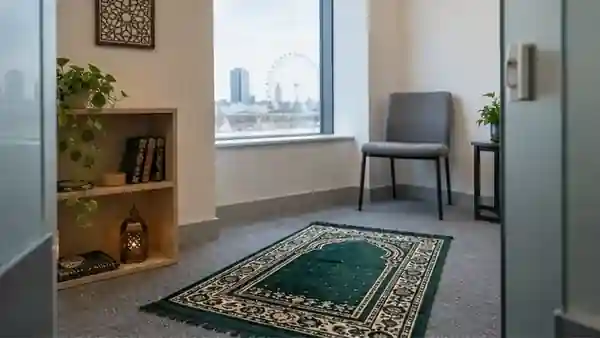
Ramadan at a UK desk job is often a timetable problem before it is a theology debate: Maghrib landing near the end of a shift, a meeting that swallows Zuhr, a “focus booth” that smells of microwave fish, or a manager who wants to help and does not know what to offer. Quiet rooms and prayer space sit in that practical middle. This is workplace etiquette for employees and line managers who want fairness without theatre. It is not legal advice, not a verdict on any employer, and not a substitute for HR or a qualified adviser. The boutique photograph with this article is thematic interiors stock; it does not depict a workplace prayer room.
Public guidance from Acas on preventing religion or belief discrimination (checked around September 2026) is a useful fairness frame: there is no blanket legal requirement to provide religious time or facilities, yet employers should try to accommodate requests where possible, and an unreasonable refusal can raise discrimination issues. The Equality and Human Rights Commission also publishes guidance on religion or belief discrimination as a protected characteristic under the Equality Act 2010. Policies and cases turn on facts. Verify the live Acas and EHRC pages and your own contract, handbook and local process.
What “quiet room” usually means in practice
Most offices will not unveil a purpose-built musalla. What people actually negotiate is a clean, low-traffic space for a short period: a bookable meeting room, a multi-faith or wellbeing room, or a screened corner that is not the only staff kitchen. Acas notes that employers do not need to provide a dedicated prayer room, but should consider providing a suitable space, and must not favour one religion or belief over another if facilities are offered.
Ask for what the space must do. Privacy for rak‘ahs, a door that closes, floor that can take a personal prayer mat, and somewhere to leave shoes without blocking a fire route are clearer than “we need a prayer room.” Offer reciprocity in the same sentence: the room can remain multi-use; you will book it; you will leave it tidy; colleagues of other beliefs can use it for reflection too.
How to ask without turning the aisle into a tribunal
Write a short, operational request to your manager or HR mailbox:
- Which prayer windows fall inside your shift during this month’s timetable (and that Maghrib moves).
- How many minutes you need, and whether existing breaks can absorb them.
- Which quiet space you are proposing, and any booking tool you will use.
- How you will cover urgent work: buddy, delayed Slack responses, or a shifted lunch.
A workable request looks like logistics, not a sermon. Example shape: “During Ramadan my Maghrib window falls around 18:10–18:25 this week and moves later each day. I can take ten minutes from a reshaped lunch, book Meeting Room B, and have Priya cover the queue. Happy to start at 08:20 so total hours stay even.” Attach nothing preachy. You are solving coverage and dignity.
If the first answer is “not possible,” ask which constraint is binding: customer-facing rota, lone working, safety-critical role, and whether a narrower ask would work on Fridays only, or only for Maghrib in summer. Keep the thread. Clarity protects everyone if memories diverge later.
| Request element | Why managers need it |
|---|---|
| Exact time windows this week | Maghrib and Zuhr move; vague “prayer breaks” are hard to roster |
| Minutes needed | Shows whether lunch can absorb the break |
| Named space + booking method | Turns a principle into a calendar entry |
| Coverage plan | Protects teammates from dumped work |
Ramadan-specific friction points
Fasting changes energy and social texture. Acas’s wider religion-or-belief guidance encourages employers to consider requests related to fasting, for example temporary changes to duties or hours, without disadvantaging colleagues who do not fast. In etiquette terms: tell your manager early if late-afternoon safety-critical tasks should move earlier while you adjust; do not wait until you feel faint beside a fryer or a driving shift. Colleagues can help by not staging surprise cake at your desk and by accepting a declined lunch invitation without interrogation.
Iftar at the office only works with consent and a plan: food storage, a clean surface, and no pressure on non-fasting staff to perform piety. Taraweeh is usually outside work; do not imply that skipping optional night prayer is a workplace failure. If annual leave for Eid is contested because too many people want the same day, fair advance booking rules help more than last-minute moral pressure. Acas discusses managing festival time off without sidelining people who have no religion: religious leave should not automatically outrank every other request.
Fairness cuts both ways
A quiet room that becomes permanently unavailable to everyone else, or a break pattern that dumps workload on one teammate every dusk, breeds avoidable conflict. Share the rota maths. Rotate Maghrib cover in teams where several people fast. If you manage, brief the whole team once: short prayer breaks may occur; total hours stay even; mockery and “jokes” about fasting are not banter. If you pray, leave the space on time for the next booking and keep wudu water off polished corridors.
The goal is a workplace where prayer is ordinary logistics: booked, brief, mutual, rather than a favour granted in a whisper or a spectacle staged for LinkedIn.
What to put in writing after the first yes
Once a manager agrees a pattern, send a short confirmation: which days, which minutes, which room booking tool, and how cover works when Maghrib moves. Copy HR only if your workplace expects that. A written confirmation prevents the arrangement from living only in one person’s memory when a new rota or temporary manager arrives mid-month.
If the arrangement fails in practice, raise the specific failure: the booked room was double-booked, the buddy cover vanished, the customer rota made Maghrib impossible on Thursdays. Specific failures can be fixed. Vague resentment usually cannot.
Small workplaces and customer-facing roles
A three-person shop, a care rota, or a classroom with legal ratios cannot always absorb the same break pattern as a large office with empty meeting rooms. Say the constraint out loud and ask for the narrowest workable ask: Friday Jummah timing, Maghrib in summer only, or a swapped lunch. Acas’s frame still applies: consider the request; do not dismiss it because it is unfamiliar. Employees should also avoid framing every refusal as hostility before the operational problem has been explored.
Remote and hybrid workers still need clarity. Camera-off for a ten-minute prayer is ordinary if you mark yourself away in the team tool. Do not disappear from a live customer call without cover. Managers of hybrid teams should apply the same total-hours fairness they would apply in the office, not invent a stricter standard for people who happen to be on site during Maghrib.
Multi-faith rooms and shared etiquette
If the employer offers a multi-faith or wellbeing room, treat it as shared infrastructure. Do not store personal items overnight in a way that claims the room. Do not monopolise peak times without a booking. Leave shoes where they do not create a trip hazard. Wipe spills. A room that smells of neglected socks becomes an argument about religion that was actually an argument about tidiness.
Colleagues who use the same space for quiet reflection, lactation (where policy allows dual use carefully), or medication breaks need the same dignity. Schedules and clear booking beats informal occupation.
Jummah Fridays versus daily Maghrib
Friday Jummah often needs a longer window than a weekday Zuhr break. Ask early whether a slightly longer lunch, a shifted start, or remote work for part of Friday is workable. Bring the mosque’s approximate khutbah timing for your area as orientation, not as a demand that the rota rewrite itself around a specific imam. In small teams, rotating who covers the floor on Fridays can be fairer than expecting the same non-fasting colleague to absorb every gap.
Daily Maghrib in British summer can fall close to finishing time. That is precisely when a written pattern helps: finish the customer queue at a stated minute, hand over, pray, return or clock out according to the hours agreement. Do not invent a second unpaid Maghrib break on top of a full lunch if the agreement was that lunch would absorb prayer time. Acas’s total-hours framing exists to prevent that resentment.
Managers: a five-minute team brief
If you line-manage, one calm brief beats a month of whispers. Say that some colleagues may take short prayer breaks during Ramadan; that total hours will stay even; that cover will be arranged; and that jokes about fasting or prayer are unacceptable. Invite people to raise operational clashes early. You do not need to lead a theology seminar. You need a rota that survives dusk.
When conversations stall
Use internal policy routes and, if needed, independent advice. Acas publishes guidance and helpline routes for workplace questions; employment facts are specific. Treat this article as etiquette and orientation for Ramadan quiet space in UK workplaces, then confirm details against current official guidance and the people who own your rota.
The workable Ramadan desk is rarely a grand gesture. It is a booked ten minutes, a covered queue, a room left clean, and a team that understands total hours stayed even. That is enough for most offices to get through the month without turning prayer into either a secret or a spectacle.
Sources and official profiles
Was this helpful?
Keep reading
Related stories
More from this desk, this beat, and the tags on this piece.



Pakistani names in British and American workplaces: pronunciation without embarrassment
Bilal Ahmed · 13 Sep 2026

Moving from Pakistan to the UK: what household items are worth bringing
Rabia Kamal · 13 Sep 2026
Readers
The conversation
0 notes
Anyone can leave a note. Guests add a name and email — no account required, and the email is never published.
No notes yet. Yours would be the first.