British Pakistani runners: finding community and winter training
Find UK running community through parkrun discovery and trusted local networks, then train through dark winters with reflective kit, safer routes and NHS-aligned activity sense without inventing club rankings.
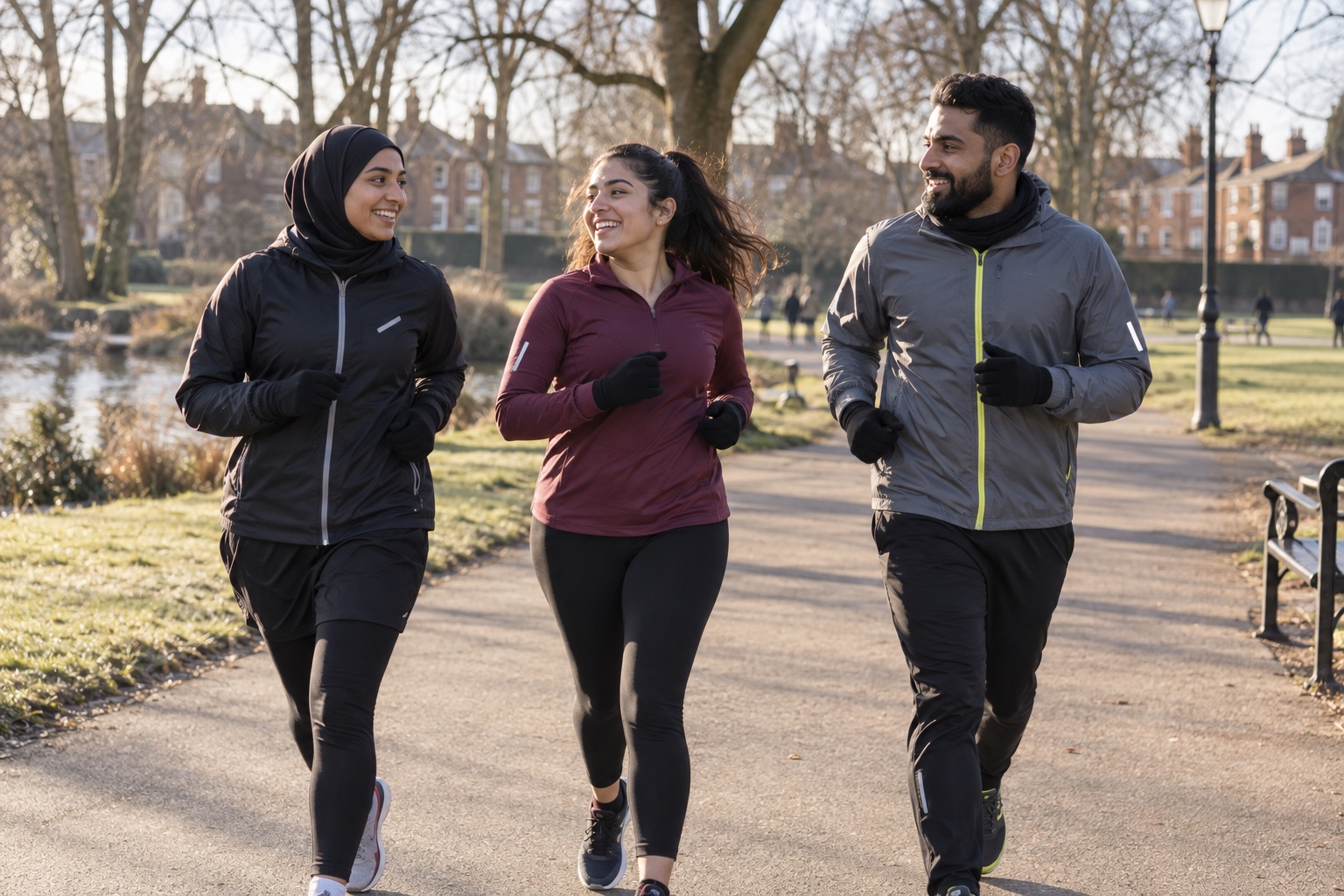
Plenty of British Pakistani runners start alone: early Maghrib in winter, a watch that only beeps for pace, and a sense that running clubs are for people who already know the route. Community is easier to find than the stereotype suggests, and winter training is less about heroics than about being seen, staying upright, and coming back next week. The image is an AI-generated illustration of a winter group run, not a photograph of a named club or event.
This is a discovery and winter-safety method. It does not rank clubs, invent race times, or diagnose injuries. For general adult activity framing, the NHS pages on physical activity guidelines for adults and running and aerobic exercises are useful public baselines. Your own health questions belong with a qualified professional.
Why winter is the real test
Summer group runs hide logistics problems. Winter reveals them: dark pavements, ice, prayer clocks colliding with rush hour, and relatives who think running in the rain is eccentric. If you can keep a modest winter pattern, summer will feel easy. If you only train in good weather, every January becomes a restart.
British Pakistani runners also navigate comments about modesty, safety, and “what will people say.” Choose companions and routes that reduce those frictions rather than arguing with every relative before each session. Visible reflective kit and lit main roads are practical answers. So is running with someone your household trusts.
Finding people without waiting for a perfect club
Begin with a discovery method, not a loyalty vow. The free Saturday morning parkrun network lists local 5k events across the UK. You register once, find a venue by place name, and turn up. Walking, jogging and volunteering all count. That first barcode scan is often enough to meet marshals and regulars who can point you toward midweek groups, women-only sessions, or mosque-adjacent fitness circles that never appear in glossy club marketing.
Also ask inside networks you already trust: workplace steps challenges, university alumni chats, local running groups tagged by borough, and friends who train for the same charity 10k. When you visit a group, notice whether start times respect prayer and family rhythms, whether routes feel safe after dark, and whether beginners are spoken to like guests. You are allowed to try two sessions and leave without a speech.
Community is the person who texts “icy on the canal path, use the main road” before your alarm goes off.
What “fits” for British Pakistani routines
Some runners need spaces where hijab, modest layers, or prayer timing are ordinary rather than explained each week. Others simply need a group that does not treat Ramadan, Eid, or wedding season as personal failure. Ask practical questions: Is there a slower pack? Are toilet stops possible near the route? Does anyone share lifts after dark? A club that photographs well but ignores those constraints will not keep you through February.
Women-only or women-led sessions matter for some households and are irrelevant for others. Do not assume one model. Find the room that matches your actual constraints, then judge it by whether you return.
Winter training that respects British pavements
- Light first. Dark commuting hours arrive early. Wear reflective detail on the moving parts (ankles, wrists) and carry a small light if shared paths lack streetlamps. Assume drivers have not seen you until they visibly adjust.
- Surface second. Black ice likes bridges, shaded corners and painted lines. Shorten the stride, keep the cadence quick, and choose gritted main paths over picturesque towpaths after freezing rain. A cancelled session is better than a wrist fracture before a family wedding season.
- Warmth without overheating. Layers you can unzip beat a single heavy top. Cover ears and hands. Cold fingers make kerbs feel farther away than they are.
- Fuel and prayer timing. If you train fasted or between Maghrib and Isha, plan water and a simple snack around the run rather than improvising dizziness on an empty dual carriageway.
Check local weather before you leave. The Met Office is a practical UK forecast source for ice, wind and rain warnings. Forecast apps are tools, not guarantees. If pavements shine, walk or move the session indoors.
Progress you can feel by March
Winter fitness for diaspora runners is often consistency under constraint: shorter loops, strength work in a kitchen doorway, and one parkrun a month that keeps the social thread warm. NHS activity guidance emphasises building movement you can sustain, including strength on at least two days for adults in the public guidelines linked above. Track how you felt on the coldest weeks, not only personal bests.
If pain alters your gait, stop and seek appropriate clinical advice rather than “running through” into spring. Social media running plans that ignore your sleep, commuting load, or Ramadan schedule are not authoritative. Consistency that keeps ankles intact beats a heroic December that ends in January physio queues.
| Winter constraint | Useful response | Poor response |
|---|---|---|
| Dark commute hours | Reflective kit; lit roads; shared location | Unlit canal towpath with both earbuds in |
| Ice warnings | Shorten stride or cancel; choose gritted paths | “Hero miles” on shiny painted crossings |
| Prayer and family timing | Choose groups that respect real clocks | Force a club culture that shames absence |
| Low motivation | Parkrun or one trusted text buddy | Buy more kit instead of finding people |
Ramadan, Eid and wedding-season interruptions
British Pakistani training years are full of calendar collisions. In Ramadan, some runners reduce intensity, shift sessions earlier or later, or replace hard efforts with walking and strength. That is judgment, not failure. Eid weeks and wedding seasons may pause racing goals entirely. A community that only celebrates unbroken streaks will not hold diaspora life.
Tell your group when you will be away. Ask for a slower rejoining pace afterward. Parkrun’s format (walk, jog, volunteer) is useful precisely because it allows re-entry without a fitness interrogation.
Strength and easy days without a gym membership
NHS adult activity guidance includes strength on at least two days as part of the public baseline linked above. Doorway rows with a resistance band, calf raises on a bottom step, and careful bodyweight squats can support running when ice cancels outdoor miles. Easy days are training. They are not moral weakness. Winter progress that ignores recovery usually ends in spring niggles.
Kit that earns its place in a UK winter
You need visibility, grip you trust on wet pavement, and layers you can remove when a hill warms you up. You do not need a full catalogue. Reflective detail can be as simple as bands and a light. Shoes should be ones you have already tested in daylight rain before you rely on them at 6 a.m. Cotton next to skin in freezing rain becomes a cold wet sheet; a simple technical base layer is usually more comfortable.
Carry a card or phone note with an emergency contact if you run alone. Tell someone your route. These are ordinary precautions, not paranoia.
From first parkrun to a midweek habit
Week one: find a parkrun, walk or jog it, speak to one marshal. Week two: repeat or try a midweek group once. Week three: add one short weekday loop on lit roads you know. Week four: decide whether the group fits prayer and family timing. That month is enough data. Buying a race entry before you have a sustainable weekday pattern usually produces guilt rather than fitness.
If anxiety about joining groups is the real blocker, volunteer at parkrun first. Many people find it easier to belong by handing out finish tokens than by lining up at the front of a pack.
Shared family calendars and training guilt
Wedding weekends, visiting relatives, and school-holiday childcare will interrupt plans. Write those interruptions into the month instead of treating them as moral failure. A winter that includes eight solid sessions and three family weeks is still a winter of training. Guilt is not a coach.
The point is not to look like a national-team montage. It is to know who would notice if you did not show up, and to arrive home with intact ankles when the pavement shines.
Sources and official profiles
Was this helpful?
Keep reading
Related stories
More from this desk, this beat, and the tags on this piece.

Running alone as a woman in Pakistani cities: practical safety planning
Sara Malik · 13 Sep 2026

Readers
The conversation
0 notes
Anyone can leave a note. Guests add a name and email — no account required, and the email is never published.
No notes yet. Yours would be the first.