Lala Rukh: drawing, sound, activism, and disciplined looking
How to look at Lala Rukh’s quiet drawings, sound-related works, and Women’s Action Forum posters held by The Met.
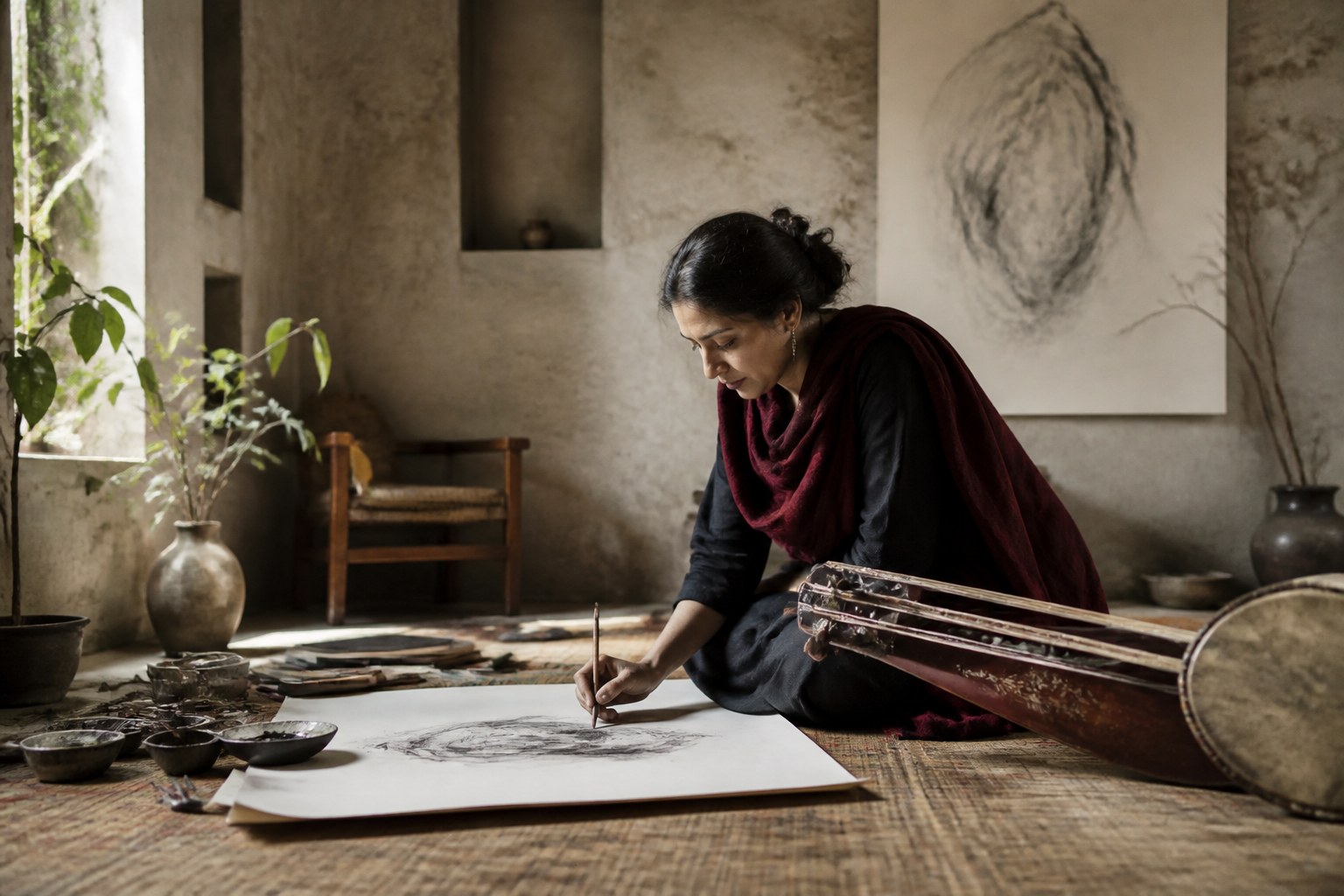
Lala Rukh’s work divides attention into two tempos that rarely share a wall in popular memory: the near-silence of a dark drawing that only yields a horizon after several minutes, and the blunt public speech of Women’s Action Forum posters made when commercial printers refused the job. Both belong to the same career. The Metropolitan Museum of Art’s 2020 acquisitions make that pairing available for study without forcing every quiet mark to become a slogan, or every poster to stand in for the whole studio practice.
How much time should a quiet artwork be allowed before we call it empty?
— PakStyles culture desk
What The Met actually acquired
According to The Met’s January 2020 press release, the museum purchased two major works with Tia Collection support: the collage series Mirror Image 1, 2, 3 (1997) and the digital animation Rupak (2016). The Estate of Lala Rukh additionally gifted six Women’s Action Forum posters. The Met described itself as the first United States museum to acquire her work. Those facts matter because search summaries often collapse the career into a single “activist artist” label and miss the media range the museum itself recorded.
Born in Lahore (1948–2017), Rukh earned an MFA from Punjab University and a second MFA from the University of Chicago in 1976. The Met notes that her time in the United States exposed her to practices associated with Robert Rauschenberg, John Baldessari, and Christo, as well as collaborative performance by Merce Cunningham and John Cage. She returned to Lahore in 1977, into an increasingly repressive climate for women under General Zia-ul-Haq, co-founded the Women’s Action Forum, and taught for roughly three decades at Punjab University and the National College of Arts. Biography here is chronology, not allegory. It explains access to experimental methods and the urgency of organising; it does not turn every later drawing into an illustration of either.
Grey Noise in Dubai has represented the estate in public communications around institutional placements. Estate stewardship is a circulation fact: it shapes which works enter museums and how they are photographed. It does not finish interpretation. Readers should still return to medium, date, and the specific political or musical problem a sheet addresses.
Mirror Image: blackening the circulating photograph
Mirror Image 1, 2, 3 responds to communal violence after the 1992 destruction of the Babri Masjid in Ayodhya and the riots that followed in cities including Mumbai, Dhaka, and Lahore. The Met’s account is specific about method: Rukh cut out newspaper images of riots and damage, blackened them with charcoal and related media until the photographs became abstracted, then attached them in pairs to sheets of grid paper. Obfuscation was not evasion. It was a reply to the propagandist force of images that travel widely while claiming to be neutral records.
Readers who only know Rukh through WAF graphics should sit with this collage logic. The newspaper is already a political object; charcoal on top of it is a second political act. Grid paper—normally a tool of measurement—becomes the ground for doubled, darkened evidence. When teaching or writing about the work, name the Babri aftermath as The Met does, and describe the physical steps. “About violence” is too vague a caption for a collage that refuses the newspaper’s original legibility.
Compare Mirror Image with later digital practices that also harvest news imagery. Rukh’s charcoal blackening is slower and more irreversible than a filter. The hand’s pressure remains visible as decision. That material difference is part of the argument about how images harm when they circulate without friction.
Rupak: drawing a seven-beat taal into animation
Rupak (2016), commissioned for Documenta 14 and described by The Met as Rukh’s final work, concentrates her long interest in Hindustani classical music. It is a stop-motion animation built on the seven-beat structure of the rupak taal. She collaborated with composer-musician Sunny Justin on a twelve-second tabla solo, then invented her own transcription method: over two months she drew and redrew the beats as dots on a grid, using the angled tip of a qalam—a dried reed pen associated with calligraphy. Eighty-eight drawings were scanned and animated so that the marks coalesce as a single white point moving rhythmically across the screen.
That process matters more than any soft metaphor about “music becoming art.” Duration, counting, and calligraphic tools are the real subjects. Sound here is not soundtrack decoration for a video; it is the score that generates the drawing system. Viewers who meet Rupak only as a looping file on a phone should ask what disappears without the Documenta context and without knowledge of the eighty-eight sheets behind the moving dot. Quiet work is labour-intensive work.
Hindustani classical music had informed drawings and teaching long before the animation. Rupak makes the relationship explicit by forcing drawing to obey a counted cycle. The seven-beat structure is not a decorative title; it is the work’s clock. Listeners familiar with tabla can test whether the visual rhythm matches the remembered taal; viewers without that training can still count and watch the dot’s return.
Posters when printers said no
The estate gift brings WAF graphics into the same institutional conversation. Collection records for works such as Masaawi Haqooq (1983–84), Ek Aurat, Ek Gawahi (1983), and Crimes against Women (1985) document screen-printed and related posters that call for equal rights and respond to evidentiary and media climates of the period. In an era when government-controlled printers refused WAF materials, Rukh’s decision to produce posters herself is part of the object history, not a side anecdote.
Masaawi Haqooq places a shackled woman in a burqa beside Urdu text demanding equal rights. Ek Aurat, Ek Gawahi turns legal language about testimony into graphic form, referencing evidentiary rules that required multiple male Muslim witnesses for certain cases. Crimes against Women aggregates newspaper reports so that volume itself becomes argument. Reproduce these works with captions that preserve Urdu text and legal context. Cropping for social media can erase the referent that made the urgency legible. Estate rights and accurate dating belong in any classroom handout.
Poster history and drawing history should be taught as parallel disciplines within one life, not as early politics and late aesthetics. The same person who screen-printed under constraint later spent months drawing tabla beats for Documenta. Continuity lives in discipline: attention to rhythm, refusal of easy legibility, and a belief that public speech and private looking can share a practice.
Drawing near the threshold of visibility
Alongside posters and collage, Rukh pursued drawings that reward changes in light and attention: sparse lines on dark fields, calligraphy-informed rhythms, series that approach the edge of what a photograph can capture. Reproduction often flattens those decisions into a uniform grey. The honest viewer’s question is not “What does the line symbolise?” but “What becomes visible only when I stay?” Disciplined looking is the work’s demand on the audience; it is also continuous with the same patience required to print a poster by hand when institutions refuse cooperation.
Quiet is not the opposite of politics. In a culture of constant messaging, an artwork that withholds slogan speed can still be political because it refuses the tempo of propaganda. That claim should be tested against specific sheets and installations, not asserted as a personality trait. Pair a near-threshold drawing with a WAF poster in a seminar and ask students to describe materials before ideologies. The career’s force is that both speeds belonged to one practice under pressure.
Gallery lighting can make or break these drawings. A phone flash may invent highlights the charcoal never offered. Prefer museum installation views and, where possible, in-person looking with time to let eyes adjust. Write down the first minute’s impression and the fifth minute’s correction; the gap is often the work.
Teaching, estate stewardship, and what not to invent
Thirty years of teaching in Lahore shaped publics that auction headlines rarely track. Institutional collections, Documenta records, and Met object pages allow the work to be dated across media. Estate and gallery placements into museums are circulation facts; they do not finish interpretation. Do not invent private motives, medical narratives, or relationship gossip. Do not treat Chicago training and Lahore return as a simple morality play. Experimental looking and feminist organising coexisted in one practice; the useful memorial is continued looking with sources open.
A workable dossier for editors and classrooms: The Met press release for acquisition facts; one poster collection page with medium and date; the Rupak process notes as The Met summarises them; and a dated note of when those pages were last checked. Corrections should cite a named work and an institutional URL. Unsupported superlatives—“the most important,” “the only”—age poorly and are rarely what the collection records themselves claim.
Allow the quiet work its time. Then let the posters remind you that the same disciplined attention knew how to speak in public when speech was costly. That is the reading The Met’s double acquisition makes possible, and it remains more useful than any single viral image of either tempo alone. For diaspora reading groups, assign the sources list first and the adjectives second. Argument without evidence is preference with better punctuation—and Lala Rukh’s career already supplies enough evidence to make preference unnecessary.
Sources and official profiles
Was this helpful?
Keep reading
Related stories
More from this desk, this beat, and the tags on this piece.
A nikah in England is not automatically a civil marriage: check the legal registration
Bilal Ahmed · 28 Oct 2026

Urdu and Panjabi in England and Wales: what Census 2021 language data shows
Bilal Ahmed · 28 Oct 2026
Walima explained: what the reception is for and why every family does it differently
Bilal Ahmed · 27 Oct 2026
Dholki, mayun and mehndi: why Pakistani pre-wedding events are not the same thing
Bilal Ahmed · 25 Oct 2026
NADRA Family Registration Certificate: what an FRC proves and what it does not
Bilal Ahmed · 22 Oct 2026
Readers
The conversation
0 notes
Anyone can leave a note. Guests add a name and email — no account required, and the email is never published.
No notes yet. Yours would be the first.