New Jersey / NYC masjid dinner culture for newcomers
Find and verify New Jersey and NYC masjid community dinners, learn newcomer etiquette, handle communal food safely, and volunteer usefully without an invented masjid shortlist.
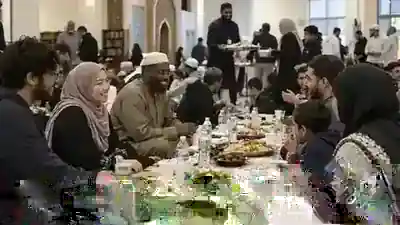
Moving to New Jersey or New York City with a Pakistani Muslim household often means the first community dinner arrives as a forwarded flyer, a WhatsApp screenshot, or a cousin’s confident directions that stop at “everyone knows that masjid.” Useful entry is quieter than that. It is a method for finding meals that are actually open to newcomers, checking that the invitation belongs to the institution it claims, and arriving ready to share space rather than perform belonging.
This is a field guide, not a directory. Masjid programmes change with the calendar, leadership, and building works. Any named shortlist would age badly and would invent authority PakStyles does not have. Treat every tip below as a way to verify locally. Food-safety notes reference public NYC guidance checked as general literacy around September 2026; they are not an inspection of any particular kitchen.

What masjid dinner culture usually means in this corridor
In the NJ–NYC corridor, dinners tied to a masjid might be a weekly free or donation-based meal, a Ramadan iftar open to the neighbourhood, a fundraising banquet with tickets, a youth-night pizza tray, or a one-off welcome for new families after Jummah. Some events are explicitly public. Others are for registered members, a language circle, or a women’s or men’s programme. The difference matters. A public iftar flyer is not the same invitation as a private fundraising dinner that happens to be held in a prayer hall.
Pakistani households are prominent in many of these rooms, but the room is rarely only Pakistani. You may hear Urdu, English, Arabic, Bangla, and Pashto in the same queue. Food may be Pakistani one week and deliberately mixed the next. Go for the hospitality and the people, not for a guarantee that the menu will match home.
How to find dinners without trusting a screenshot
- Start from the institution, not the meme. Search the masjid’s own website or the contact details published on a signboard you can physically see. Prefer an events page, newsletter signup, or phone number that lives on that domain over a third-party flyer with no source.
- Match names and addresses. Confirm that the ZIP code, street, and institution name on the post match the official site. Lookalike pages and recycled graphics are common before Ramadan and Eid.
- Check the date language carefully. “Every Friday” on an old PDF may no longer be true. Call or email the office listed on the official site and ask whether the meal is open to visitors that week.
- Use municipal and campus listings as secondary clues only. City community calendars, university MSA pages, and library boards sometimes repeat announcements. Still follow the trail back to the masjid’s own channel before you travel.
- Ask a living person one concrete question. “Is the Tuesday dinner open to newcomers, and do we enter through the main door or the basement?” is better than “Is there food somewhere?”
Food safety literacy for communal trays
Community kitchens vary in professionalism. You are a guest, not an inspector, but you can still use public literacy. New York City’s health department publishes food safety guidance for the public and a restaurant grades system for regulated food service establishments. A masjid meal is not always operating as a graded restaurant. Do not invent a grade for a volunteer kitchen. Do use ordinary habits: wash hands, be cautious with foods left long at room temperature, and follow any posted allergen notes. If someone in your household has a severe food allergy, ask the organisers how trays are labelled and whether shared utensils are used before you rely on the meal as their only dinner.
Bring a plan for leftovers. Hot food that sits in a car while you make three more stops is a food-safety problem. FSIS guidance on take-out foods is a practical baseline for how long perishable cooked food should sit unrefrigerated.
Etiquette that travels well on the first visit
Arrive in clothing appropriate to a prayer space even if the meal is in a basement hall. Follow the building’s shoe, gender-entrance, and photography rules without treating them as optional. Greet people, take the plate size that matches the remaining trays, and do not lecture volunteers about how your auntie would have seasoned the rice.
- Ask where newcomers should sit if the room is organised by families or language circles.
- Supervise children near serving lines and prayer areas.
- Donate if a box is present and you can; do not perform generosity loudly.
- Leave the serving table usable for the next person. Stack or dispose of plates as directed.
- If you take photos, ask before faces go on Instagram, especially of women and children.
Language anxiety is common. English is widely used in NJ and NYC masjid halls. Urdu may appear, but you will not fail the evening by speaking English clearly. A simple “Assalamu alaikum, we are new to the area” opens more doors than a performance of fluency you do not have.
Parking, transit, and timing reality
New Jersey lots fill early for popular iftars. NYC and PATH-adjacent buildings may depend on transit more than cars; check last-train timing before you promise elders a late stay. Build wudu and shoe-rack time into arrival. If you are coming from work in Manhattan to a New Jersey dinner, the map’s minutes are optimistic at 6 p.m.
Ramadan iftars versus weekly dinners
Ramadan compresses crowds, parking, and tempers. Go early if the door opens before Maghrib for seating, or arrive with a backup snack if the line is the event. Weekly off-season dinners are often calmer places to meet people and learn the building. Use Ramadan for worship and community spirit; use a quieter week to ask about youth programmes, Sunday schools, and who coordinates newcomer welcome.
Ticketed fundraising banquets are different again. Read what the ticket includes, whether childcare exists, and whether the dress code is formal. Do not show up to a gala with the assumptions of a free weekly tray dinner.
Volunteering without making yourself the main character
Useful volunteer offers are concrete: “I can chop onions from 5 to 6,” “I can run the drinks table,” “I can help stack chairs.” Vague offers (“tell me if you need anything”) are harder for stressed coordinators to use. Show up when you said you would. Follow food-handling instructions from whoever is responsible for the kitchen that night. If you are ill, stay home.
Do not use volunteering as a shortcut to critique the menu, the politics of the board, or another ethnicity’s spice level on night one. Belonging grows through reliability.
Bringing your own household constraints
If elders need chairs with backs, if a child has allergies, or if someone needs a quieter corner to eat, ask before the adhan rather than during the scramble for foam plates. If the answer is that the building cannot accommodate a need, thank them and plan a different evening rather than forcing a scene. Not every masjid dinner can be every family’s perfect table. That is not a moral failure. It is architecture and capacity.
| Signal | Treat as | Next step |
|---|---|---|
| Event on masjid’s own domain or answered by listed office | Stronger verification | Ask open-to-visitors question; plan travel |
| WhatsApp graphic with no matching official page | Unverified | Call, email, or visit office hours |
| Ticketed banquet language | Different event type | Read inclusions and dress code |
| Allergy uncertainty for a high-risk household member | Risk | Eat beforehand or skip trays that cannot be explained |
Newcomer dinner culture in New Jersey and New York City rewards people who verify, arrive courteously, and return as reliable neighbours. The flyer can start the search. The institution’s own channel should finish it.
Sources and official profiles
Was this helpful?
Keep reading
Related stories
More from this desk, this beat, and the tags on this piece.






Readers
The conversation
0 notes
Anyone can leave a note. Guests add a name and email — no account required, and the email is never published.
No notes yet. Yours would be the first.