Finding Pakistani barbers for textured hair in US cities
A discovery and briefing guide for finding barbers in US cities who can cut dense, textured South Asian hair: how to vet shops and ask for the cut, without a ranked list of names.
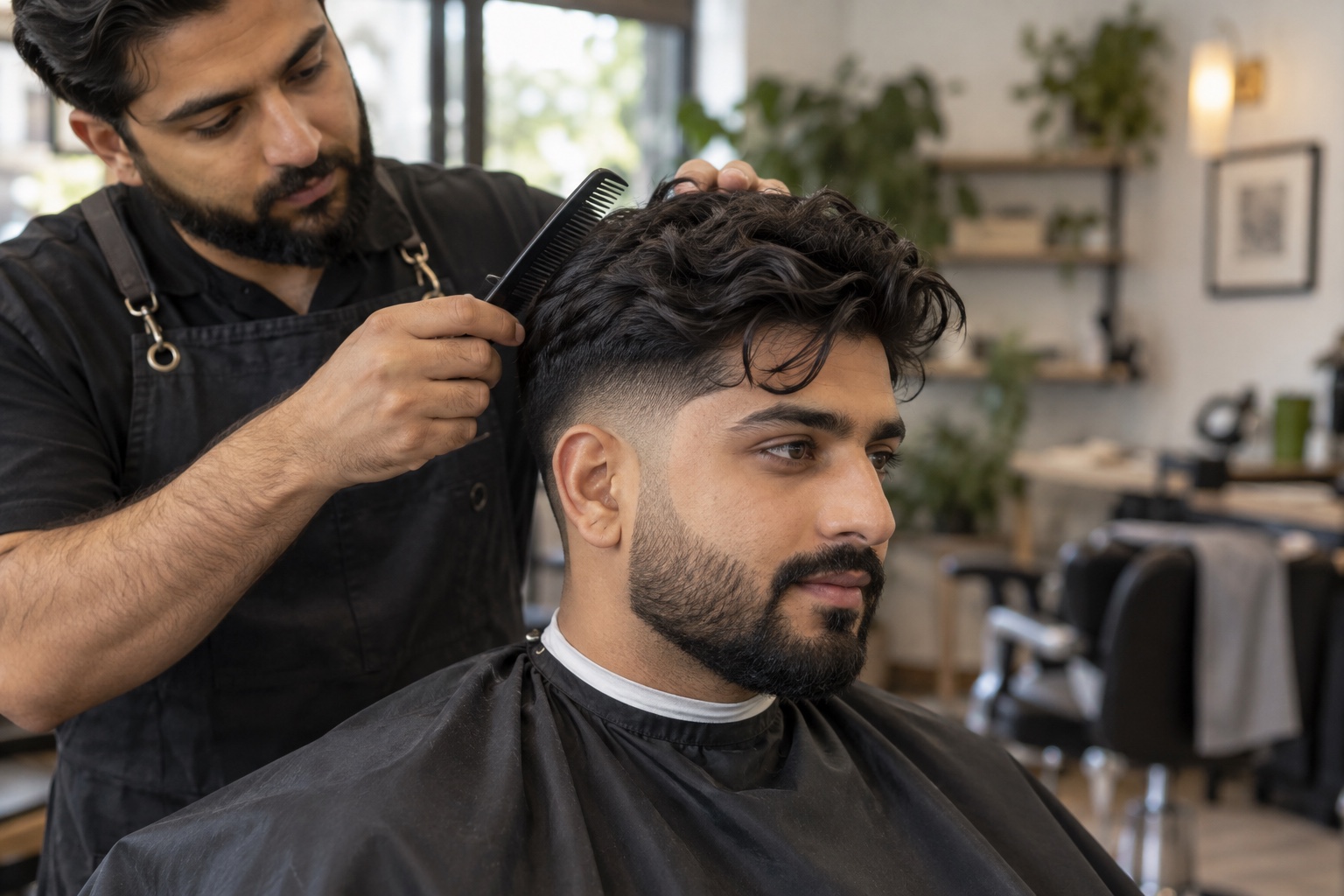
A bad US haircut on dense Pakistani or broader South Asian hair is rarely only “the fade was uneven.” More often the barber cut for hair that behaves differently when it dries: finer strands that stay where the clippers left them, less spring, less bulk at the crown. You leave looking sharp wet and mushroomed by dinner. This guide is about finding someone who already works that density, and briefing them so the chair is not a translation exercise. It is not a ranked shortlist of shops. Names age; your hair’s physics does not.
Pakistani hair is not one texture. Some men grow thick, nearly straight hair that stands when short; others wave or coil once length returns; many sit somewhere in between with a dense scalp that fights a blunt outline. Treat “textured” here as a working word for density, spring, and how much the dry shape differs from the wet one. It is not a claim that every barber of Pakistani origin cuts the same way, or that only Pakistani barbers can do the job.
What “textured” means in the chair, not on a poster
Before you search, name your own hair in three plain facts. Density is how much hair occupies the scalp, not how long it is. Spring is how much the strand lifts or waves once dry. Growth pattern is where cowlicks and crown swirls fight a hard outline. A barber who thrives on fine, limp hair can still be talented and still leave your crown looking swollen if they cut only to the wet silhouette.
Common South Asian patterns that change the brief:
- Dense and nearly straight when short: sides can look blocky if the outline is too blunt; the top needs length that still looks intentional after five days.
- Wavy once longer: wet length lies flatter than dry length; a “short on top” request can become a crop you did not mean.
- Coarser strand with volume at the crown: heavy thinning can leave holes; light texturising and a dry check matter more than a celebrity skin fade.
You do not need salon vocabulary to start. You do need a photo of your own head after a week of growth, not only a fresh salon selfie.
Where discovery actually happens
Start with people whose dry hair looks like yours after a week of growth, not with strangers’ “best barber in [city]” threads. Ask cousins, mosque WhatsApp groups, cricket teams, and coworkers for the barber’s full name or shop page, and for a recent photo of the asker’s own head, not a celebrity screenshot. A recommendation without a photo of that person’s density is half a tip.
When you open maps or booking apps, ignore star averages as a ranking. Use them as a lead generator, then verify:
- Recent client photos on the shop’s own profile. Prefer men with comparable density and similar length goals. A gallery full of skin fades on fine hair is a different craft than a mid fade on thick crown hair.
- Language that matches the work. Mentions of South Asian, Desi, Pakistani, Indian, or “thick hair” clients are signals, not guarantees. Call and ask who usually takes dense hair and how long the slot runs.
- Booking length honesty. If a shop only offers twenty-minute slots and your last good cut needed forty, you already know the mismatch.
- Product honesty. Ask what they finish with. A cut that only works under heavy pomade and shop lighting is a different product from a cut that still reads when your hair is dry at 8 a.m.
The phone call that saves the appointment
Before you book, send a short message or call with specifics. You are not asking for flattery; you are checking fit.
- Describe density in plain terms: “thick, dense hair that springs up when dry” or “wavy when longer, heavy at the crown.”
- Name the finish you want: low / mid / high fade, taper, or scissor-only sides; length on top in fingers or inches.
- Ask whether they texturise or thin for bulk, and whether they check the shape dry before you leave.
- Ask price and time for a first visit. A rushed first cut on unfamiliar hair is how you pay twice.
- Ask whether a walk-in first visit is wise, or whether a longer booked slot is safer for your density.
If the answer is vague (“we cut everything”) and they will not look at a photo, keep searching. Competence with dense hair is ordinary in many chairs; willingness to confirm it before you sit is the filter.
How to brief the cut once you are in the chair
Bring two or three reference photos of people with hair like yours, ideally after a week of growth, not only fresh from the salon. Say what you like in each photo (silhouette, fade height, fringe weight) and what you reject (skin fade, heavy fringe, too much thinning). Vague praise of a celebrity whose hair is finer than yours is how disappointments get scheduled.
Useful phrases that travel across shops:
- “Leave length on top for when it dries. It will sit shorter than it looks wet.”
- “Keep bulk off the sides without a hard shelf; blend into a [low/mid] fade / soft taper.”
- “If the top gets mushroom-heavy, thin lightly. Don’t carve chunks.”
- “I want it to still look intentional after five days, not only for tonight.”
- “Check the crown dry before we call it done.”
Guard numbers (a 1, 2, or 3 on the sides) help when both of you share that vocabulary; they are not universal poetry. Pair the number with where the fade or taper should start and how much top length you need dry. If English is shared but barbering slang is not, point to your own head zones and the photos. Silence while they cut is fine; stop them early if the wet shape already looks shorter than you meant.
Fades, tapers, and where dense hair usually goes wrong
A skin fade can look sharp on fine hair and severe on dense hair if the blend fights your growth pattern. Mid and low fades often forgive density better because they leave more room for the dry spring to settle. Soft tapers and scissor work on the sides can be the better answer when your crown fights a hard shelf.
Texturising is not the same as aggressive thinning. Light texturising removes bulk so the silhouette does not balloon; carving out chunks can leave bald-looking windows once the hair dries and separates. If a barber reaches for thinning shears immediately without asking how your hair behaves at day five, pause and restate the dry goal.
Wedding and event cuts deserve an earlier appointment than you think. Dense hair advertises growth quickly. Book far enough ahead that you can live with the week-one shape, not only the chair-exit selfie.
Aftercare is part of discovery
Judge the cut the next morning and again at day five. Dense hair advertises weight and growth patterns once product and shop lighting are gone. If the barber asked the right questions, checked dry shape, and the week holds, book the next slot before you forget the name. If the cut only works under their pomade and dies by Wednesday, that is data, not a personality verdict. You may need a different chair, a clearer brief, or both.
Between cuts, keep the brief notes you used. Density does not change because a new shop opened near campus. The next barber still needs the same three facts: how it springs dry, where bulk gathers, and how intentional you want day five to look.
PakStyles will not publish a rotating “top ten Desi barbers” for US cities. Shops move, chairs change, and a perfect fade for your cousin’s soft wave can still fail your crown. Discovery is local and personal: verify density match, brief in lengths and silhouettes, and keep the shops that still look right when your hair is dry and you are late for work.
Was this helpful?
Keep reading
Related stories
More from this desk, this beat, and the tags on this piece.
Readers
The conversation
0 notes
Anyone can leave a note. Guests add a name and email — no account required, and the email is never published.
No notes yet. Yours would be the first.