US apartment laundry days when shalwar kameez fills the basket
How US apartment laundry works when shalwar kameez, dupattas and office wear share one basket: care-label sorting, embroidery protection, machine timing and dryer decisions.
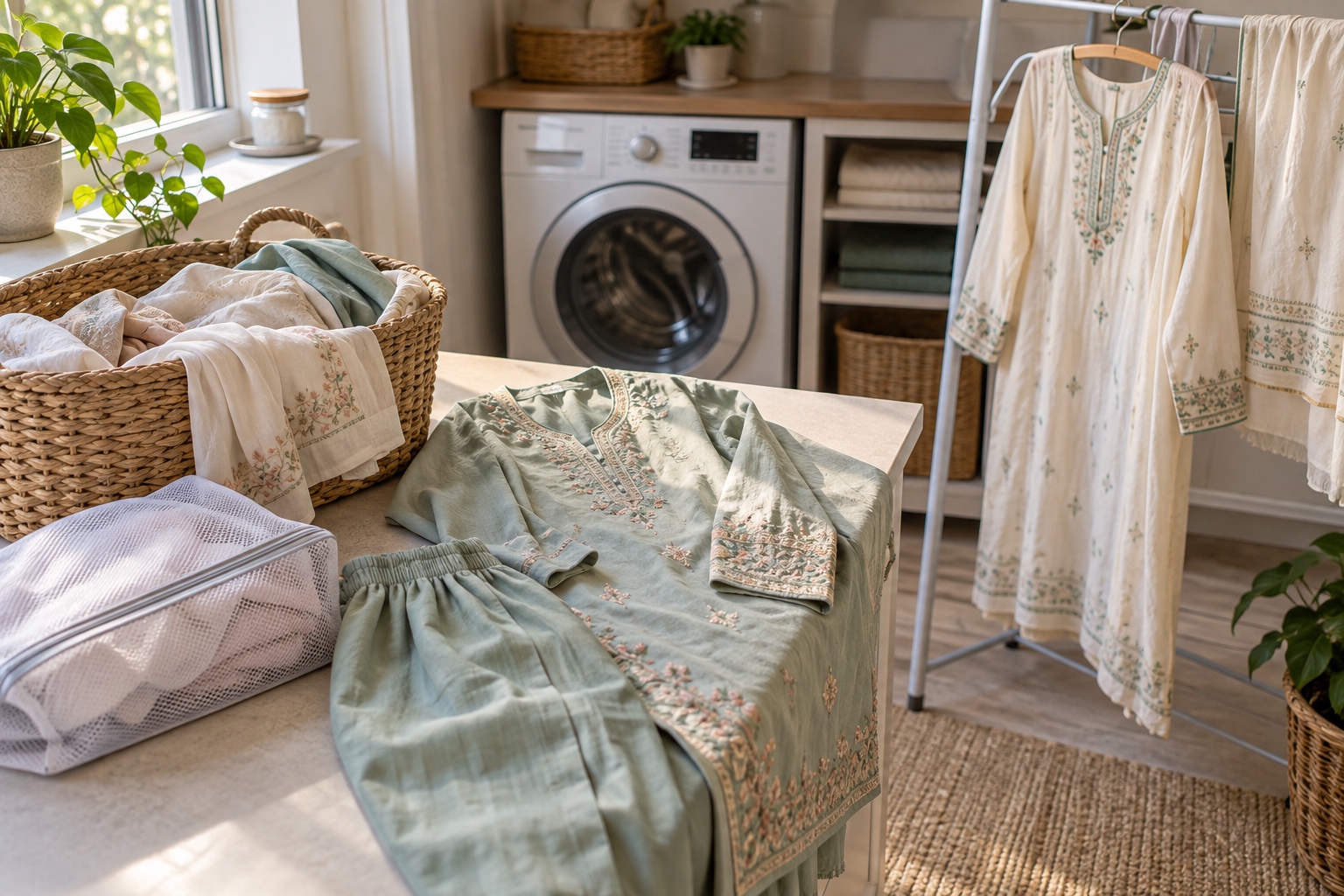
A US apartment laundry room does not care that Eid week, two office kurtas, and a child's school uniforms landed in the same hamper. It cares about machine time, detergent spills, and whether your delicates cycle is still spinning when the next resident's shift ends. When shalwar kameez fills the basket, the problem is logistics first and fabric second: sort by care truth, protect embroidery, and leave the room usable for everyone else.
Care-label context below draws on the FTC's public explanation of the Care Labeling Rule: the reason US garments carry washing or drycleaning instructions in the first place. Related FTC materials such as the Care Labeling Rule business guidance explain why those labels exist. Labels are your primary instructions; this article helps you plan a shared-laundry day around them. It is not a product ranking and not a substitute for what a particular garment's label says.
Sort the basket like a triage desk
Make four piles before you leave the apartment: (1) machine-wash cold, gentle (most cotton lawn and many everyday shalwars); (2) hand-wash or mesh-bag only (chiffon dupattas, heavy embroidery, anything with mirror work or loose zari); (3) dark office separates that can share a normal cycle with jeans; (4) dry-clean only or “do not wash” pieces that should not enter the apartment machines at all. Read the sewn-in label on each kameez; South Asian suits sold for the US market should carry care instructions, but older imported pieces sometimes arrive with faded or missing tags. When the tag is gone, default to the gentlest method you are willing to risk, not the fastest.
Turn garments inside out. Close hooks and zippers. Drop sequinned or heavily embroidered panels into zippered mesh bags so they do not hook a neighbour's hoodie in a shared machine. Wash pale lawn away from new black jeans; dye bleed ruins more Eid outfits than poor stitching ever will.
Time the machines as if someone is waiting
Check building rules for hours, dye restrictions, and whether you must stay with your load. Book or claim one washer for the gentle pile and, only if a second machine is free, a normal cycle for towels or darks. Do not colonise every drum “because wedding clothes.” Set a phone timer for two minutes before the cycle ends so wet shalwars do not sit sour in a locked drum while you answer email upstairs.
Move finished loads promptly into baskets, not onto every folding table. Wipe detergent drips. If the dryer is shared, remove your items when the buzz ends; a forgotten load is how laundry rooms acquire building-wide grudges.
If your building uses paid cards or apps, keep enough balance for a second wash if a dye bleed forces a rewash. Standing empty-handed at a locked machine mid-cycle is a bad time to discover the card is empty.
Dry with the fabric's future in mind
Many lawn and viscose blends survive a cool wash and then die in a hot dryer (they shrink, dull, or cook the embroidery backing). When the label allows tumble drying, use low heat and pull pieces while slightly damp to hang-finish. When the label says line dry or dry flat, believe it: drape kameez over a shower rod with a towel underneath for drips, reshape shalwar waists before they dry crooked, and keep sequinned yokes flat rather than pegged by one shoulder.
Iron or steam only after you check fibre and embellishment. A hot iron on synthetic zari can glaze or melt; a press cloth and lower heat are cheaper than a new suit. Hang finished outfits with space between hangers so damp hems do not transfer colour onto the next garment in a tight closet.
Dupattas, nets, and the mesh-bag discipline
Chiffon and net dupattas wrap around agitators and zippers. Mesh bags are not optional for them in shared machines. Wash pale dupattas alone or with other pales. Do not toss a red georgette with a white cotton shalwar and hope. If hand-washing in the bathtub, rinse until the water runs clear, then press in a towel before hanging; wringing twists and warps bias edges.
Embroidered panels appreciate short gentle cycles and no high-heat dryers. Mirror work can crack under heat and abrasion. When in doubt, mesh bag and air dry.
Stain triage for turmeric, oil, and makeup
Turmeric and oil are the recurring villains on pale lawn. Blot oil; do not rub. Pre-treat with a method safe for the fibre and colour before the machine cycle. Makeup on hijab edges and kameez collars needs gentle point treatment; a full hot wash “to be sure” is how colours migrate. When the care label says cold, stay cold.
Blood, henna, and grass stains from events each need different first responses. If you do not know the fibre, test any treatment on an inside seam. Guessing with bleach on unknown South Asian blends is how heirloom pieces retire early.
Apartment constraints: racks, humidity, and neighbours
Over-door racks and collapsible frames make Eid weeks possible without monopolising the building dryer. Place racks where drips will not ruin flooring or bother downstairs neighbours. Run a fan if humidity climbs; damp clothes in a sealed studio breed mildew smells that cling to lawn fabric.
Do not hang dripping kameez over shared hallway rails. Building management notices, and so do people who brush past wet hems on their way to work. Dry inside your unit or in approved laundry-room racks only. High heat plus sequins is how plastic embellishment warps; keep embroidered kameez out of hot shared dryers when the label says line dry.
A weekly rhythm that prevents Eid panics
Wash everyday cotton shalwars on a fixed weekday so the hamper never becomes a mountain of mixed embellishment. Keep dry-clean pieces in a separate bag by the door so they do not accidentally enter a hot wash during a rushed Sunday. After events, treat stains early with methods safe for the fibre; set turmeric and oil stains become permanent narratives on pale lawn.
Do not pack slightly damp outfits into suitcases or sealed bags. Mildew smells cling to lawn. Button or loosely fold garments to reduce crease lines across embroidery. Rotate seasonal Eid pieces so they are not crushed at the back of a small closet for eleven months.
A laundry day that clears a shalwar-heavy basket is successful when the clothes keep their shape, the labels were obeyed, and the next resident finds empty machines and a clean folding table. That is apartment courtesy wearing diaspora fabric.
When the building has only one machine and Eid is tomorrow
Prioritise: (1) outfits needed in twenty-four hours, (2) pale lawn that cannot wait beside turmeric stains, (3) everything else. Hand-wash the urgent embroidered pieces in the bathtub while the machine runs cottons. Do not start three delicates cycles that block neighbours overnight.
Message the building group if your culture's festival week is coming and loads will spike. Courtesy announcements reduce note-wars. Offer to swap a machine slot with someone who works nights. Shared laundry is a commons; festival weeks test whether residents remember that.
Children's shalwars, school uniforms, and mixed hampers
Children's cotton shalwars can often share a normal cold cycle with other darks once you check for drawstrings that tangle. Remove belts and loose izarbands before the wash. School uniforms with logos may have different care needs than lawn kameez; keep them in the triage pile that matches their labels, not the pile that matches their cultural origin.
Teach older children to turn garments inside out and to place mesh bags correctly. Shared laundry rooms run smoother when teenagers can complete a load without calling upstairs mid-cycle. Post a one-page household sort chart inside the closet door: pale lawn, embroidery, darks, dry-clean. Charts beat arguments at 9 p.m.
If a machine eats a drawstring, stop the cycle if safe to do so and free the tangle before the next spin. Forcing a jammed drum breaks more than one family's patience. Report broken machines promptly so the building can service them before Eid week arrives.
Sources and official profiles
Was this helpful?
Keep reading
Related stories
More from this desk, this beat, and the tags on this piece.
Moving from Pakistan to the UK: what household items are worth bringing
Rabia Kamal · 13 Sep 2026
How to display Pakistani art without turning the room into a souvenir shop
Rabia Kamal · 13 Sep 2026
Readers
The conversation
0 notes
Anyone can leave a note. Guests add a name and email — no account required, and the email is never published.
No notes yet. Yours would be the first.