Bridal
Mehndi artist booking guide for UK and US brides
Compare mehndi artists by healed stain, coverage, timing, paste ingredients, and written UK/US contracts—not social-media style labels.
By Ayesha Khan
Editor-in-chief
8 min read
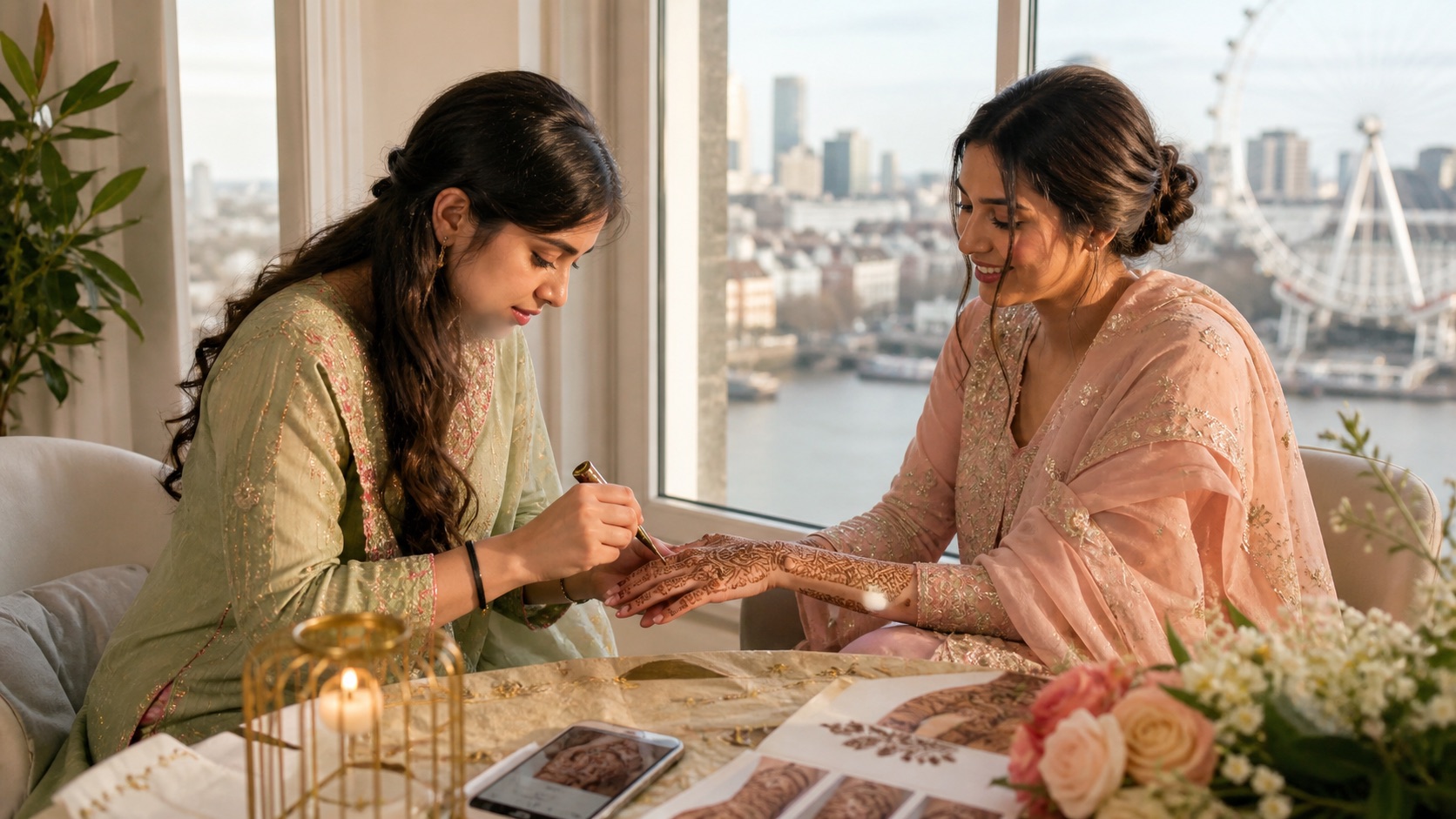
A mehndi artist’s most spectacular photograph is not necessarily the most useful one when you are deciding whom to trust with your wedding hands. The photograph may show fresh paste rather than the stain, crop out uneven fingertips, or represent six hours of work when your schedule allows three. Begin somewhere less glamorous: picture the moment you need to be finished. Your hands are decorated, the photographer is waiting, and you still need to eat, rest, and protect the paste. Work backwards from there.
The right artist is not simply the person whose “style” you like. It is someone whose actual work suits your requested coverage, whose process fits the day, whose paste ingredients are clearly explained, and whose agreement still makes sense if travel or timing changes.
Read a portfolio from paste to finished stain
Look for recent examples at the coverage you intend to book. A wrist design cannot tell you how an artist handles a dense bridal forearm; one immaculate palm cannot show whether both hands feel balanced together. Zoom in on turns around fingers and wrists, transitions between dense and open areas, and whether fine lines remain legible rather than merging into a dark block.
Then ask to see healed stain photographs, ideally taken in ordinary light and labelled with the day after application. Henna stain develops after the dried paste comes away, so a photograph of wet paste demonstrates application but not the final colour. Skin, aftercare, and body chemistry vary, which means no responsible artist can promise one identical shade on every client. They should, however, be able to explain their paste, preparation, and aftercare without guaranteeing an impossible result.
Do not reduce all of this to a label such as “Arabic”, “Indian”, or “Pakistani”. Those names are used loosely online. Show the visual decisions you care about: generous negative space, architectural geometry, jaali-like pattern, floral density, figurative storytelling, matched hands, or deliberate asymmetry. Ask which examples in their own portfolio are closest. You are hiring the hand visible in that portfolio, not a search tag.
Time the work, not just the ceremony
Your enquiry should produce an estimated application window, not merely an arrival time. Coverage and intricacy affect duration, as do breaks, photography, conversation, and guests asking questions. For guest mehndi, ask how many simple designs the artist normally completes in an hour and what that estimate assumes. A party of forty cannot be planned from a photograph of one full bridal hand.
- Choose the finish time first. Leave space after the appointment for the paste to remain undisturbed; do not place a tight beauty, dressing, or dinner commitment immediately afterwards.
- Separate bridal and guest service. Agree design size, service period, queue method, and hard stopping time. Ask whether a second artist is needed.
- Protect the room. Supportive chair, table, good light, comfortable temperature, quiet working area. Confirm parking, stairs, venue access, and who will meet the artist.
- Plan for delay in writing. Decide what happens if the artist, client, or venue runs late, and whether overtime is available or chargeable.
Several established artists publish booking windows, deposits, travel fees, and timing estimates on their own sites, but terms differ. Henna by Ria describes pricing by complexity and publishes an indicative party-design pace; Nisha Mehndi’s UK terms address travel, parking, and backup arrangements. Treat these as examples of details a professional may define—not universal rules. Read the terms for the artist you are actually hiring.
UK and US logistics that change the quote
In the UK, parking, congestion charges, train times and venue loading bays can matter as much as the design hour. Ask whether the artist prices Greater London differently from outside the M25, and whether hotel appointments need a contact on the door. In the US, tolls, long suburban drives, airport hotels and tip expectations (where relevant to the artist’s published policy) can shift a mobile booking. Neither country has one standard mehndi contract—compare written scope.
Time zones and family WhatsApp pressure are not the artist’s scheduling system. Send one consolidated brief from the decision-maker. If aunties will add guests on the day, either budget a second artist or accept that bridal coverage will shrink.
The ingredient question is a safety question
Ask for a complete ingredient list and whether the paste is mixed fresh by the artist or supplied by somebody else. Natural henna paste is not black. The US Food and Drug Administration warns that products sold as “black henna” may contain para-phenylenediamine (PPD), which can cause dangerous skin reactions; the FDA also says PPD is not permitted in cosmetics intended for application to skin in the United States. The NHS warns that a previous black-henna reaction can increase the risk of reacting to PPD hair dye.
A vague assurance that a paste is “organic” or “chemical-free” is not an ingredient list. If an artist will not tell you what touches your skin, do not negotiate yourself out of that concern. Anyone with a history of reactions, a skin condition, pregnancy-related concerns, or other medical questions should discuss their own circumstances with an appropriate clinician rather than rely on a wedding supplier or a general article.
Patch tests and what they can (and cannot) prove
Some artists offer a small test stain days before the event. A clear test lowers risk; it does not guarantee zero reaction under stress, heat or different body sites. If you test, use the same paste batch plan the artist intends for the wedding, and photograph any reaction for your clinician. Never “blacken” a stain with hair dye or unknown oils because a relative wants a darker Instagram colour.
What the quotation should settle
Compare written scope, not headline price. The quotation should identify the artist who will attend, coverage, anticipated duration, location, travel and parking charges, deposit, balance date, cancellation or postponement terms, overtime, guest work, and any assistant. Ask what happens if the named artist becomes ill or cannot travel. “We will find someone” is not a complete backup policy. You need to know whether a substitute would be discussed with you, whether that person’s portfolio is available, and whether you may instead receive a refund under the written terms. Settle photography consent before the camera is pointed at you.
“Could you quote for both hands, palms and backs, extending approximately 8 cm above the wrist, plus feet to the ankles? I need to finish by 6 pm at [postcode/ZIP]. I like the open spacing in reference one and the fingertip treatment in reference two, but I do not want figurative elements. Please include the estimated application time, paste ingredients, travel, deposit, cancellation, and backup terms.”
— A useful first enquiry
Aftercare that protects the booking you just made
Agree aftercare in plain language: how long paste should stay on, whether a sealant is used, what to avoid (water, gym, tight jewellery) in the first hours, and when the stain typically deepens. Build that timeline into the wedding day so a makeup slot or outdoor shoot does not destroy the work. Keep lemon-sugar home remedies and mystery oils out of the plan unless the artist specifically recommends a product they trust—random advice from a group chat is how stains blotch.
- You have seen recent work at comparable coverage, including healed stain where available.
- The named artist—not merely a studio account—is identified.
- The finish time and estimated duration work with the rest of the day.
- Paste ingredients are specific; no “black henna” or PPD product will be used.
- Travel, parking or tolls, overtime, cancellation, postponement, and backup arrangements are written down.
- Guest numbers match a realistic designs-per-hour plan.
- Photography consent is understood; you have kept the signed agreement and payment record.
A strong booking should make you more relaxed, not merely more impressed. Specific experiences—good or bad, without speculation about motives—help the next reader prepare a better brief. For another example of a professional contact page that sets expectations clearly, see Henna Ni Art’s contact information—again as a specimen of clarity, not as a universal booking recommendation.
Sources and official profiles
Filed under
Keep reading
Related stories
More from this desk, this beat, and the tags on this piece.
Pakistani wedding-dress alterations: the final six-week timeline
Zainab Noor · 13 Sep 2026 · 17 min
Bridal blouse fitting: neckline, sleeves, support and movement
Zainab Noor · 13 Sep 2026 · 15 min
Double dupatta bridal styling without doubling the discomfort
Zainab Noor · 13 Sep 2026 · 15 min
Nikah dupatta guide: coverage, pins, weight and photographs
Zainab Noor · 13 Sep 2026 · 16 min
Readers
The conversation
0 notes
Anyone can leave a note. Guests add a name and email — no account required, and the email is never published.
No notes yet. Yours would be the first.