What to wear to a Pakistani nikah as a guest
A nikah guest guide built around place, time and participation - not a list of supposedly compulsory colours.
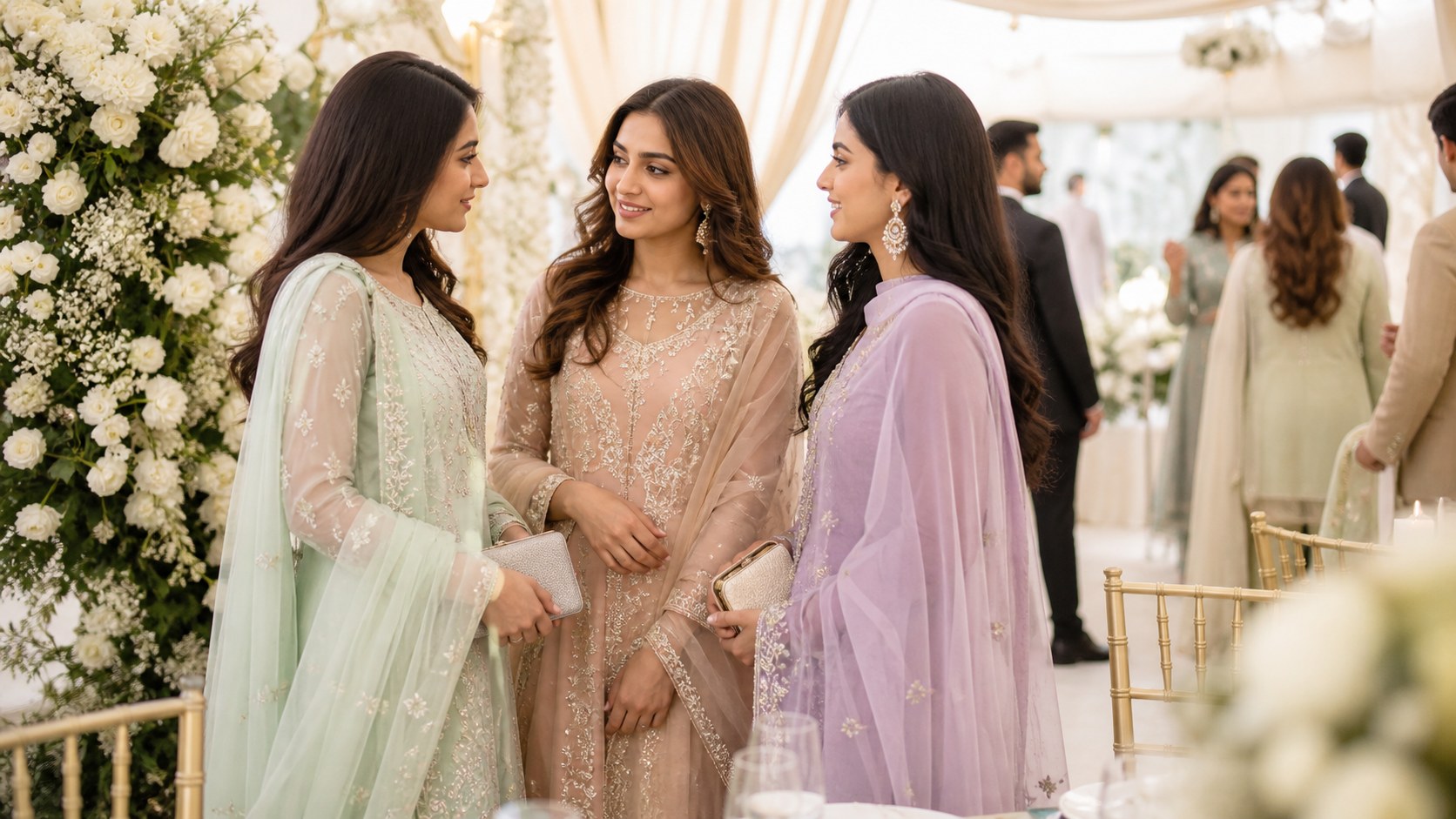
A nikah can take ten quiet minutes in a family sitting room or become the centre of a formal reception. The invitation gives you the event name; it does not automatically give you the dress code. Before buying anything, find out where the ceremony happens, what time guests arrive, whether shoes come off, whether a head covering is expected or preferred in that space, and whether the same outfit must carry you into dinner.
That sequence matters more than any list of supposedly compulsory colours. A mosque nikah, a home nikah and a hotel ballroom nikah ask different things of sleeves, hems, jewellery noise and bag size.
Dress for the room you will enter
For a mosque or dedicated prayer room, bring a clean, easy head covering if you expect or prefer to cover, and choose sleeves, neckline and hem that remain comfortable while sitting and removing shoes. Avoid trailing hems that collect carpet dust and then travel onto prayer textiles. Choose footwear you can remove and find again without a struggle in a crowd.
At home, avoid a train or stiff skirt that occupies the family’s walking space. Doorways, sofas and a temporary ceremony corner need circulation. A hotel nikah can support more structure, but check whether the ceremony itself is in a smaller prayer room before the doors open into a reception. The outfit may need to do quiet ceremony work first and reception work later.
| Setting | Priorities | Usually leave behind |
|---|---|---|
| Mosque / prayer room | Easy coverage, removable shoes, quiet jewellery, modest hem control | Trails, loud bangles, insecure heels |
| Family home | Seated comfort, washable fabric, small footprint | Ballroom volume, fragile embellishment near food |
| Hotel ceremony room | Polished tailoring, photograph-ready fabric, adaptable layer | Assuming the dress code equals black-tie sparkle |
Daylight, evening and the myth of forbidden colours
Daylight rewards texture and careful tailoring: ivory raw silk, a printed organza dupatta, soft sage, powder blue or a gently coloured gharara can feel celebratory without competing with the couple. Evening allows deeper colour and more reflective work. There is no universal ban on red, white or black across all Pakistani nikahs. Family preference, regional practice and the couple’s own request matter more than an internet rule.
If the invitation is ambiguous, ask the host. A thirty-second message prevents both under-dressing and accidental bridal mirroring. For mixed guest lists, explain the setting in functional terms to friends unfamiliar with nikah dress: “seated ceremony, shoes off, quieter jewellery” is clearer than “wear desi formal.”
Run the outfit through the ceremony
- Can you sit without the neckline or waist needing adjustment?
- Can footwear be removed and recovered easily?
- Will bangles or a bag make noise during recitation?
- Can you greet elders and appear in photographs without managing the dupatta every few seconds?
- If you will sign as a witness or help with logistics, can your hands work freely?
Polish comes from editing. If the fabric is heavily worked, let jewellery become quieter. If the silhouette is simple, one pair of memorable earrings may be enough. A nikah is not the place to debut an untested farshi hem or a first-time head-drape that requires both hands.
Coverage, agency and avoiding surveillance dressing
Modest dressing at a nikah should be treated as practical respect for the room and as personal agency, not as a public exam. Opacity needs checking in daylight with the intended underlayer. Side slits need enough ease and an underlayer that remains covered when you sit. A dupatta used for head coverage needs stable weight distribution so it does not become a constant correction.
Do not invent stricter rules than the hosts have indicated. Equally, do not treat a mosque space like a club entrance. The useful middle is clothes that let you participate attentively.
Men’s nikah guest notes
A clean, well-fitted kurta and trouser, sometimes with a waistcoat, covers many daytime nikahs. Save heavier sherwani language for baraat unless the hosts have set a more formal tone. Shoulder fit, sleeve length and shoe condition still read clearly in close seating. Strong cologne in a small room is a guest problem, not a signature.
When nikah and reception share one outfit
Many diaspora schedules attach dinner to the nikah. In that case, choose a base that can intensify rather than a full reception look that feels theatrical during recitation. A refined suit with a quieter dupatta for the ceremony can gain a more decorative dupatta, a jacket or stronger jewellery afterward if the room changes. Plan the change for a private corner, and keep the second pieces few.
If elders will be photographed with you, test seated postures. Low sofas and floor cushions expose different fit issues than banquet chairs. Bring a light shawl if air-conditioning is likely after outdoor arrivals.
Photography, privacy and phones
Nikah rooms are often intimate. Avoid blocking the ceremony with a raised phone. Dress in a way that does not require a friend to arrange you every time a camera appears. If you prefer not to be posted, say so to the people most likely to film; clothing cannot solve consent, but a complicated outfit can make you more dependent on other people’s hands and cameras.
A calm nikah packing list
- Head covering already steamed and practised, if needed.
- Shoes that remove cleanly; optional socks or footies if the floor will be cold.
- Quiet jewellery; spare backs and one safety pin.
- A bag small enough for a seated room.
- A layer for cold lobbies between car and ceremony.
The best nikah guest outfit lets you listen, greet and sit without becoming the event’s wardrobe subplot. Intention beats volume. If the clothes support attention rather than demand it, you have dressed for the ceremony you were invited to, not for a different party with the same name.
Fabric, noise and the small-room test
Nikah rooms amplify sound. Metal bangles, coin-edged dupattas and hard-heeled shoes become part of the acoustic environment. Soft soles, fewer bracelets and a dupatta without loud embellishment edges are practical courtesies. Softly textured fabrics - raw silk, fine cotton, controlled organza - read well in daylight without demanding glitter.
Do a small-room test at home: sit on a dining chair for ten minutes in the full outfit, turn to speak to someone on both sides, and stand without using your hands to fix the neckline. If you need both hands to rise modestly, the cut needs more ease or a longer kameez.
Witnesses, helpers and working hands
If you may be asked to witness documents, hold flowers, manage an elder or handle a phone for the family, keep at least one hand free and avoid rings that obstruct writing. A beautiful hath phool can wait for baraat. Ceremony logistics are part of guest dress when you are close family.
Travel between home and venue can include cold car parks and warm rooms. A light shawl that matches the outfit prevents the visual rupture of a sports coat over formalwear. Steam the outfit after travel; nikah photographs are often close and unforgiving of suitcase creases across the chest.
After the vows
Congratulations come in waves. Choose jewellery that survives hugs. Keep a tissue and a spare pin in the bag. If dinner follows, eat before adjusting a complicated drape near shared dishes. The ceremony’s dignity is not preserved by severity; it is preserved by clothes that allow attention. Dress so you can give it.
When in doubt, prefer a cleaner silhouette, verified coverage for the actual room, and one considered accessory. That combination outranks a trend colour justified by a thread you cannot verify.
Regional and family variation without panic
Urdu-speaking, Punjabi, Pathan, Sindhi, diaspora British and American families do not share one nikah dress script. Some homes treat the nikah as intimate and soft; others stage it as the public emotional centre. Listen to the hosts you know rather than averaging strangers online. If two relatives give contradictory colour advice, ask the person named on the invitation.
A useful default for uncertain guests is polished daytime formal with adaptable coverage: sleeves, opaque fabric, a dupatta that can move to the head if needed, and jewellery that can be reduced. You can always add a statement earring later; you cannot easily subtract a theatrical trail once you are seated in the front row.
End with courtesy. Arrive on time if the ceremony window is short. Keep conversations soft near the signing table. Dress is only one part of being a good nikah guest; attention is the rest.
If you are buying new for the nikah alone, prefer a piece that can reappear at Eid or a later dinner. Guest clothing that only works for one quiet hour is expensive symbolism. A well-cut classic set with a ceremony-specific dupatta usually earns its keep longer than a trend colour with nowhere else to go.
If relatives join by video, check neckline and earrings on camera without compromising room respect. Secure jewellery and a hug-proof drape matter.
Keep a short written brief before the next purchase: setting, movement, garments already owned, and the single addition that unlocks the most combinations. Test sitting and walking, then stop adjusting at the door.
Filed under
Was this helpful?
Keep reading
Related stories
More from this desk, this beat, and the tags on this piece.
Pakistani plus-size occasionwear: fit questions shops should answer
Ayesha Khan · 31 Jan 2026
Readers
The conversation
0 notes
Anyone can leave a note. Guests add a name and email — no account required, and the email is never published.
No notes yet. Yours would be the first.