· Updated
Karachi by the sea: Hawke's Bay to Sandspit
Karachi’s public shoreline from Hawke’s Bay toward Sandspit: timing, manners with working crews, turtles and camels, rubbish, and city safety sense.
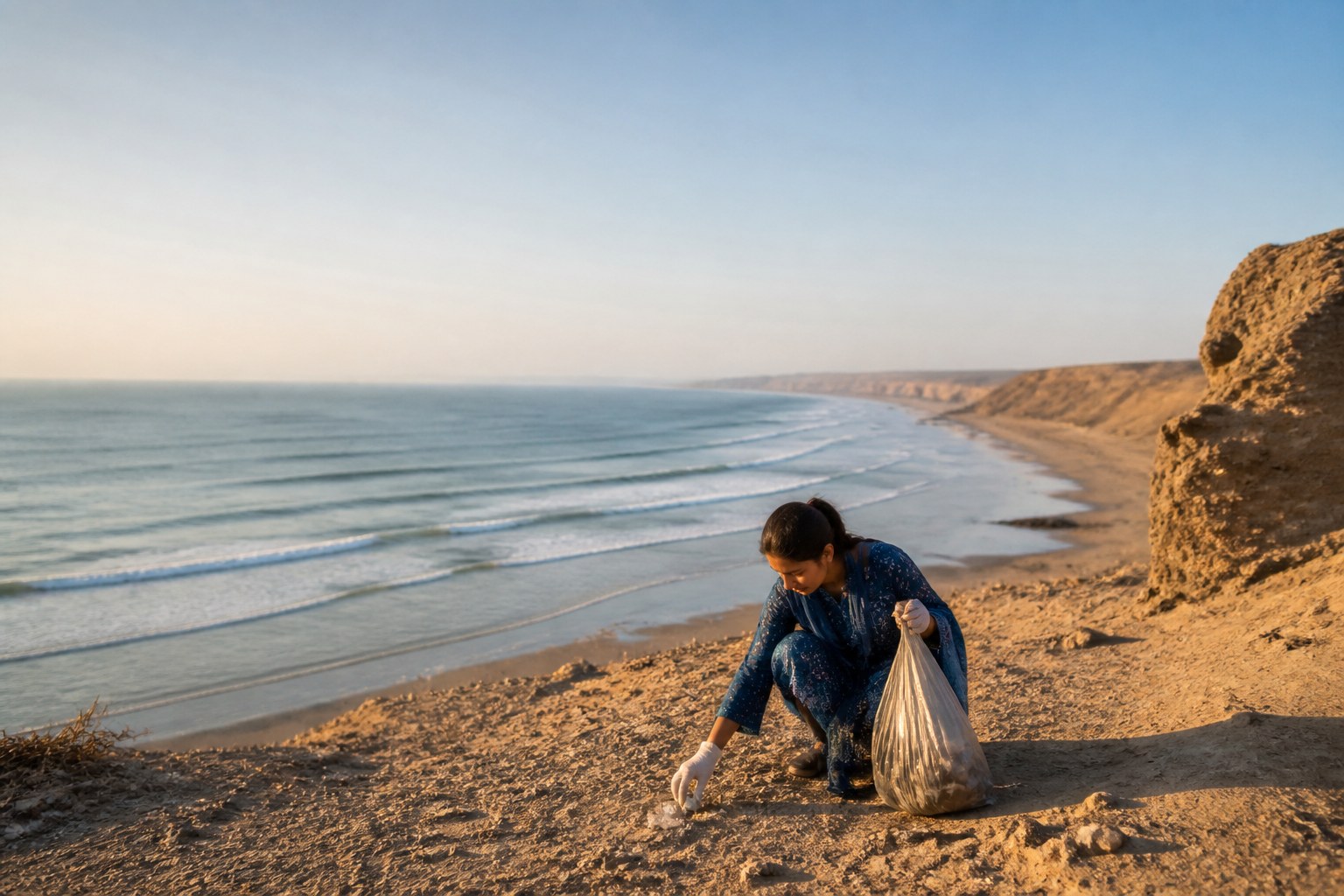
Karachi’s sea is not a holiday brochure. It is a working edge of the city: fishermen, camel men, families who drove out after asr with a mat and a thermos, and a wind that argues with whatever you planned to wear. Hawke’s Bay to Sandspit is the stretch people mean when they say they went to the beach and mean it.
It is not clean in the postcard sense. It is used. That is the more useful fact.
City safety is part of a sea day
Read current FCDO Pakistan travel advice if you are travelling on a foreign passport or advising someone who is. FCDO notes that Karachi’s daily safety can be unpredictable, with risks including armed robbery and disruption from strikes, and it flags particular vigilance in named districts with higher historical violence. Plan the drive, tell someone your timing, and be ready to cancel if local contacts advise it.
Residents already practise route timing and neighbourhood knowledge. Visitors should not treat a beach afternoon as an exemption from urban caution.
A shore, not a set
The drive from the city is part of the piece: billboards, dust, then a turning that smells of salt. Hawke’s Bay opens as a wide beach that can look empty on a Tuesday and like a wedding without a hall on Sunday. Sandspit sits further along in mood—closer to boats and, in season, to turtle conservation stories. Walk between the ideas of the two. Do not treat either as a backdrop for a white shirt.
There is no polite boardwalk. There is sand in the car, water you enter with respect, and vendors who have heard every bargain. Pay posted prices for water. Pay fairly if someone watched your shoes. The sea does not make you a guest of honour. It makes you one more person who should have brought a bag for rubbish.
When to go, and who is already there
Weekday mornings belong to fishermen and to people whose jobs start later than the heat. Weekends belong to the city. If you only come on Sunday at noon in June, you will write a piece about crowds and miss the quieter truth. Go at first light in a month that is not showing off. Take chai from the stall that is actually open. Leave before SUV convoys turn sand into a car park with a view.
Families come with full production: cooler, speaker, a nephew without a cap. You are not better than them because you brought linen. You are sharing a public shore. Keep speakers down. Keep distance from crews landing a net. Photograph the horizon if you must. Photograph workers only if you have asked—and then respect the time you took.
Turtles, camels, and other tests of manners
Sandspit has a turtle story. The story is not an invitation to stand over a nest with a torch and a phone. If you come in nesting season, go with people who work conservation, follow their rules, and accept that you may see nothing. Seeing nothing is better than a viral clip of an animal that did not consent.
Camels will be offered. If you ride, pay well and do not make the animal a joke in the caption. If you do not ride, do not take the picture anyway as free content. Other people’s work is not scenery.
Swim with respect for a working sea
Currents, debris and uneven supervision make this coastline different from a resort pool. Enter with locals’ caution. Watch children continuously. Alcohol and swimming are a bad pairing anywhere; heat multiplies the risk. If you cannot see a sober plan for getting a tired swimmer out, stay in the shallows or stay on the mat.
Eat without a coastal fantasy menu
The romantic version is a hamper. The Karachi version is fried fish from a stall, or food from home because you know your stomach. Both are honest. Demanding a tasting menu from a man with a fryer and a generator is not. Eat, pay, thank. Carry boxes back. The tide is not your bin.
For picnic-style perishables, ordinary outdoor food-safety sense applies: keep cold food cold, do not leave dairy and meat in the sun, and discard what has sat too long. UK readers can map that habit to FSA picnic food safety guidance even on Arabian Sea sand.
The city does not stop at the sand
You will return through the same heat you left. That is the point of a Karachi sea day: a pause, not an exit. Stop for water. Do not speed on beach roads as if you escaped the rules. People who live along this strip stay when you have gone back to Defence or North Nazimabad. Leave the place as a neighbour would—not as a visitor who thinks the Arabian Sea resets overnight.
Hawke’s Bay to Sandspit is Karachi at its most literal: public, imperfect, and used. Go when it is quiet enough to hear the wind. Pay the people who work the edge. Do not ask the coast to be somewhere else.
A Tuesday plan versus a Sunday plan
Tuesday: leave early, reach Hawke’s Bay while fishermen still dominate the mood, walk toward Sandspit without turning every worker into a portrait, pay for tea, leave before heat peaks, return through ordinary traffic with sand in the car as proof you went.
Sunday: if you must, arrive earlier than you think, accept crowds as the city’s claim on its own shore, keep speakers down, keep children hydrated, leave before the exit road becomes a second beach of engines. Sunday is not invalid. It is a different sport.
Either day fails when rubbish stays behind and manners stay in the car. Either day succeeds when the coast feels slightly better for your having been there—or at least no worse. That is a low bar and somehow still the one many visitors miss.
Why this page exists
Search results on this topic are crowded with itinerary theatre, borrowed adjectives and advice that ignores heat, advisories or household reality. PakStyles publishes a longer page when the reader’s decision—how to train, how to eat, how to be a guest, when to go—needs specificity rather than another list of nouns. If a shorter page could answer the question completely, we would publish the shorter page. Here the extra length is for distinctions, checklists and sourced cautions that generic summaries skip.
Read the sections that match your constraint first: safety, heat, money, calendar, manners. Skip the rest until you need it. A reference page can be walked nonlinearly. What it should not be is a mood board. Use it, annotate it, contradict it with your local knowledge where you have fresher facts, and send corrections when businesses, trails or advisories change.
Editorial freshness for time-sensitive claims on this page was checked around 17 September 2026. Recheck live official sources before you treat any advisory, road status or health guidance as current. That habit matters more than any single paragraph here.
Field notes readers usually ask next
Carry water even when the plan feels short. Heat and hills punish optimism. Carry cash for tips, tea and sudden transport changes. Tell someone your timing. Photograph rate cards and advisory pages when you rely on them later. Prefer written confirmations for rooms, jeeps and membership freezes over voice notes that vanish.
If children or elders are with you, shorten distances and lengthen rests. If you are solo, choose routes and hours that match your safety constraints rather than a stranger’s highlight reel. If you are recovering from illness or injury, get clinical advice before copying any training template on this site.
Local knowledge beats this page on the morning you leave—road closures, stall hours, trail mud, gym compressor failures. Use PakStyles for structure and sourcing; use people on the ground for the last mile. That division of labour is how researched articles stay useful without pretending to be omniscient.
Finally, leave places and rooms better than the stereotype expects: rubbish packed out, bills paid without sport bargaining, photographs limited to what was welcomed. The cultural aftertaste of Pakistani hospitality depends partly on whether guests behave as if other people’s towns are sets. They are not. They are homes with weather, wages and rules.
Sources and official profiles
Was this helpful?
Keep reading
Related stories
More from this desk, this beat, and the tags on this piece.

Zahoor ul Akhlaq: the artist who reshaped Pakistan's miniature debate
Mehreen Ali · 8 Sep 2026
Driving from Lahore to Islamabad on the M-2: plan the stops before the motorway
Mehreen Ali · 27 Oct 2026
Landing in Lahore after midnight: an arrival plan for tired families
Mehreen Ali · 25 Oct 2026
Driving in Pakistan with a UK licence: get the 1968 IDP before you fly
Mehreen Ali · 24 Oct 2026
Readers
The conversation
0 notes
Anyone can leave a note. Guests add a name and email — no account required, and the email is never published.
No notes yet. Yours would be the first.