Zahoor ul Akhlaq: the artist who reshaped Pakistan's miniature debate
Why Zahoor ul Akhlaq’s frames, grids, and NCA teaching still matter to contemporary miniature—via Met and Mathaf records.
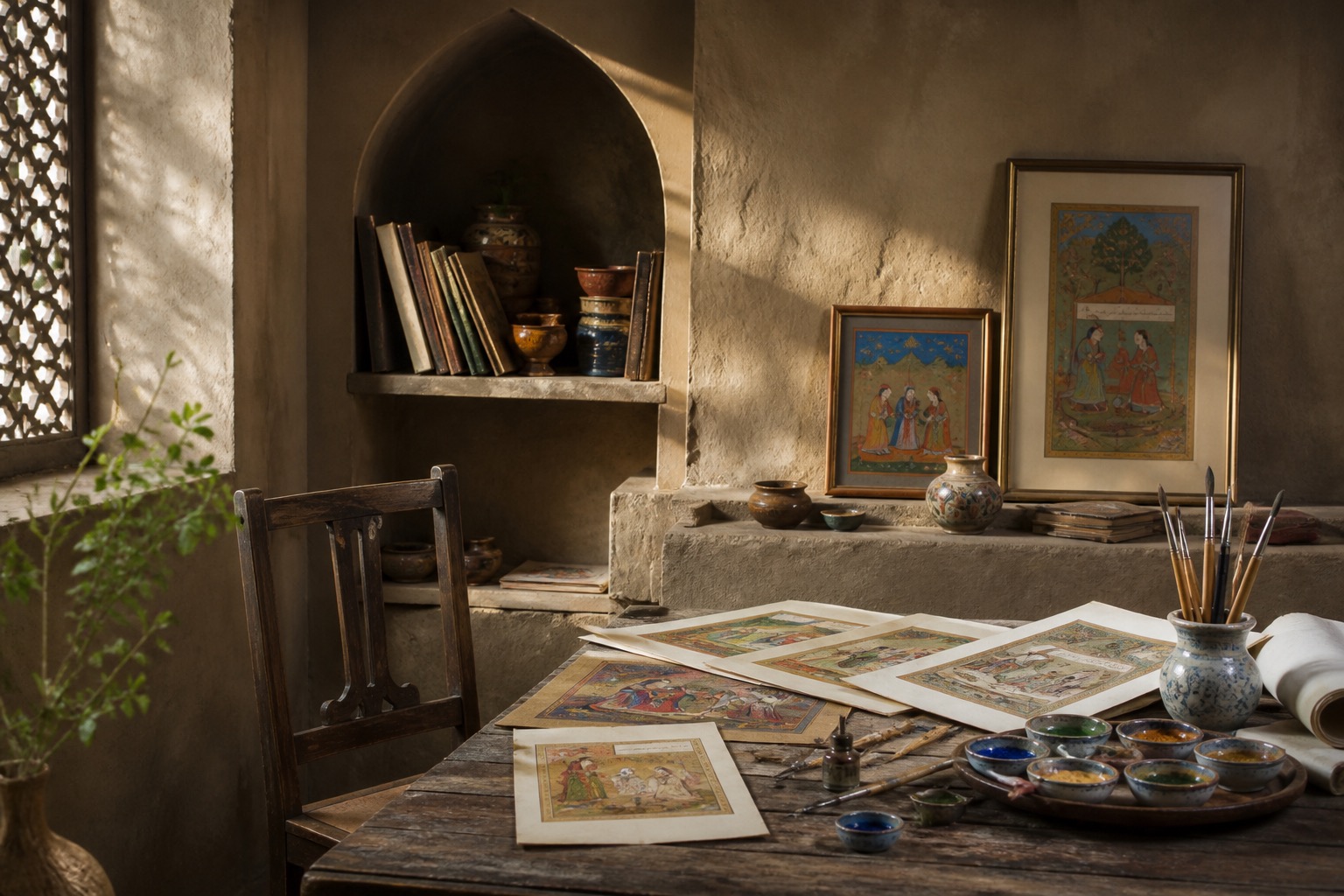
Zahoor ul Akhlaq changed Pakistan’s miniature debate by treating the manuscript frame as a modern problem—something to quote, empty, enlarge, and interrupt—rather than a heritage costume to wear for authenticity. He was a painter, printmaker, and teacher whose questions entered later generations at the National College of Arts more lastingly than any single signature style. The useful approach is not to invent a “Lahore school” brand, but to follow frames, grids, and pedagogy through museum records.
Can an artist challenge a tradition most powerfully by mastering its rules or by making those rules visible as choices?
— PakStyles culture desk
Delhi, Partition, Karachi, Lahore
Mathaf’s encyclopedia entry by Samina Iqbal places Akhlaq’s birth in Delhi on 4 February 1941. After Partition in 1947 his family migrated to Pakistan and settled in Karachi. Early education at Sindh Madrasa included calligraphy study with Yousaf Dehlvi. In 1958 he joined the National College of Arts, Lahore, studying under Shakir Ali and, among others, American sculptor Mark Ritter Sponenburgh, NCA’s first principal (1958–1961). He graduated, joined the fine arts faculty as a lecturer in 1963, and later headed the department.
A British Council scholarship took him to postgraduate printmaking at Hornsey College of Art (1966–67) and the Royal College of Art (1968–69). London’s Persian and Mughal manuscript collections at the Victoria and Albert Museum and the British Museum sharpened his attention to borders, nested frames, and multiple perspectives. Further work at Stanley Hayter’s Atelier 17 in Paris placed him beside international printmaking experiment, including contact with Krishna Reddy’s circle. These are research facts, not tourism colour: manuscript study supplied formal problems he would later enlarge onto acrylic and oil.
Calligraphy training in Karachi and manuscript looking in London should not be collapsed into a single “Islamic art” label. Akhlaq often treated line as aesthetic character rather than religious text. Mathaf is explicit that calligraphic forms in his etchings and drawings frequently carry no specific semantic meaning. That distinction protects the work from being drafted into identity arguments it did not ask to fight.
What he took from miniature—and what he refused
After returning to Pakistan in 1969, Akhlaq resumed teaching and extended experimentation across lithography, etching, ink drawing, and acrylic. Mathaf notes that he selected specific formal characteristics of miniature painting—frame within a frame, decorated borders, multiple perspectives—and employed them inside modernist and abstract fields. Grids and geometric shapes recur alongside clouds, figures, hands, mountains, and vernacular motifs. The grid could rhyme with Islamic architectural geometry and with Mondrian; the rhyme is a problem, not a proof of lineage.
Colour could be selective, frequently dominated by black and white. Akhlaq argued that colour, line, dimension, and balance create effects language cannot finish describing. That insistence matters for viewers who arrive expecting narrative miniature storytelling. Empty fields and interrupted borders are not unfinished decoration; they are arguments about how images organise authority. What appears absent may be the pressure point.
Recurring motifs—clouds, hands, folk decorative fragments—should be tracked across series rather than decoded as fixed symbols. A hand in one year may not mean what a hand meant five years earlier. Chronological looking is the antidote to symbolic laziness.
Autumn III and the Yale chromatic interval
Autumn III (1988), in The Met’s collection, is a useful single-object test of the larger project. Institutional wall text describes the painting as bridging Mughal manuscript spatial structures with modernist abstraction, referencing artists such as Josef Albers and Mark Rothko while drawing chromatic cues from New Haven autumn during a Yale research period. In 1987 Akhlaq joined Yale’s Institute of Sacred Music, Religion, and the Arts on a Fulbright and completed postdoctoral work, returning to NCA teaching in 1989. He exhibited with his wife, ceramicist Sherezade Alam, during that period—another reminder that Pakistani modernism’s networks were domestic and international at once.
Use The Met’s reading as a hypothesis, not a closed verdict. Compare Autumn III with other dated series rather than treating one Yale-period canvas as a summary of decades. Borders, divisions, and open fields reveal how an image claims space; the manuscript reference is structural, not costume. Viewers who only know neo-miniature through later biennale branding can still follow the argument by asking what a frame is doing when it no longer contains a court scene.
Albers and Rothko appear in wall text as comparative neighbours, not as Western parents who legitimise Pakistani work. The more interesting comparison may be to manuscript folio architecture itself: how a border disciplines looking, how empty ground holds tension, how multiple vantage points refuse Renaissance single-point comfort.
Teaching as the second artwork
Akhlaq’s mentorship at NCA is repeatedly cited as a springboard for later internationally visible artists. Mathaf names students including Rashid Rana, Shahzia Sikander, Ali Raza, and Risham Syed among those who carried questions forward through their own experiments. Credit carefully: name the institution, the period, and the problem posed about frames and grids. Do not flatten disagreement into a single school logo.
Atteqa Ali’s Met essay on postmodern developments in Pakistan and Bangladesh notes Akhlaq’s insistence on miniature painting’s relevance as a source for contemporary artists. Some later practitioners reversed his balance—using miniature craft as foundation rather than abstracting primarily from its structures. The debate is richer when those differences remain visible. In 1982 Bashir Ahmed formalised a bachelor’s programme in miniature painting at NCA with Akhlaq’s support as department head—often described as the first such college course of its kind. Curriculum is not destiny, but it changed what students could claim as contemporary practice.
Memorial galleries named for Akhlaq at NCA are honour and prompt. Visitors should ask what questions about tradition remain unfinished in Pakistani art education today, not only which famous alumni passed through the rooms.
How to look without inventing a school brand
Read series instead of signatures. Compare works across dates and formats for recurring grids, fragments, and density shifts. One recognisable image cannot explain the intellectual project. Public commissions between the mid-1970s and his death in 1999 belong to the same career as the canvases; they do not require private-life speculation to be historically meaningful.
At a 1991 Karachi exhibition, Mathaf records him saying that the paintings on view were no more and no less than paintings—they did not have to be “understood” as something else. Treat that as a warning against over-allegory, not as a ban on historical reading. Social injustice and political upheaval appear in the work’s pressures without turning every grid into a coded pamphlet. Biography should stop where evidence stops.
Diaspora viewers encountering neo-miniature through London or New York galleries should remember the pedagogical middle that made manuscript structures available as contemporary language. Market success is not the origin of the debate. Teaching and manuscript study are.
Printmaking as thinking, not side skill
Hornsey, the Royal College of Art, and Atelier 17 were not résumé decorations. Printmaking trained Akhlaq in reverse thinking—how an image survives transfer, how a plate holds a decision, how multiples complicate aura. Etching lines that resemble calligraphy without quoting scripture show that training’s afterlife. When contemporary painters cite him only through acrylic grids, they miss the pressure printmaking put on his sense of edge and interval.
Compare an etching’s bitten line with an acrylic border’s painted edge. Both can frame emptiness; they do not do so with the same bodily history. Students who inherit only the look of the grid without the discipline of the plate often produce design where Akhlaq produced inquiry. The difference is available to anyone willing to read medium labels carefully.
Collections that hold both paintings and prints—where they do—offer the best classroom pairing. If only paintings are accessible, say so. Absence of print evidence in a public encounter is a limitation of the visit, not proof that printmaking was minor.
Collections, memorials, and unfinished questions
Institutional holdings cited across encyclopedia and museum pages include Mathaf, Pakistan’s National Art Gallery, Bibliothèque Nationale de France, and other international collections. The posthumous Sitara-i-Imtiaz (2005) and earlier teaching awards—including a National Council of the Arts best-teacher recognition—are state and council facts; they do not replace looking. Roger Connah’s monographs and surveys by Salima Hashmi, Akbar Naqvi, Marcella Sirhandi, and Simone Wille remain routes into the literature; for a first public encounter, Mathaf’s biography plus The Met’s Autumn III page and Ali’s essay form a solid short dossier.
Akhlaq died in Lahore on 18 January 1999. The useful memorial is continued honesty about who taught whom what, and continued looking at frames that refuse to behave like transparent windows. Tradition here was never obedience. It was a set of spatial problems still worth arguing with—problems that later miniature practitioners answered differently precisely because Akhlaq made the frame visible as a choice.
For editors updating this entry, prefer Mathaf and Met URLs over undated social summaries, record access dates, and resist auction-house adjectives. Living estates and memorial galleries deserve the same precision PakStyles demands of product pages and travel advisories elsewhere in the catalogue.
Sources and official profiles
Was this helpful?
Keep reading
Related stories
More from this desk, this beat, and the tags on this piece.
Zubeida Agha: colour and the beginnings of modern art in Pakistan
Mehreen Ali · 18 Sep 2026
Stitched, unstitched, and semi-stitched Pakistani suits explained
Mehreen Ali · 12 Jun 2026
Readers
The conversation
3 notes
Anyone can leave a note. Guests add a name and email — no account required, and the email is never published.
What Time Does the Item Shop Change
Guest
What Time Does the Item Shop Change https://www.youtube.com/shorts/pzIcNcgWLh8 Some people were enthusiastic players or enjoyed music and dancing. Chances are you’ll remember that you were happiest on the running track. Even so, with increasing obligations maybe you have found no time to have pleasure in any of your interests. Are you affected by depression and want to get free from its abysmal depths without lifelong antidepresants? You could attempt and help yourself to overcome depression naturally.
What Time Does the Item Shop Change
Guest
Some people were enthusiastic players or enjoyed music and dancing. Chances are you’ll remember that you were happiest on the running track. Even so, with increasing obligations maybe you have found no time to have pleasure in any of your interests. Are you affected by depression and want to get free from its abysmal depths without lifelong antidepresants? You could attempt and help yourself to overcome depression naturally. [url=https://www.youtube.com/shorts/pzIcNcgWLh8]What Time Does the Item Shop Change[/url]
What Time Does the Item Shop Change
Guest
Some people were enthusiastic players or enjoyed music and dancing. Chances are you’ll remember that you were happiest on the running track. Even so, with increasing obligations maybe you have found no time to have pleasure in any of your interests. Are you affected by depression and want to get free from its abysmal depths without lifelong antidepresants? You could attempt and help yourself to overcome depression naturally. <a href="https://www.youtube.com/shorts/pzIcNcgWLh8">What Time Does the Item Shop Change</a>