Salman Toor: painting friendship, interiors, and queer life
A work-focused reading of Salman Toor’s Whitney exhibition How Will I Know—friendship, green interiors, and queer diasporic life without gossip.
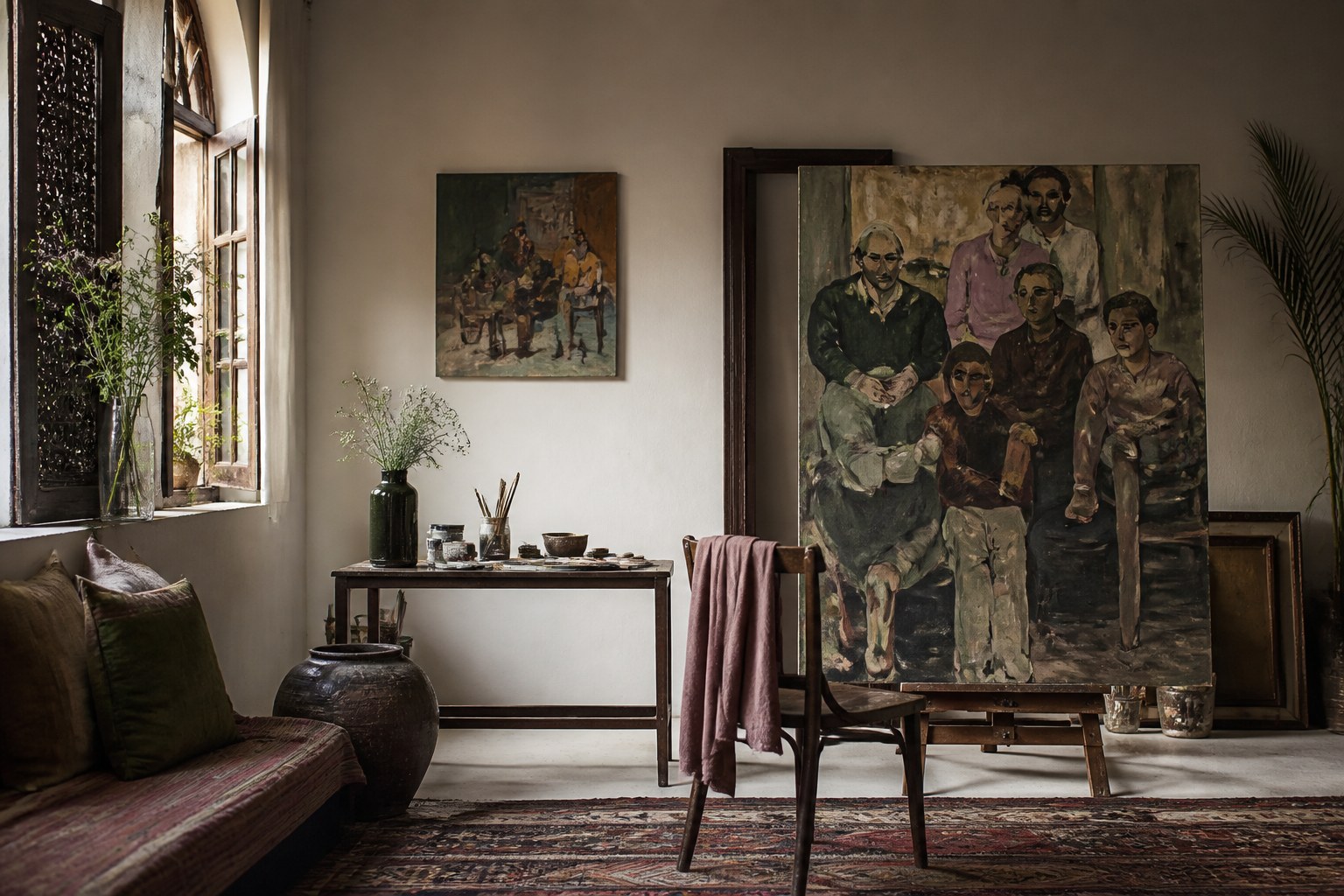
Salman Toor’s paintings are easiest to misread as diary pages. They are not. The Whitney Museum’s first museum solo for the artist, How Will I Know (13 November 2020–4 April 2021), framed the work as imagined lives of young queer Brown men moving between New York City and South Asia—scenes of friendship, phones, family tables, and security lines painted with academic skill and a quick, sketch-like touch. The responsible reading stays with those canvases and the museum’s language. It does not invent a private biography from green paint.
Which rooms in these paintings feel like refuge, and which feel like surveillance with better lighting?
— PakStyles culture desk
What the Whitney put on the wall
According to the Whitney exhibition overview, Toor (b. 1983) presented new and recent oil paintings, often small-scale figurative works. Curators Christopher Y. Lew and Ambika Trasi organised the show within the museum’s emerging artists programme. Institutional text emphasises recurring colour palettes, art-historical references, and narratives drawn from lived experience without converting the show into a confessional. Lush interiors show friends dancing, playing with puppies, gazing into smartphones; more muted tableaus carry nostalgia, alienation, airport scrutiny, or family tension.
Installation photographs published by the museum name works such as Four Friends (2019), Bar Boy (2019), Tea (2020), Puppy Play Date (2019), Sleeping Boy (2019), Bedroom Boy (2019), Stoop (2020), and Man with Face Creams and Phone Plug (2019). Titles are part of the evidence. They locate genre—bar, bedroom, stoop, security—before any critic’s identity thesis. Collection pages such as Bedroom Boy keep medium and dimensions available after the temporary show closes.
Small scale is not minorness. Many of these paintings pull the viewer close, creating an ethics of proximity: you cannot consume a crowd scene from across a plaza when the object itself asks for conversational distance. That physical demand shapes how friendship and vulnerability are pictured.
Green as atmosphere, not brand logo
Writers often fixate on Toor’s greens as a trademark. Better to treat green as climate: evening rooms, phone light, envy, safety, sickness, glamour—sometimes several at once. The Whitney notes that recurring palettes heighten emotional impact and add a fantastical element. Fantastical here does not mean unreal; it means the paintings can idealise refuge while still showing how fragile that refuge is. Compare a crowded, emerald gathering with a cooler scene of passivity. The shift is compositional and chromatic before it is sociological.
Art-historical echoes—salon intimacy, nocturnes, figurative traditions—are tools Toor uses, not costumes that prove Western belonging. Queer diasporic life in these pictures includes joy and watchfulness in the same week. Idealistic interiors free figures from some outdoor impositions; airport and family scenes remind the viewer that freedom is situational. Hold both without forcing a single “East versus West” caption onto every canvas.
Phone screens appear as light sources and as social theatres. A face lit by a device is a contemporary problem of attention, not merely a prop for “youth culture” captions. Notice who looks at whom, who looks at a screen, and who is looked at without looking back. Those vectors are as important as any flag of identity.
Friendship as subject, not soft focus
Friendship in Toor’s Whitney group is work: looking, teasing, waiting, sharing a screen, sharing a cigarette, sharing silence. Community appears as demimonde and as chosen family, sometimes overlapping. The museum’s overview states that the paintings consider vulnerability in public and private life and the notion of community in queer, diasporic identity. That sentence is already precise. Expanding it into celebrity gossip about the painter’s own relationships is a category error.
When teaching the show, ask students to describe one interior’s furniture, light source, and phone placement before debating identity. Material facts—oil on plywood for Four Friends, scale that pulls the viewer close—shape intimacy as much as subject matter does. Soft focus is a photographic metaphor that fails here; Toor’s paint can be tender and still leave edges sharp enough to cut.
Animals and toys in certain scenes are not automatic innocence. They can mark domestic play, Instagrammable cuteness, or the temporary suspension of adult threat. Describe them as objects in a room before assigning symbolism.
Public vulnerability and the airport table
Not every painting is a party. Institutional descriptions highlight a man whose possessions are displayed for airport security officers, and unspoken tensions around a family dinner table. Those scenes matter because they refuse the false choice between “happy representation” and “trauma content.” Scrutiny, boredom, fear, and tenderness share a career. Diaspora viewers who recognise the security-line still life should still cite the painting’s title and date rather than treating recognition as autobiography of the artist.
Press coverage around the Whitney show ranged from fashion magazines to art journals. Use press as reception history, not as fact sheet. Prefer the museum’s own overview and press materials for claims about curatorial intent. Living artists continue to work; one solo does not freeze a practice. Later exhibitions and gallery placements should be dated separately rather than collapsed into the 2020–21 moment.
Pandemic-era viewing also shaped the show’s reception: many audiences met the paintings online or under restricted museum conditions. Note that historical accident when citing contemporary reviews. Online looking flattens scale; restricted galleries change dwell time. Both alter what “intimacy” means.
Editorial boundaries for a living painter
PakStyles’ standard for living public figures applies with extra force here. Do not speculate about relationships, health, finances, or private conduct. Do not invent quotations. Do not treat queer subject matter as permission for invasive curiosity. Credit museums, curators, and lenders as the Whitney does. When a work enters a collection, link the collection record. When a claim cannot be tied to an institutional page, leave it out.
A practical dossier: the Whitney exhibition page; the Whitney press materials; one collection object with medium and year; and a dated note of access. Write what the painting shows—who stands where, what glows green, what object sits on the table—before writing what it “says about Pakistan” or “says about America.” Specificity is respect. The more precisely the interiors are described, the less the figures become mascots for someone else’s argument.
How Will I Know borrowed its title from a pop song about uncertain recognition. That uncertainty is useful for critics too. Recognise friendship, surveillance, and fantasy as they appear in oil. Refuse the intimacy the paintings do not offer about the person who made them. The work already asks enough—and answering with gossip is a failure of looking, not a form of cultural solidarity.
For diaspora classrooms, assign one lush interior and one muted public scene as a pair. Ask what changes in colour, posture, and props. Collect those descriptions before opening debates about nation or sexuality. The paintings will survive that slower method; the reputation economy around them often will not, and that is fine.
Between New York and South Asia without a map key
The Whitney’s language places figures “between New York City and South Asia.” That between is a condition, not a passport stamp. Some rooms feel like New York bars; some family tables feel like elsewhere; some airport scenes could happen in multiple terminals that police Brown travellers similarly. Resist forcing each canvas to declare a city. Ask instead what social rules the room enforces—who may touch whom, who may look bored, who must perform gratitude.
Diaspora readers sometimes want the paintings to explain Pakistan to relatives abroad, or America to relatives at home. The paintings are under no obligation to do either. They are under an obligation—self-imposed by their own precision—to make friendship and scrutiny visible as painted situations. Let that be enough.
When wall texts mention academic technique beside sketch-like speed, test the claim on one face and one hand. Where is the paint thin? Where does a contour hesitate? Technique talk becomes useful only when tied to a square inch.
Later market attention and gallery representation expanded after the Whitney moment; report those developments with dates if you must mention them at all. Market heat is not a looking method. The looking method remains: name the room, the light, the phone, the posture, and the institutional page that authorised your facts. Everything else is optional noise around a practice that already knows how to be quiet and glamorous in the same evening.
Corrections to this page should cite a titled painting, a Whitney URL, and an access date. Unsupported superlatives and private-life speculation do not belong here even when they travel well on social platforms. The green rooms will outlast the gossip if editors let them.
If you recommend a first encounter, prefer the Whitney’s documented works and installation photographs over unsigned round-ups. Accessibility of evidence matters as much as rarity. Date your notes. “I saw,” “I read,” and “I compared” become useful to the next editor only when attached to a day, a URL, and a title as the museum gives it.
Sources and official profiles
Was this helpful?
Keep reading
Related stories
More from this desk, this beat, and the tags on this piece.

A nikah in England is not automatically a civil marriage: check the legal registration
Bilal Ahmed · 28 Oct 2026

Urdu and Panjabi in England and Wales: what Census 2021 language data shows
Bilal Ahmed · 28 Oct 2026
Walima explained: what the reception is for and why every family does it differently
Bilal Ahmed · 27 Oct 2026
Dholki, mayun and mehndi: why Pakistani pre-wedding events are not the same thing
Bilal Ahmed · 25 Oct 2026
Readers
The conversation
0 notes
Anyone can leave a note. Guests add a name and email — no account required, and the email is never published.
No notes yet. Yours would be the first.