Sanam Saeed: theatre, television, film, and music
Sanam Saeed\u2019s career across theatre musicals, Zindagi Gulzar Hai, film work including Cake, and Coke Studio backing vocals\u2014read as discipline-crossing craft.
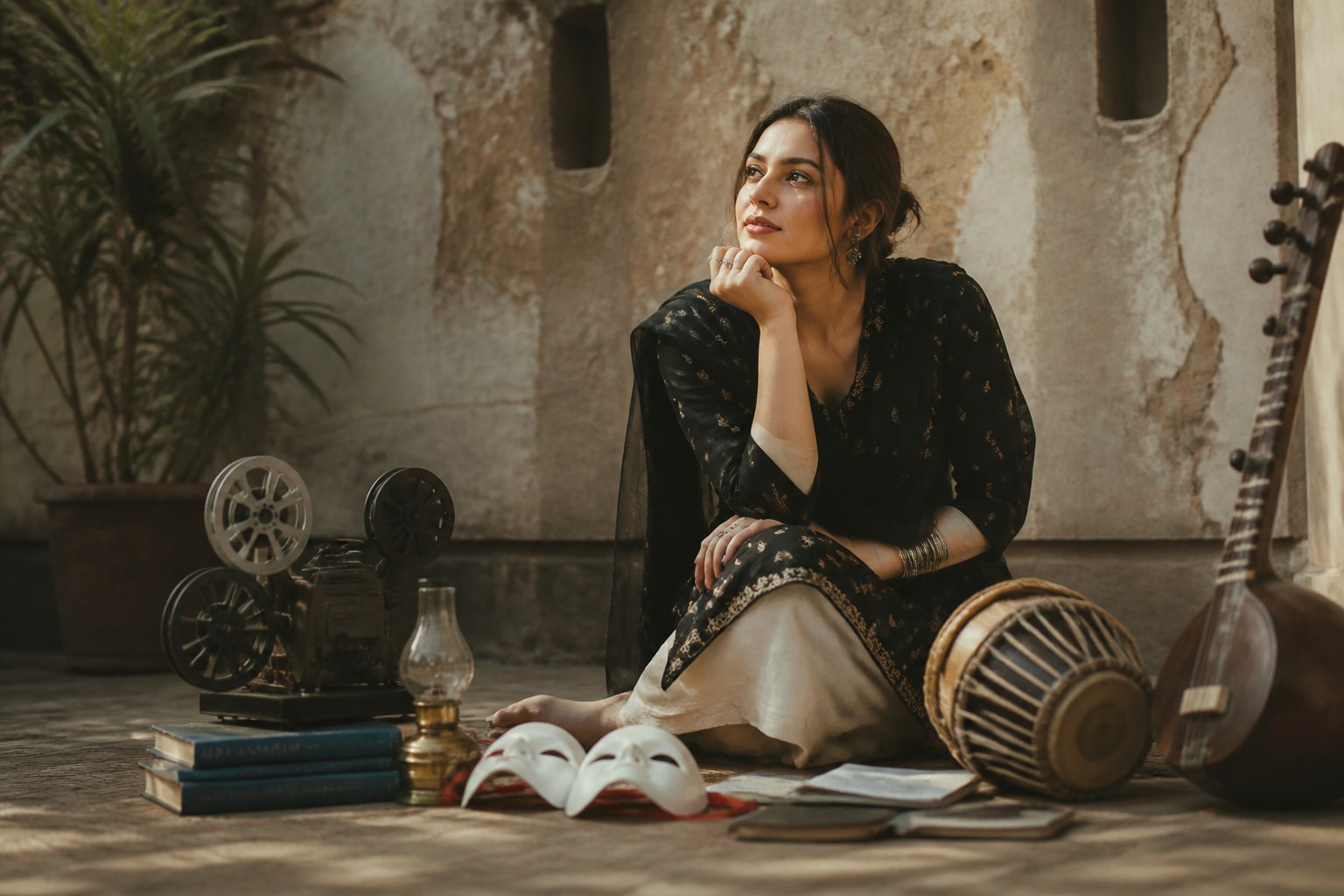
Sanam Saeed’s career makes more sense as a movement between disciplines than as a single breakout legend. Theatre precision, musical ensemble work, television intimacy and film’s demand for compression each leave different traces on the same performer. A guide that only says Kashaf from Zindagi Gulzar Hai is not wrong about popularity. It is incomplete about craft.
This profile stays with public credits, published reviews and attributable performance history. It does not use private life as an explanatory key.
Stage training and the complete body
Before television made her face ubiquitous, Saeed worked in stage musicals associated with Nida Butt’s productions, including Chicago and Mamma Mia!—forms that require singing, dancing and acting to share one continuous physical intention. Theatre asks an actor to sustain choices beyond the close-up. When you watch Saeed on screen, ask whether the body is idle while the face works. Often it is not. Spatial awareness in family-house blocking, sustained intention in long takes, and a refusal to let the close-up do all the acting are stage habits that still show.
Musical theatre also trains listening: matching another singer’s vowel, hitting a mark without looking as if you are hitting a mark, and keeping character while breath is allocated to song. Those habits matter later when film and television ask for quieter music—the music of speech rhythm and silence.
Television arrival and the Kashaf problem
Early serial work—including titles such as Daam and Mata-e-Jaan Hai Tu—established her inside contemporary Pakistani television before Zindagi Gulzar Hai (an adaptation of Umera Ahmad’s novel, directed by Sultana Siddiqui) made Kashaf Murtaza a durable reference point. Kashaf’s intelligence does not dissolve resentment, fear or class friction. Saeed lets diary voice, guarded conversation and private reaction produce different versions of the same woman.
The pairing with Fawad Khan became a commercial and diaspora event. A performance-led guide should still separate chemistry from character construction. Kashaf’s interior weather is the durable craft object. Verify official availability through HUM TV. Diaspora households often meet the serial through soft clips; rebuild episode context before declaring that Kashaf is only a soft romance archetype. She is also a class argument, a diary argument, and a study in how intelligence survives humiliation.
Film: compression, ensembles, and Cake
Saeed’s filmography includes mainstream and more intimate projects—among them Bachaana, Dobara Phir Se, Mah-e-Mir, Rahm and Cake (2018). Film asks for compression: arcs that television might develop across twenty episodes must flicker in glances and cuts. Ensemble films further ask an actor to share the frame without vanishing or monopolising it.
Cake, in which she plays Zara, drew critical attention for controlled interiority. Reviewing the film for The Express Tribune, Rahul Aijaz wrote that Saeed portrays Zara with suppressed emotion and that her calm exterior and controlled speaking style aid the character’s insecurities. Watch Cake for what is withheld: care work, sibling irritation and family history depend on actors who can let silence remain unsettled. Television watchers can learn from that compression—notice when a serial scene would be stronger if it trusted a glance the way Cake does.
Music as practice, not novelty
Saeed appeared in Coke Studio Pakistan’s orbit as a backing vocalist in season 3, including credits associated with performances such as Alif Allah (Jugni), Aisha, and Chori Chori. Backing vocals are ensemble musicianship: blend, timing, vowel matching and the discipline of not pulling focus. Listen via the official Coke Studio Pakistan channel. Treating those credits as a fun celebrity cameo misses the point; they are evidence of a performer trained to serve a larger musical architecture.
Stage musicals, backing vocals and screen roles share a question: when does Sanam Saeed lead, and when does she support? Careers that only celebrate leading can undervalue the craft of support. Careers that only praise versatility can lose track of what each medium actually asked her to do. Name the medium’s demand before praising range in the abstract.
Cross-medium habits worth tracking
- How she plays intelligence without making it a costume.
- How class is signalled through speech rhythm and listening.
- How anger arrives: explosion, freeze, or precise cut.
- How she shares frame with children, elders and servants.
- How film roles use fewer words without losing intention.
- How musical credits show blend rather than spotlight hunger.
| Stop | Why | What to write after |
|---|---|---|
| Stage-aware early TV | Sustained physical intention | One note on posture or blocking |
| Zindagi Gulzar Hai | Interior weather across long-form television | How diary voice differs from public speech |
| One non-Kashaf serial | Break the single-role freeze | What changes when the brief is not Kashaf |
| Cake | Compression, withholding, ensemble listening | What silence carries that dialogue would dilute |
| Coke Studio season 3 backing credits | Ensemble musical discipline | Where her voice sits in the blend |
Breaking the single-breakout freeze
Popular culture freezes successful actors inside one role. Saeed’s Kashaf is a strong freeze candidate because the serial travelled widely and still circulates in soft-focus nostalgia. Counter the freeze deliberately: watch one earlier serial for pre-Kashaf habits, watch Cake for film compression, and listen to backing credits for ensemble discipline. Then return to Kashaf and notice what you missed the first time—often the class work and the diary work rather than the romance stills.
Reporting in outlets such as The Express Tribune can help date reviews and festival conversations; prefer dated criticism over undated fan summaries. Future updates should follow verified credits. Private-life speculation adds heat without craft information.
Sanam Saeed’s cross-medium career is useful precisely because it refuses a single template. Theatre trains the whole body; television rewards sustained interior weather; film rewards compression; music rewards blend. A viewer who can name those demands will see more than a breakout still—and will have a fairer vocabulary for whatever she does next.
Compression lessons from Cake for television watchers
Television watchers can steal a film habit without abandoning serial pleasures. After an episode of Zindagi Gulzar Hai, ask which glance could have replaced a speech. After Cake, ask which withheld reaction carried sibling history. The point is not that film is superior. The point is that Saeed’s career makes the comparison available inside one performer’s body of work.
Stage musical training also explains why her stillness rarely looks empty. Musical theatre teaches you to stay alive while waiting for a cue; screen close-ups punish dead waiting. When Saeed listens in a family scene, watch whether the listening has a physical destination—a breath, a shifted weight, a decision deferred. That is craft you can name without gossip.
Backing-vocal credits remain underrated in celebrity culture because they refuse the spotlight. Use them as a corrective: a performer who can blend is less likely to treat every scene as a solo. When recommending Saeed to someone who only knows Kashaf stills, send them the Coke Studio season 3 credits and Cake before another soft clip. The freeze breaks faster when the next encounter is a different discipline, not another romance still.
Future updates should follow verified credits on network and press routes. Private-life speculation adds heat without craft information. Sanam Saeed’s cross-medium map stays useful only if readers keep naming the medium’s demand—theatre body, television weather, film compression, musical blend—before praising range in the abstract.
What “range” must mean to stay honest
Range is not a synonym for busyness. Sanam Saeed’s schedule across stage, television, film and music only becomes an argument when you can name what each medium asked her to change. Theatre asked for continuous physical intention. Television asked for interior weather across weeks. Film asked for compression. Backing vocals asked for blend. If a praise post cannot name those asks, it is celebrating celebrity density, not craft range.
Kashaf remains a legitimate doorway because the serial travelled and still teaches class and diary voice. It becomes a freeze when every later encounter is compared only to soft stills. Break the freeze with Cake, with a non-Kashaf serial, and with musical credits. Then return to Kashaf and notice the class work you previously filed under romance.
Press routes such as The Express Tribune help date criticism; HUM TV helps confirm availability; Coke Studio’s official channel helps confirm musical credits. Use them. Speculation about private life will always be louder. It will almost never make you a better watcher of what she actually does in a frame.
Ensemble ethics on stage, screen, and in the mix
Whether in a musical ensemble, a family serial, a sibling drama like Cake, or a Coke Studio blend, Saeed’s stronger work shows an actor who can share oxygen. Watch how she yields frame to children and elders. Listen for whether backing vowels match without competing. Notice whether film silence is generous to another actor’s gesture. Ensemble ethics are not soft virtues; they are technical skills with moral consequences for how stories distribute attention.
Celebrity culture prefers solos. Saeed’s career repeatedly refuses that preference. A viewer who only celebrates Kashaf monologues will miss half the craft. A viewer who tracks listening, blend and withheld reaction will see why theatre training still matters on a television schedule built for close-ups and weekly delivery.
Sources and official profiles
Was this helpful?
Keep reading
Related stories
More from this desk, this beat, and the tags on this piece.



A nikah in England is not automatically a civil marriage: check the legal registration
Bilal Ahmed · 28 Oct 2026

Urdu and Panjabi in England and Wales: what Census 2021 language data shows
Bilal Ahmed · 28 Oct 2026

Walima explained: what the reception is for and why every family does it differently
Bilal Ahmed · 27 Oct 2026
Dholki, mayun and mehndi: why Pakistani pre-wedding events are not the same thing
Bilal Ahmed · 25 Oct 2026
Readers
The conversation
0 notes
Anyone can leave a note. Guests add a name and email — no account required, and the email is never published.
No notes yet. Yours would be the first.