Pakistani brunch menu for guests: workflow and holding times
Run a Pakistani brunch for guests by cooking the night-before tray first, holding breads intelligently, and leaving eggs for the final ten minutes.
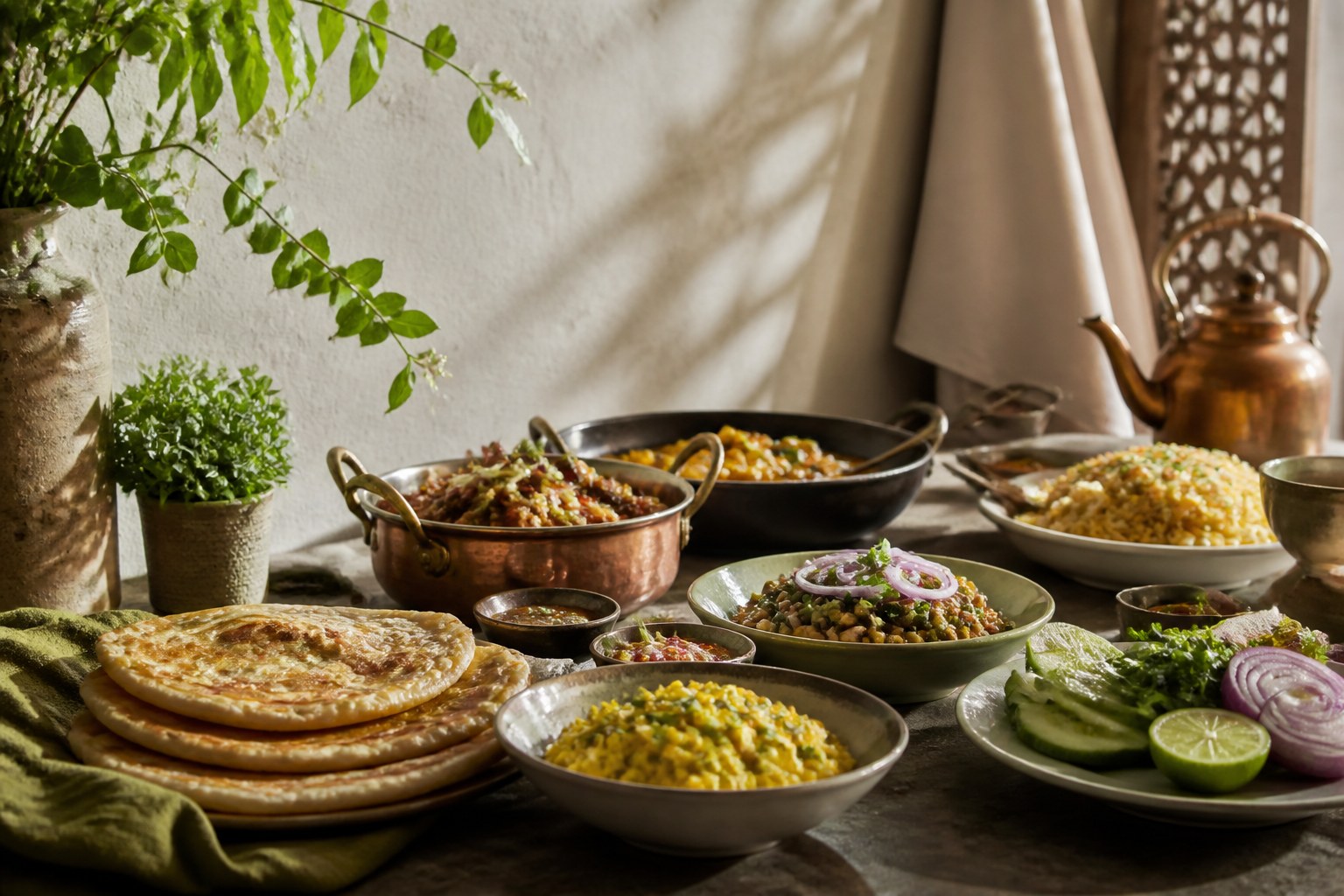
Pakistani brunch fails in the last twenty minutes more often than in the recipe. Halwa goes cold while eggs are fried one by one; parathas stack into a steamed brick; chai is poured once and forgotten. The fix is workflow: everything that can wait is prepared to wait, and eggs define the final stretch.
This is a timing guide for hosting guests at home—weekend cousins, post-nikah drop-ins, or the friend who “just wants something desi for brunch.” It is not a restaurant manual. Hot-holding equipment in a flat is usually a low oven, a covered pot and honesty about time.
Write the menu as a sequence, not a wishlist
A workable guest brunch rarely needs more than:
- one bread programme (paratha, puri, or toast with a Pakistani topping);
- one slow savoury that holds (chana, aloo bhujia, keema);
- one egg dish cooked last;
- one sweet or halwa option;
- chai in waves;
- something raw and sharp (onion, cucumber, lemon).
Halwa puri, anda paratha and chana toast can all be excellent. They should not all be attempted by one cook without help. Choose a primary path and let the others become optional add-ons.
The night-before tray
The night before is for anything that improves with rest or can be chilled safely:
- Soak and cook chana; cool quickly in shallow containers and refrigerate. The FSA’s chilling guidance and the USDA FSIS leftovers advice both stress prompt refrigeration after cooking.
- Mix spice bases and chop onions, green chillies and herbs; store covered and cold.
- Knead dough if your bread plan needs it; chill dough rather than leaving it warm overnight in a hot kitchen.
- Set the tableware, tea pot count and serving spoons so morning decisions are only about heat.
Do not leave cooked rice, meat or dairy dishes on the counter “because brunch is early.” Early is still inside the danger zone if the food sits out. FSIS describes the danger zone between 40°F and 140°F; keep hot food hot and cold food cold, and limit how long perishable dishes sit in between.
Parathas need a holding strategy
Parathas are the brunch item most often ruined by kindness—someone keeps cooking while guests eat, and the stack becomes sodden. Options that work in a home kitchen:
- Staggered cooking: one cook at the tawa while guests start with chana and tea; bread arrives in small piles.
- Brief covered hold: a clean cloth-lined box or low oven can hold for a short period; steam still softens crisp edges, so do not pretend a thirty-minute hold equals fresh.
- Partial advance: roll and layer with parchment in the fridge; cook to order for a smaller group.
Puris are less forgiving. Fry close to service. Halwa can be finished early and gently rewarmed; it holds better than fried bread.
Eggs define the final ten minutes
Eggs are the freshness signal. Guests forgive a chana that was made yesterday if it is reheated properly. They notice rubbery eggs that waited under a lid. Cook eggs last, in the quantity people will eat now. A second egg batch is better than a holding graveyard.
If you serve anda paratha, treat the egg as the last action on a hot tawa, not as a filling made an hour early. If you serve a tray of boiled eggs, keep them cold until plating unless they will be eaten immediately; do not leave peeled eggs on a buffet without temperature control. Follow thorough-cooking expectations in the FSA’s cooking guidance for dishes that must be piping hot.
Serve tea in waves
One giant early pot solves anxiety and creates lukewarm chai by the time eggs arrive. Two or three smaller pots keep aroma aligned with food. Assign someone—anyone not on the tawa—to refill water and cups. Brunch is a systems problem disguised as hospitality.
Holding times without lying to yourself
| Item | Practical home hold | Better move if delayed |
|---|---|---|
| Chana / aloo | Keep hot and covered; reheat to piping hot if cooled | Return to fridge if delay exceeds a safe room-temperature window |
| Paratha | Short covered hold only | Cook another small batch |
| Puri | Minutes, not half an hour | Fry to order |
| Eggs | Serve immediately | Cook a second round |
| Halwa | Gentle rewarm | Keep covered; watch moisture |
| Salad / yoghurt | Cold until service | Bring out in small bowls |
For outdoor or roaming service, treat the FSA’s picnic advice as a warning: perishable food should not sit out indefinitely while photographs happen.
Guest flow that protects the cook
Tell guests when food will hit the table. “Eggs in ten minutes” prevents people from filling up on biscuits. Put the sharp salad out early so hungry arrivals have something immediate. Keep children’s plates simpler if spice levels vary—brunch is a poor moment for a chilli surprise.
A successful Pakistani brunch feels abundant because heat arrives in the right order, not because every regional breakfast appeared at once. When guests leave, you should have empty egg plates, a managed bread basket and a kitchen that does not look like a continuous fryer accident. That is the standard.
If you host often, keep a written sequence on the fridge: night-before list, morning heat order, egg last. The note looks unromantic. It is how romance survives the second pot of chai.
Sources and official profiles
Was this helpful?
Keep reading
Related stories
More from this desk, this beat, and the tags on this piece.
Pakistani grocery shopping in the UK: pantry, freezer, and fresh food
Hassan Raza · 15 Feb 2026
Pakistani groceries online in the USA: shipping, frozen food, and pantry planning
Hassan Raza · 9 Feb 2026
Readers
The conversation
0 notes
Anyone can leave a note. Guests add a name and email — no account required, and the email is never published.
No notes yet. Yours would be the first.