How to choose a Pakistani wedding caterer
A tasting-to-contract guide for choosing food and service that can survive the actual wedding.
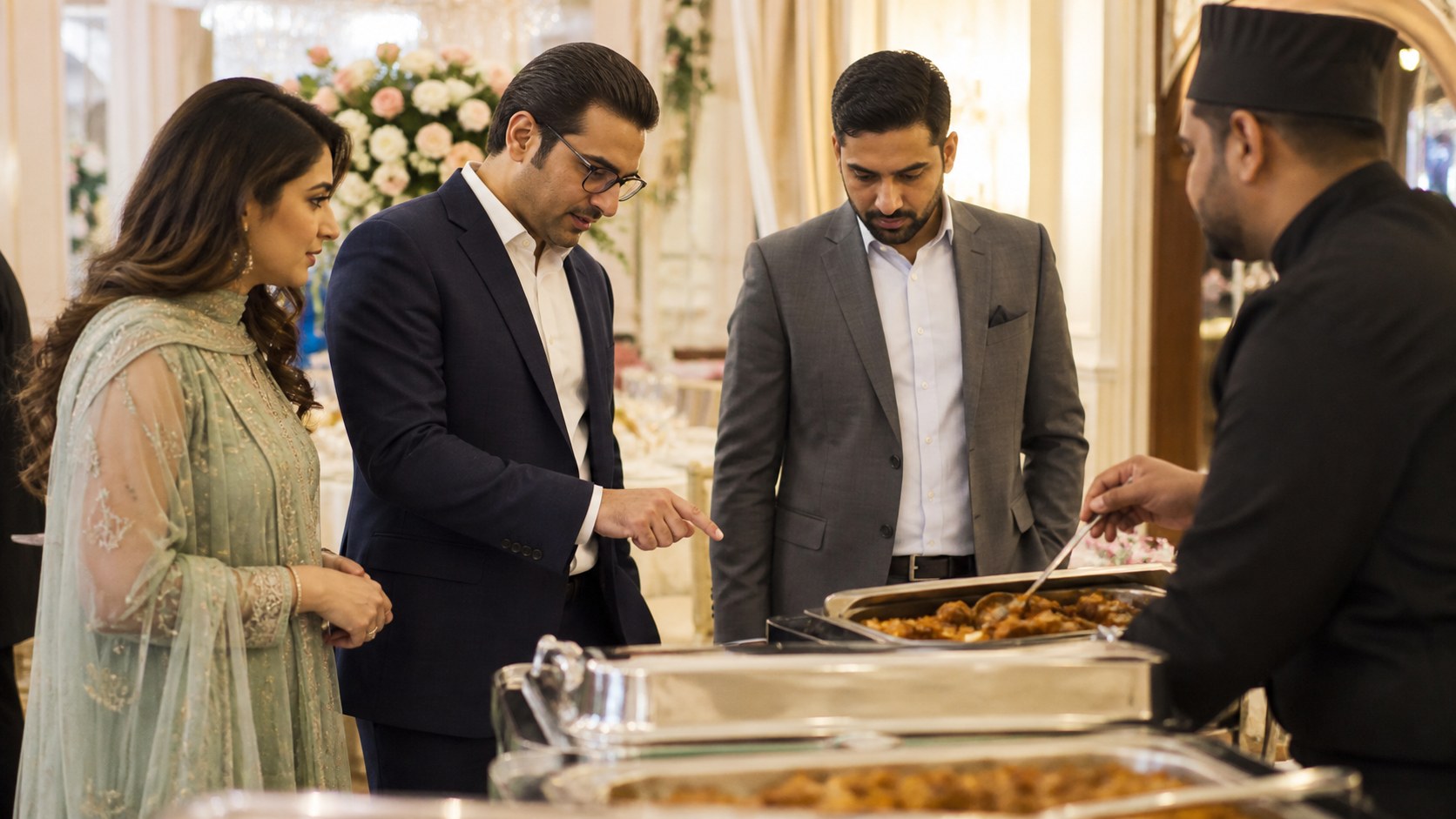
Wedding food is judged twice: once at a calm tasting table, and again when two hundred guests arrive late, the biryani must hold, and the vegetarian aunt still needs a real plate. Choosing a Pakistani wedding caterer is less about finding a famous karahi and more about finding a team whose systems survive the real event.
This guide walks from shortlist to tasting to contract. It assumes UK or similar diaspora logistics where venues, hygiene ratings and allergen duties matter. The same discipline helps elsewhere even when the paperwork differs: write the job, test under honest conditions, and put risk in writing before the deposit clears.
Write the job before you write the menu
Food style follows ceremony shape. A seated nikah lunch, a mehndi with grazing trays, and a late baraat buffet are different catering problems with different staffing curves. Record guest-count ranges, service style, timing of the bridal party, whether elders need plated service, whether children need a true route through the table, and which dishes are non-negotiable for your family versus decorative for the room.
Also record constraints the caterer did not create: venue kitchen access, power, load-in hours, alcohol policy if relevant, prayer timings, leftover rules, and whether outside catering is allowed at all. A brilliant menu that cannot legally enter the building is not a menu. If the venue forces an approved-supplier list, evaluate that list with the same hygiene and tasting standards rather than treating approval as culinary proof.
Shortlist on systems, not only flavour stories
In England, Wales and Northern Ireland, check a food business’s rating on the official food hygiene ratings site. A rating is not a wedding review, but it is public hygiene evidence you should not ignore. Read it alongside recent references for comparable guest counts—not three dinner-party cousins who loved a home karahi.
Ask how they staff a Pakistani wedding specifically: who runs the buffet line, who replenishes, who handles bridal-room trays, who speaks to the venue coordinator when the baraat is late. Ask what they cook themselves versus buy in. “Full Pakistani menu” can mean a kitchen brigade or a skilful assembly of bought components. Either can work; surprise about which one you hired does not.
The Food Standards Agency is the UK’s central reference for food safety orientation. You are not becoming an inspector by reading it. You are becoming a client who can ask better questions about hold times, reheating and allergen control.
Run a tasting that teaches you something
A tasting should answer hold-time and balance questions, not only first-bite pleasure. Taste rice dishes after they have sat, not only at minute one. Check whether spice heat, oil level and salt still make sense when you imagine eating in formalwear. Look at colour and texture variety on a plate: brown-on-brown buffets photograph like fatigue and eat like fatigue.
- Include one rice, one bread plan, one signature curry, one grill or roast, one vegetarian centrepiece, one fresh side, one dessert.
- Ask which items travel and hold, and which must be finished on site.
- Note portion logic for buffet versus plated service.
- Ask how they stop the first guests emptying the best dish.
- Ask what they would remove if the bridal party were ninety minutes late.
Bring the person who will manage vendor communication on the day. Leave the full committee at home if a crowd turns the tasting into a performance. Take notes on service demeanour as carefully as on flavour; the same team culture usually appears under pressure.
Allergens and dietary needs are operations
Collect nut, sesame, gluten, dairy, egg and other requirements in writing early enough to act. The FSA publishes guidance for consumers on allergen information and for businesses on allergen duties. Your caterer should explain cross-contact prevention, server briefing, and how a guest asks a safe question without improvisation at the tray.
Halal standards vary by household. Ask which certification or supply chain they rely on, and decide whether that meets your family’s requirements. Do not outsource that decision to a menu PDF. Vegetarian and vegan routes should be designed dishes, not a lonely paneer cube beside three meat salans.
Venue logistics decide whether flavour arrives intact
| Logistics point | Why it matters | Ask |
|---|---|---|
| Load-in window | Late access compresses cooking and staging | Exact arrival, parking, lift rules |
| Power and equipment | Warmers fail quietly | What they bring vs venue supply |
| Service rhythm | Bridal delays are normal | Safe hold plan and communication chain |
| Waste and leftovers | Family expectation vs venue rules | Who may take food, packing, liability |
Holding food safely is not folkloric wisdom. Use the FSA’s practical pages on chilling and cooking as the baseline for questions about hot holding, reheating and what happens to trays that miss their window. Confirm staffing numbers in writing for your guest count. Understaffed buffets create queues that feel like disrespect even when the food is good.
Read the contract like a risk document
The written agreement should cover menu, guest-count bands and price triggers, service times, staffing, equipment, tastings included, deposits, cancellation, damage, leftover policy and day-of authority. Keep changes in writing. For UK consumer framing when a paid service goes wrong, start with Citizens Advice consumer guidance rather than a family WhatsApp tribunal.
Clarify tax, service charge, travel fees, corkage interactions if any, and late-night surcharges before you compare quotes. The cheapest per-head number is often incomplete. Compare like for like: same count, same service style, same dessert inclusions, same bridal trays, same staff ratio.
Menu balance for Pakistani weddings
Guests need a path through the table: something fresh, something grilled or roasted, something sauced, a carbohydrate that is not an afterthought, and a dessert that can be served without a chemistry project at midnight. If every dish is rich, people stop eating and start enduring. If every dish is mild for “mixed guests,” the people who came for your food notice.
Schedule late-night snacks only if venue curfew and staff overtime make them real. A promised chai-and-samosa hour that collapses into cold trays in a closed kitchen helps nobody. If your family expects a sweet send-off, put it in the contract with a time and a responsible lead.
Final selection questions
- Can they name the on-the-day manager?
- Do hygiene evidence, references and tasting align?
- Is the allergen process specific enough to brief a server?
- Does the contract match the venue’s real constraints?
- Do you trust them to tell you bad news early about timing, counts or a dish that will not hold?
Choose the caterer whose systems make good food likely under pressure. Flavour without logistics is a tasting-room fantasy. Logistics without flavour is efficiently distributed disappointment. You need both, in writing, before anyone starts measuring rose petals for the tray garnish.
Bridal trays, late arrivals and the politics of the first plate
Agree who eats when. Bridal-party trays that arrive cold after photographs are a common failure mode, as is a buffet opened before the couple can enter. Write a sequence: canapé or welcome drink if any, formal open, replenishment rules, and dessert timing. If speeches overlap service, decide whether cutlery noise is acceptable or whether service pauses—then staff it.
Late baraats are normal enough that a caterer without a late plan is underprepared. Ask what they do at plus thirty, plus sixty and plus ninety minutes: which dishes hold, which are cooked in waves, which are abandoned. Pair that answer with the venue’s real kitchen access. A wave-cooking plan that needs a kitchen you do not have is fiction.
Portion culture varies. Some families want abundance that photographs as overflowing trays; others prefer less waste and cleaner tables. Neither is morally superior, but they require different production volumes and different leftover plans. Put the preference in the brief so the tasting portions are interpreted correctly.
Comparing two finalists without losing the plot
When two caterers taste similarly, score systems: staffing plan, allergen briefing, late-hold plan, contract clarity, and how they spoke about failure. Flavour ties should be broken by operations. Visit or video-call the manager who will be on the floor if they were not at the tasting. Chemistry with a salesperson is not chemistry with the night team.
Pay deposits only against the written scope. Keep a single shared folder for menu, floor plan, allergen list and timeline so relatives cannot invent a second menu in a side chat. The caterer can only deliver one version of the night.
Finally, protect the people feeding everyone else. Catering teams need water, a break space and clear instructions about prayer times or family moments when service should be invisible. A room that treats servers as furniture usually gets furniture-like attention in return. Courtesy is operational.
If your wedding spans multiple events with the same caterer, negotiate continuity discounts only after each event’s staffing and hold plan is specified. A cheaper combined price that understaffs the mehndi helps nobody. Continuity should mean learned preferences and safer leftovers handling—not a blurred contract.
Sources and official profiles
Filed under
Was this helpful?
Keep reading
Related stories
More from this desk, this beat, and the tags on this piece.
Pakistani wedding caterers in the UK to put on the tasting list
Hassan Raza · 18 May 2026

Readers
The conversation
0 notes
Anyone can leave a note. Guests add a name and email — no account required, and the email is never published.
No notes yet. Yours would be the first.