Heritage
A reader’s guide to Pakistani truck art
A close-looking guide to Pakistani truck art as collaborative commercial craft, regional language and a working vehicle—not a decorative pattern.
By Mehreen Ali
Travel editor
2 min read
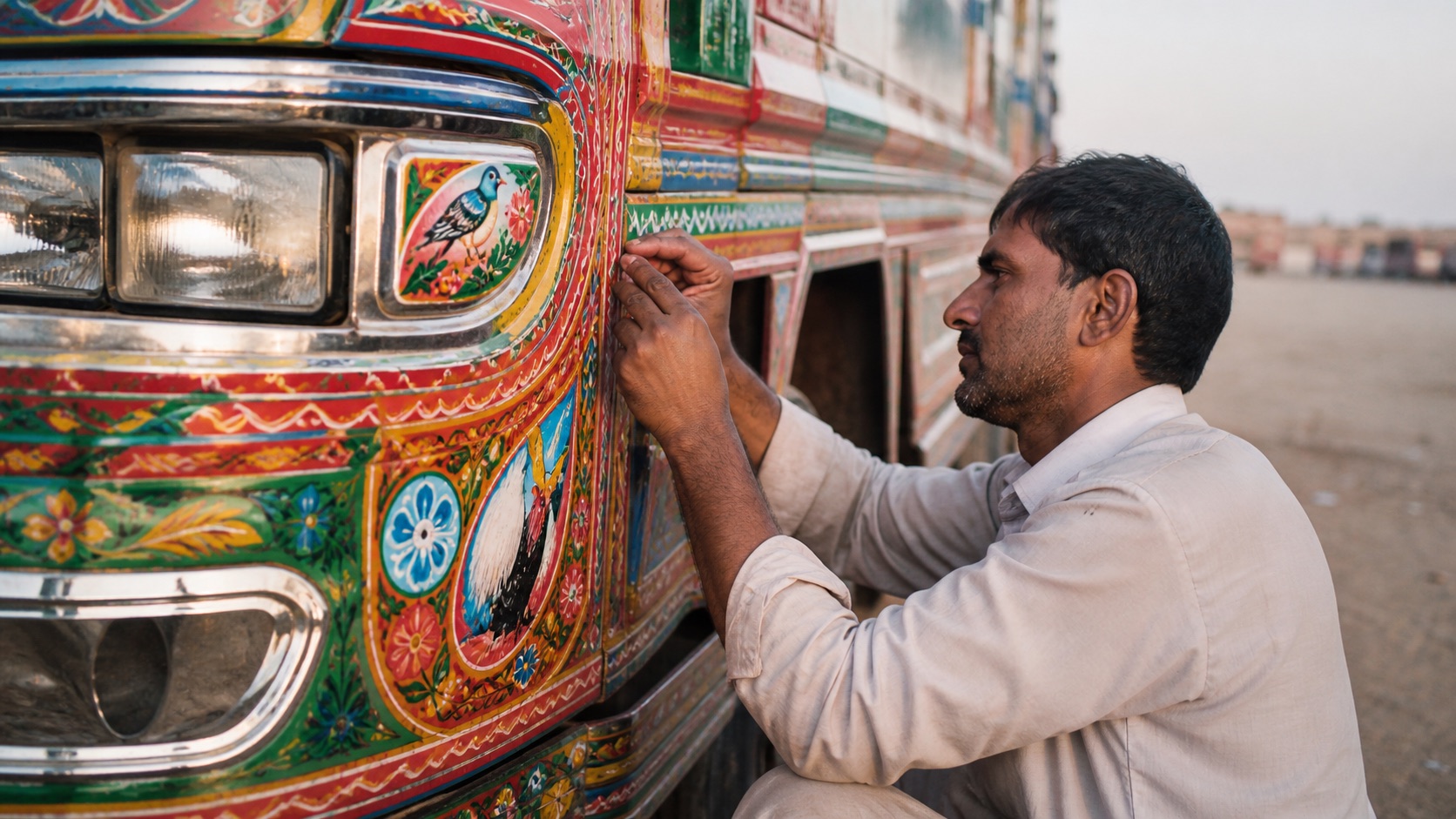
Do not begin with the peacock. Begin with the truck as somebody’s workplace: a vehicle bought to earn money, repaired on the road and decorated through conversations among an owner, driver, painter, metalworker, carpenter, upholsterer and sign writer. “Truck art” is a convenient label for that collaboration, but it can make the labour disappear.
Read from structure to surface
Look first at what has been built onto the vehicle: carved doors, projecting crown, chains, reflectors, hammered metal and painted panels shaped around vents and bolts. Then follow the image programme. Landscapes, shrines, film figures, birds, military imagery, family references, poetry and warnings may share one body. Repetition creates rhythm, while a central portrait or scene announces what this owner wanted seen at distance.
Regional styles travel with routes and workshops rather than staying inside tidy borders. The Smithsonian’s account of a truck made for its 2002 Folklife Festival describes carved wood associated with Swat and Peshawar, inlay associated with Sindh, and peacock motifs found in Punjab and Sindh—all combined on one vehicle. That example is useful precisely because it resists the idea of one national template.
Notice who receives credit
The Smithsonian names painter Haider Ali and craftsman Jamil Uddin in its documentation. Apply that habit elsewhere: when an image appears on a mug, mural or fashion campaign, ask whether the workshop or artist is identified and compensated. Decorative borrowing is not the same as understanding a working tradition.
Finally, read the words. A painted couplet, joke or invocation changes the truck from spectacle into voice, and translation may flatten its rhyme or double meaning. The reward of looking slowly is not a catalogue of motifs. It is recognising a mobile, maintained and continually negotiated work of commercial art.
Sources and official profiles
Filed under
Keep reading
Related stories
More from this desk, this beat, and the tags on this piece.
Derawar Fort and Cholistan: permissions, heat and distance
Mehreen Ali · 13 Sep 2026 · 16 min
Makli Necropolis visitor guide: heat, scale and conservation
Mehreen Ali · 13 Sep 2026 · 16 min
Readers
The conversation
0 notes
Anyone can leave a note. Guests add a name and email — no account required, and the email is never published.
No notes yet. Yours would be the first.