Pakistani wedding decor budget: spend where guests feel it
A guest-experience approach to Pakistani wedding décor that prices labour, lighting and logistics before decorative objects.
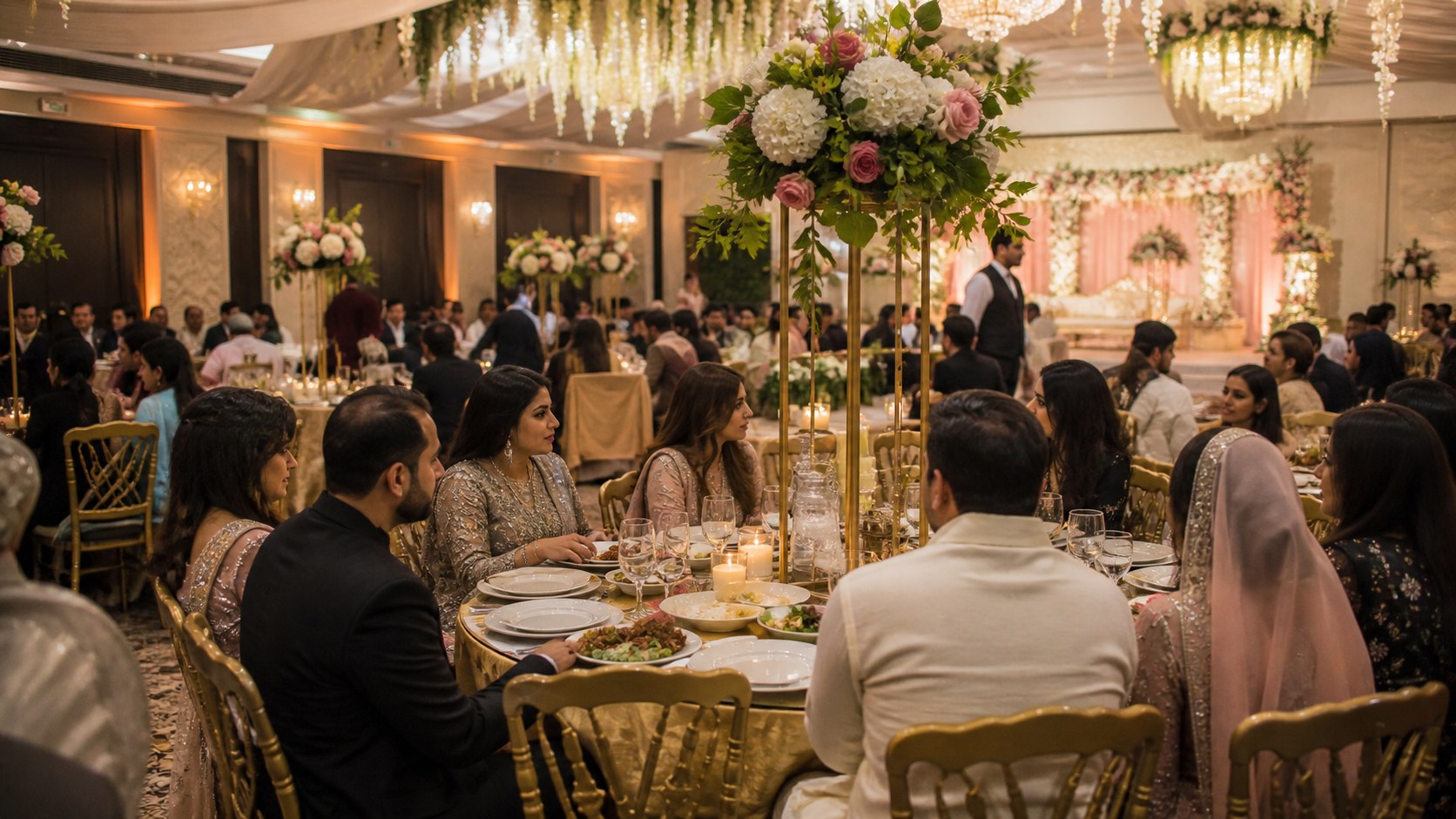
Guests do not experience a wedding as a moodboard. They experience whether they can find the entrance, see the couple, hear a speech, move between tables and recognise the people sitting opposite them. Spend first on those conditions. Flowers cannot rescue poor light or a stage that blocks half the room.
This is a budget method for Pakistani wedding décor across nikah, mehndi, baraat and walima rooms. It prices labour, logistics and lighting before decorative objects, because objects are what invoices love to multiply when the room still cannot function.
Begin with the venue after dark
Visit at the event hour if possible. Photograph existing walls, carpet, chairs, ceiling height, power points and fixed lighting. Ask what may be attached, when suppliers can enter, when everything must be removed, and whether candles, haze or hanging installations are restricted. A lower prop price can hide a second labour shift or a truck waiting outside restricted access.
Walk the guest route from car park or corridor to seat. Note choke points, single-file doors, and places where a floral arch would turn into a queue machine. If elders or wheelchair users will attend, test the route with that reality in mind rather than as a later “accessibility tweak.”
Spend where guests actually feel it
| Priority | What guests receive | Budget question |
|---|---|---|
| Lighting | Faces, food and photographs that look intentional | Power, rigging, operator, venue approval? |
| Stage / focal point | A visible, accessible place for the couple | Steps, rail, seating comfort, sightlines? |
| Tables and seating comfort | Conversation and room for service | Can existing linen/chairs be edited rather than replaced? |
| Entrance and signage | Arrival without confusion | What can be reused at another ceremony? |
| Florals and objects | Atmosphere after the room already works | Labour to install, refresh and remove? |
Lighting is often the highest-leverage line because it changes faces, food and photographs at once. A room full of expensive centrepieces under muddy light still looks unfinished. Conversely, disciplined light and one strong focal point can make simpler tables feel deliberate.
Choose one photographed moment, then repeat its language
Make one area excellent: the nikah table, stage, family portrait wall or entrance. Repeat its colours elsewhere through candles, fabric, printed details or restrained florals rather than building several competing installations that each demand labour and each fight the camera.
Fresh flowers are not automatically luxurious if they wilt under hot lamps or arrive without water mechanics. Fabric, foliage, ceramics, lanterns or good negative space may carry a room more reliably—especially for daytime mehndi heat or late baraat rooms where doors keep opening.
Quote hygiene: separate the lines that hide
- Design and creative direction
- Hire stock (furniture, draping, lanterns)
- Florals and perishables
- Transport
- Setup labour
- On-the-night stewarding if needed
- Collection and disposal
- Damage waiver or breakage liability
Ask who owns damaged or missing hired pieces. Ask what happens if the bridal party is late and candles cannot be lit on the original schedule. Ask whether the quote assumes a clear floor or includes moving venue furniture. For UK consumer framing when a paid service goes wrong, keep paperwork and start with Citizens Advice consumer guidance.
Safety is part of décor, not an afterthought
Cables, stage steps, open flames and blocked exits turn decoration into hazard. Home and community gatherings are not identical to regulated venues, but the instincts in GOV.UK’s fire safety guidance for small and medium places of assembly and workplace fire safety responsibilities still help hosts ask better questions: Are exits clear? Who controls candles? Where do guests go if an alarm sounds? Décor must not create the obstacle it later disguises with a pretty sign.
Cut in the order guests will notice last
If the estimate runs high, remove low-level detail before light, access or seating. Fewer table arrangements can still look deliberate when their scale suits the table; cramped centrepieces make conversation worse and service harder. Reduce custom signs, duplicated backdrops and single-use props before asking a supplier to compress safe installation time.
After every major cut, demand a revised drawing or floor photo markup so the remaining design still forms a complete room rather than displaying holes from the first proposal. Photograph agreed samples. Issue a final inventory. At the end, know who removes gifts, personal signage and reusable flowers before the hire company clears the room.
Ceremony-specific budget instincts
Mehndi: colour and movement matter more than symmetry; protect floor activity; avoid installations that punish dancers.
Nikah: quiet dignity around the ceremony table; sightlines for witnesses; minimal visual noise behind the person speaking.
Baraat / reception: stage and light first; entrance second; tables third; object density last.
Walima: often benefits from restraint if the previous night was maximal; guests feel relief when a room can breathe.
A closing test
Before you approve the spend, walk the imaginary guest journey once more: arrive, find the room, sit, see the couple, eat, talk, leave. Wherever that journey fails, move money there before buying another object. The strongest décor budget leaves guests remembering atmosphere and ease—not procurement.
What “Pakistani wedding décor” usually overbuys
Common overbuys include duplicated photo backdrops that guests never queue for, dense aisle florals that punish processions, chair covers that fight already acceptable venue chairs, and sign stacks that repeat the same names in five fonts. Each item can be lovely alone. Together they consume labour and visual attention without improving the guest journey.
Another quiet budget leak is colour fragmentation: mehndi colours, baraat colours and walima colours each generating separate prop purchases that cannot be reused. Choose a family palette with two constants—metal tone and one textile colour—then vary accent colours by ceremony. Continuity saves money and photographs as intention.
Labour maths that moodboards ignore
Ask for crew size, call time, break rules and overtime triggers. A design that requires eight people for a one-hour install may be cheaper than a “simple” design that needs four people for six hours because the venue only allows late access. Price time as carefully as roses.
On the night, someone must own candle lighting, fallen arrangements and cable tape that peels. If that person is also the bride’s sister and the gift table manager, something will be neglected. Either buy stewarding time or simplify until the room can survive benign neglect for twenty minutes.
Photography, stages and the false economy of the “small stage”
A stage that is too shallow forces the couple into a decorative hedge of flowers they cannot sit in comfortably. A stage that is too high without proper steps becomes a hazard in lehengas and sherwanis. Measure seating on the stage as furniture, not as a platform for objects. Leave space for fathers, mothers and whoever else your ceremony actually places there—not only for a catalogue couple pose.
Tell the photographer where the light is coming from and which backdrop is the hero. If every wall is decorated equally, the camera has nowhere to rest and you have paid for visual noise. Negative space is a design material. It is also free.
A worked budget conversation
Imagine a reception budget that first locks lighting and a usable stage, then entrance clarity, then table comfort, then florals. When relatives propose an additional hanging installation, ask which earlier priority it displaces. That question is kinder than a vague “we cannot afford it,” because it keeps the room’s function visible. Décor debates become less personal when they are tethered to guest experience rather than taste purity.
Document the final approved plan with photos and a labelled floor sketch. Share it with venue, caterer and photographer so nobody discovers a surprise stage footprint on the day. The budget is not finished when the invoice is paid. It is finished when the room works for the people inside it.
After the last guest leaves
Collection plans fail when gifts, jackets and hired lanterns occupy the same chaotic corner. Assign a reverse load-out: personal items first, florals to keep second, hire stock third. Take phone photos of emptied areas before leaving so deposit disputes have evidence. Thank the crew who stayed late; the next wedding’s service quality sometimes begins with how this one ended.
If you are decorating a home nikah rather than a hall, scale even more ruthlessly. Clear exits, protect kitchens from ornamental clutter, and remember that residential smoke alarms and open flames are a bad pairing. The intimate room already has atmosphere. It needs clarity more than inventory.
Keep a contingency line—often a modest percentage of the décor total—for access changes, broken hire pieces and last-mile tape and cable ties. Contingency is not permission to reopen the moodboard. It is how a functional room stays functional when the lift breaks.
When relatives gift décor items—centrepieces, neon names, throne chairs—add them to the inventory and the load-out plan or decline early. Unplanned objects become trip hazards and invoice disputes. Gratitude can include a clear placement decision.
Sources and official profiles
Filed under
Was this helpful?
Keep reading
Related stories
More from this desk, this beat, and the tags on this piece.
Walima explained: what the reception is for and why every family does it differently
Bilal Ahmed · 27 Oct 2026
Dholki, mayun and mehndi: why Pakistani pre-wedding events are not the same thing
Bilal Ahmed · 25 Oct 2026


Rukhsati is not a legal marriage step: what the tradition actually marks
Bilal Ahmed · 10 Oct 2026

Pakistani wedding RSVP etiquette: when the invitation names only some of the family
Bilal Ahmed · 3 Oct 2026
Readers
The conversation
0 notes
Anyone can leave a note. Guests add a name and email — no account required, and the email is never published.
No notes yet. Yours would be the first.