Phulkari beyond the wedding shawl: how Punjab's embroidery is built
Phulkari is often described simply as floral embroidery, but its structure comes from counted work on the reverse of woven cloth and dense silk-thread surfaces that can transform the base.
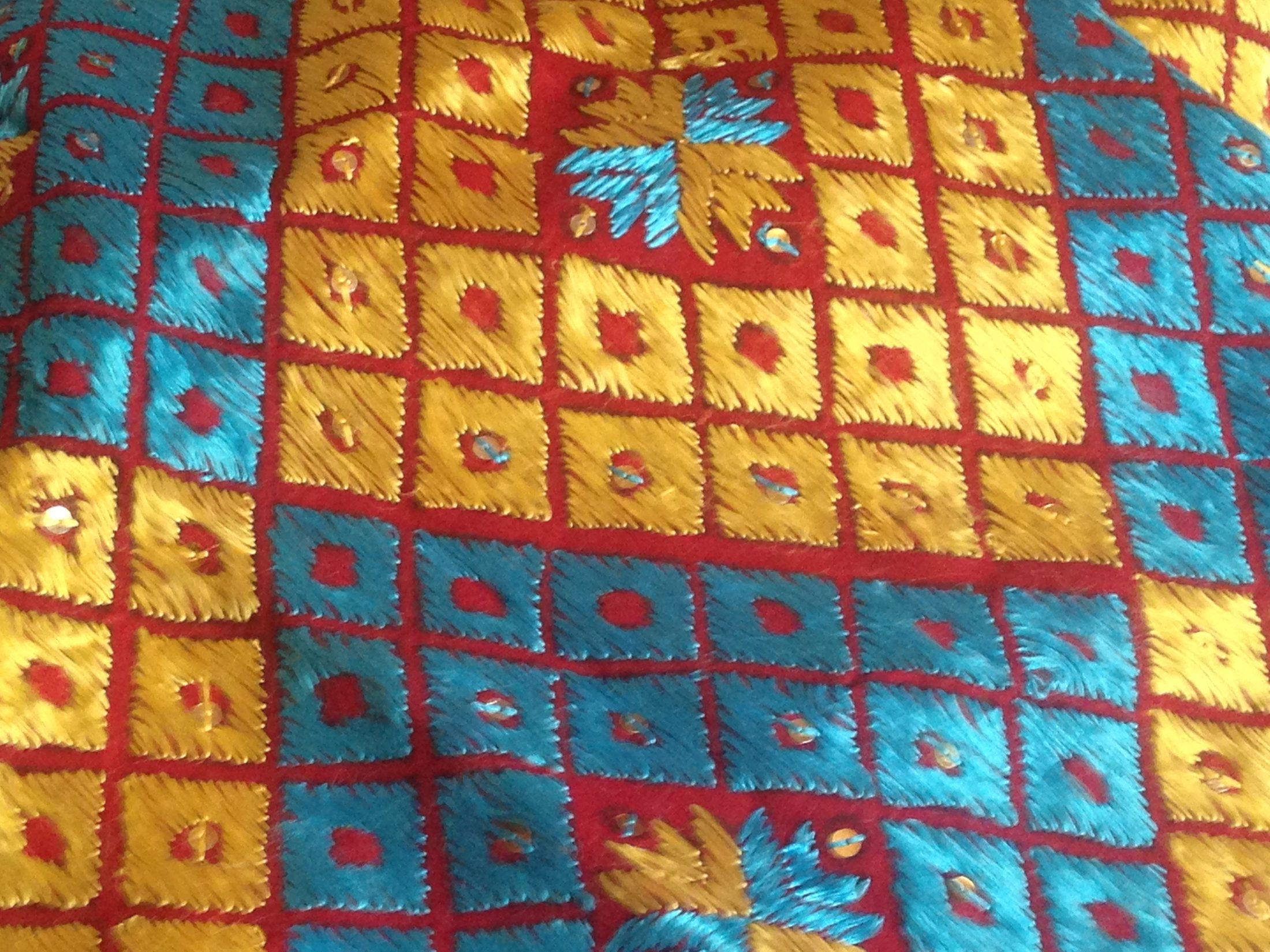
Phulkari literally evokes flower work, but reducing it to floral embroidery hides the engineering of the cloth. Traditional Punjabi Phulkari is associated with counted-thread work in which silk floss is manipulated from the reverse of a woven base so the front develops luminous geometric fields.
Museum collections preserve pieces that show enormous variation in density, motif and social use. Modern retail also uses 'phulkari' more broadly for machine embroidery and fashion products, so buyers benefit from knowing which qualities belong to the historic technique and which belong to contemporary adaptation.
Phulkari and Punjab
The embroidery is strongly associated with Punjab across what is now Pakistan and India. Family production, dowry traditions and ceremonial use gave embroidered cloth a role in life-cycle events as well as everyday identity.
Partition disrupted communities and trade routes but did not end the practice; Phulkari now belongs to multiple Punjabi diasporas as well as commercial fashion.
The base cloth matters
Historic pieces were often worked on handwoven cotton khaddar whose visible threads helped the embroiderer count and place stitches. The base was not a neutral canvas; its weave made the counted geometry possible.
Modern pieces may use finer cotton, organza, net or synthetic bases. That can be beautiful, but the stitch behaviour is different.
Silk floss creates the characteristic shine
Untwisted silk floss catches light differently as the stitch direction changes. That creates tonal shifts even when the thread colour is identical.
Synthetic rayon can imitate the sheen at lower cost. Fibre alone does not decide quality, but accurate disclosure helps buyers understand what they are paying for.
The reverse-side working method
Traditional darn-stitch Phulkari is frequently worked from the reverse, using counted threads to control the length and placement visible on the front. The method rewards consistency and mental mapping rather than drawing every motif onto the surface.
That construction is one reason experienced embroiderers can create complex geometry with remarkable regularity.
Phulkari and bagh are related, not identical
The word bagh, meaning garden, is commonly used for especially dense work in which embroidery covers most of the ground cloth. The visual effect can approach an all-over textile rather than scattered motifs.
Retailers sometimes call any richly embroidered dupatta a bagh. Density and technique matter more than the product title.
Motifs carry local vocabulary
Geometric diamonds, stepped forms, stylised flowers, human or domestic references and border systems appear across surviving pieces. Motif names vary by community and period.
Be cautious with online lists claiming every symbol has one universal meaning. Museum provenance and family histories often show more variation.
Hand embroidery leaves readable evidence
Turn the textile over. Hand-counted work has thread paths, joins and small irregularities that reveal how the piece was built. Machine embroidery usually shows a much more mechanically regular reverse and often uses stabiliser.
Neither is automatically bad. The issue is whether the seller represents the production honestly.
Why vintage pieces need careful handling
Old silk can become brittle and old cotton can weaken at folds. Heavy hanging concentrates stress, while aggressive washing can destabilise dyes and threads.
Valuable or heirloom pieces deserve textile-conservation advice rather than generic laundry hacks.
Modern Phulkari as living fashion
Contemporary designers place Phulkari-style embroidery on jackets, bags, shoes and lightweight dupattas. These adaptations can keep visual language alive even when the construction departs from historic cloth.
It is more accurate to describe them as contemporary Phulkari or Phulkari-inspired work when the technique has changed substantially.
Buying with better questions
Ask about base fabric, thread fibre, hand versus machine work, place of production and whether the seller knows the maker. Close photographs of the reverse are more informative than another styled campaign shot.
Price should reflect labour, material and provenance rather than a vague claim of being 'heritage'.
What the evidence can and cannot tell you: Phulkari beyond the wedding shawl
Phulkari's history is shared across a divided Punjab and documented through museums, family collections and oral histories. Exact origin dates and universal motif meanings are often overstated online, so this article avoids presenting uncertain folklore as settled fact.
For Phulkari embroidery history Punjab, the most useful approach is to separate verified material facts from shop language, inherited terminology and aesthetic preference. Where a label has a legal or technical meaning, read the fibre or product disclosure. Where the term is cultural rather than standardised, ask the seller what construction, material and process they actually mean.
A practical PakStyles checklist: Phulkari beyond the wedding shawl
- Inspect the reverse as well as the front.
- Ask whether thread is silk, rayon or another fibre.
- Distinguish sparse Phulkari from densely worked bagh rather than using the words interchangeably.
- Store older pieces flat or supported.
- Value contemporary adaptations honestly without mislabelling machine work as hand embroidery.
The most interesting thing about Phulkari is not that it is old. It is that a counted relationship between woven cotton and glossy thread can still make a surface look alive under changing light, whether the piece comes from a family chest or a contemporary Punjabi studio.
Care is part of value: Phulkari beyond the wedding shawl
The cost of Phulkari embroidery history Punjab is not only the checkout amount. If the item needs specialist cleaning, careful flat storage, tissue padding, regular repair or a climate-controlled place to avoid damp, those demands belong in the ownership calculation.
Keep the care label, seller instructions and spare material together. For formalwear and handmade textiles, photograph the piece before the first clean and save details of any alteration or repair. That record can extend usable life and makes future professional care less guess-based.
How to judge authenticity claims without becoming a laboratory: Phulkari beyond the wedding shawl
Most consumers cannot chemically identify fibre or date a textile at home, and they should not be expected to. For Phulkari embroidery history Punjab, use several modest signals together: accurate labelling, plausible pricing, maker or region information, construction details, clear photographs and a seller willing to answer technical questions.
What modern adaptation gets right: Phulkari beyond the wedding shawl
Contemporary versions of phulkari embroidery history Punjab can simplify production, reduce price, change fibre or adapt the format for new wardrobes. That does not automatically make them culturally empty. Living traditions survive partly because makers and wearers change how forms are used.
A better comparison method: Phulkari beyond the wedding shawl
When comparing two options around phulkari embroidery history Punjab, use the same criteria for both: material, construction, dimensions, care, comfort, origin, expected lifespan and price. Marketing categories become much less confusing when every candidate is placed on the same practical grid.
The reader's final decision: Phulkari beyond the wedding shawl
The strongest reason to learn about phulkari embroidery history Punjab is not to police other people's terminology. It is to make a purchase, styling choice or care decision with fewer surprises. Technical knowledge should create flexibility rather than another authenticity exam.
How to separate the name from the material reality: Phulkari beyond the wedding shawl
With phulkari embroidery history Punjab, the first useful habit is to separate the market name from the physical object. Retail and cultural vocabulary can carry history, prestige and regional meaning, but a buyer still needs to know fibre, construction, dimensions, finish, weight, fastening or production method where those details affect use. That distinction prevents a descriptive word from doing more work than it can support.
For a practical purchase or styling decision, write down what the object must do before judging what it is called. A shawl may need warmth without bulk, a dupatta may need grip, a formal coat may need to survive six hours of sitting and movement, and a textile may need to tolerate ordinary cleaning. Those jobs are measurable even when terminology overlaps.
What a trustworthy seller or maker should be able to explain: Phulkari beyond the wedding shawl
A strong seller response to questions about phulkari embroidery history Punjab should become more specific as the price rises. You should be able to ask what the material is, where it was produced, whether work is hand or machine made, what dimensions are supplied, how the item should be cleaned and which parts of the description are traditional names rather than regulated specifications.
Why photographs can mislead even when they are not edited: Phulkari beyond the wedding shawl
Campaign photography changes how phulkari embroidery history Punjab is perceived. Studio light increases sheen, pins create temporary drape, steaming removes handling marks and model proportions can make a garment or accessory appear lighter, longer or more structured than it will in ordinary use. None of that requires deceptive editing; it is simply the difference between styling and specification.
How climate and diaspora use change the decision: Phulkari beyond the wedding shawl
Pakistani clothing and craft products often move between climates. phulkari embroidery history Punjab may be produced with Lahore, Karachi, Multan or Peshawar conditions in mind and then worn in Birmingham, Manchester or Glasgow. Heating, rain, winter coats and long indoor events change what feels practical even when the cultural setting is the same.
Handmade variation versus poor quality: Phulkari beyond the wedding shawl
Hand production connected to phulkari embroidery history Punjab can leave small differences in repeat placement, stitch tension, dye tone or surface finish. Those variations may document process rather than negligence. The useful question is whether the variation is structurally harmless and visually consistent with the making method.
Sources and official profiles
Filed under
Was this helpful?
Keep reading
Related stories
More from this desk, this beat, and the tags on this piece.

Pakistani wedding RSVP etiquette: when the invitation names only some of the family
Bilal Ahmed · 3 Oct 2026
Urdu family words British Pakistani children hear but do not always understand
Bilal Ahmed · 3 Oct 2026
Readers
The conversation
0 notes
Anyone can leave a note. Guests add a name and email — no account required, and the email is never published.
No notes yet. Yours would be the first.